Interactional Compression and Maternal Participation in Neonatal Intensive Care Units: A Qualitative Study of Nurse–Mother Communication Barriers and Co-Produced Solutions
Nadia Bassuoni Elsharkawy, Osama Mohamed Elsayed Ramadan, Alaa Hussain Hafiz, Nouran Essam Katooa, Areej Abunar, Dena Marwan A. Attallah, Minerva Raguini, Majed Mowanes Alruwaili, Enas Mahrous Abdelaziz, Marwa Mohamed Ahmed Ouda, Arab Qassim Alkhadam, Maha Suwailem S. Alshammari

TL;DR
This study explores how communication between nurses and mothers in NICUs is limited by workload and stress, and proposes strategies like protected Q&A time and visual aids to improve maternal participation.
Contribution
The study introduces co-produced strategies such as post-round Q&A windows and visual 'mini-packs' to address communication barriers in NICUs.
Findings
Mothers often have only two or fewer speaking turns per encounter in NICUs due to workload rhythms.
Three interaction patterns—threat–compression, convergence-to-coping, and resource-scaffolded participation—were identified as shaping maternal engagement.
Co-produced solutions like protected Q&A time and standardized visual aids can reduce information fragmentation and improve comprehension.
Abstract
What are the main findings? Workload rhythms in NICUs structurally compress communication, often restricting mothers to two or fewer speaking turns per encounter.Three interaction patterns—threat–compression, convergence-to-coping, and resource-scaffolded participation—demonstrate how stress appraisal and accommodation shape maternal engagement. Workload rhythms in NICUs structurally compress communication, often restricting mothers to two or fewer speaking turns per encounter. Three interaction patterns—threat–compression, convergence-to-coping, and resource-scaffolded participation—demonstrate how stress appraisal and accommodation shape maternal engagement. What are the implications of the main findings? Co-produced strategies—protected post-round Q&A windows with teach-back and standardized visual “mini-packs”—strengthen comprehension verification and reduce information…
Genes, proteins, chemicals, diseases, species, mutations and cell lines named across the full text — each resolved to its canonical identifier and authoritative record.
Click any figure to enlarge with its caption.
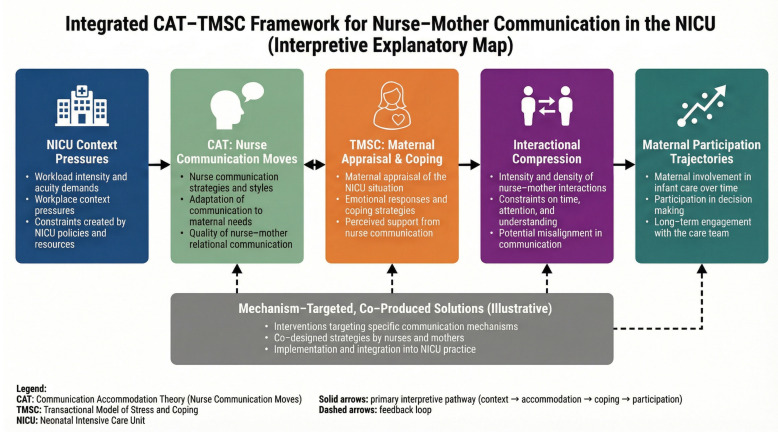 Figure 1
Peer Reviews
No public reviews on file for this paper yet. If you reviewed it on a platform where reviews are public (OpenReview, ICLR, NeurIPS, ICML), you can paste yours below so the community can read it here.
Videos
No videos yet. Explain this paper in a talk, walkthrough, or lecture? Add one.
Taxonomy
TopicsInfant Development and Preterm Care · Family and Patient Care in Intensive Care Units · Neonatal Respiratory Health Research