Euthyroid Sick Syndrome (ESS) and Monocyte-to-Lymphocyte Ratio (MLR) Are Predictors of Complications in Geriatric Hip Fractures: A Single-Center Retrospective Analysis
Giacomo Capece, Doriana Di Costa, Elisa Pesare, Michele Pomponi, Valeria Maccauro, Rocco Maria Comodo, Rami Kaplan, Umberto Capece, Pasquale Farsetti, Marcello Covino, Giulio Maccauro, Raffaele Vitiello

TL;DR
This study shows that Euthyroid Sick Syndrome and changes in monocyte-to-lymphocyte ratio can predict complications in elderly patients with hip fractures.
Contribution
The study identifies ESS and MLR as early and postoperative predictors of complications in geriatric hip fracture patients.
Findings
ESS was present in 29% of patients and linked to longer surgery duration and lower FT3 levels.
MLR emerged as a significant postoperative predictor of complications.
Hemoglobin and albumin levels were strong predictors of transfusion requirements.
Abstract
Background: Euthyroid Sick Syndrome (ESS) is a clinical condition characterized by reduced free triiodothyronine (FT3) levels in response to acute or chronic stress. Proximal femur fractures in geriatric patients are associated with high morbidity and mortality rates and ESS may influence outcomes in this population. This study aimed to investigate the role of ESS as a predictor of complications in elderly patients with hip fractures, analyzing its association with inflammatory and nutritional markers, including the Monocyte-to-Lymphocyte Ratio (MLR), Controlling Nutritional Status (CONUT) score and Hemoglobin, Albumin, Lymphocyte, and Platelet (HALP) score. Materials and Methods: We conducted a single-center retrospective analysis of patients aged 65 and older who were admitted with proximal femur fractures requiring surgical intervention. Thyroid hormone profiles, inflammatory markers…
Genes, proteins, chemicals, diseases, species, mutations and cell lines named across the full text — each resolved to its canonical identifier and authoritative record.
Click any figure to enlarge with its caption.
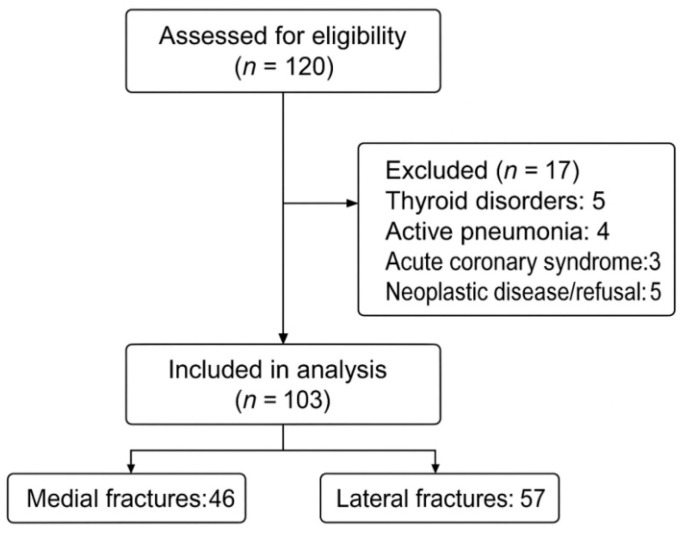 Figure 1
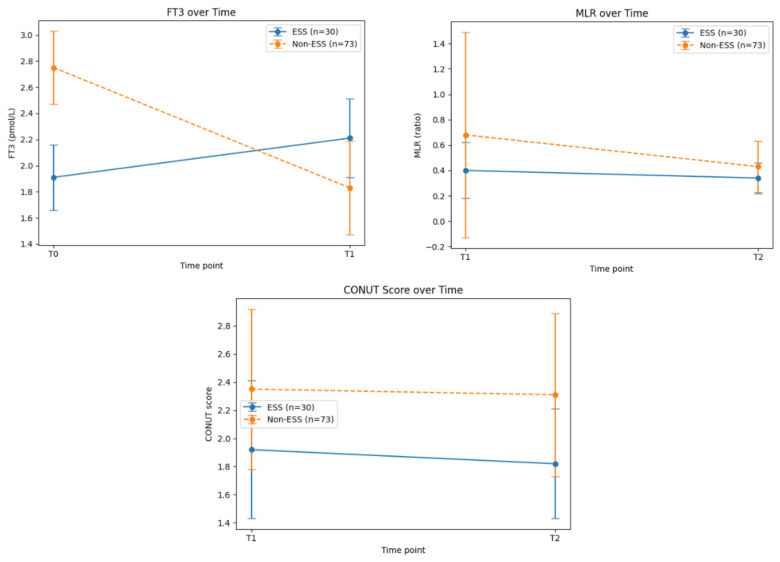 Figure 2
Peer Reviews
No public reviews on file for this paper yet. If you reviewed it on a platform where reviews are public (OpenReview, ICLR, NeurIPS, ICML), you can paste yours below so the community can read it here.
Videos
No videos yet. Explain this paper in a talk, walkthrough, or lecture? Add one.
Taxonomy
TopicsThyroid Disorders and Treatments · Bone health and treatments · Bone health and osteoporosis research