Health-Related Quality of Life in Radiologically Isolated Syndrome Resembles Relapsing–Remitting Multiple Sclerosis
Julián Benito-León, María Díez-Cirarda, Mariano Ruiz-Ortiz, Yolanda Aladro, Constanza Cuevas, Ángela Domingo-Santos, Victoria Galán Sánchez-Seco, Andrés Labiano-Fontcuberta, Ana Gómez-López, Paula Salgado-Cámara, Lucienne Costa-Frossard, Enric Monreal, Susana Sainz de la Maza

TL;DR
People with radiologically isolated syndrome have similar quality of life to those with relapsing-remitting multiple sclerosis, with fatigue being the strongest factor affecting outcomes.
Contribution
This study is the first to compare HRQoL in RIS and RRMS while adjusting for fatigue, cognition, and psychological distress.
Findings
HRQoL in RIS and RRMS was comparable after adjusting for key factors.
Fatigue had the strongest negative impact on HRQoL across all groups.
Psychological distress affected MS-specific HRQoL but not generic HRQoL.
Abstract
Background: Radiologically isolated syndrome (RIS) is defined by MRI findings that are suggestive of multiple sclerosis (MS) in the absence of prior clinical demyelinating events. We aimed to compare the health-related quality of life (HRQoL) between RIS and relapsing–remitting MS (RRMS) after adjusting for fatigue, cognition, and psychological distress, and to contextualize generic HRQoL, relative to healthy controls. Methods: In this cross-sectional analysis of the baseline data, 30 RIS, 29 RRMS, and 30 healthy controls were analyzed. MS-specific HRQoL (patients only) was assessed with the Functional Assessment of Multiple Sclerosis (FAMS), and generic HRQoL (all participants) was assessed with the EuroQol-5D (EQ-5D) visual analogue scale and utility index. Multi-variable linear regression models with robust (HC3) standard errors were used, adjusting for demographics, fatigue impact,…
Genes, proteins, chemicals, diseases, species, mutations and cell lines named across the full text — each resolved to its canonical identifier and authoritative record.
Click any figure to enlarge with its caption.
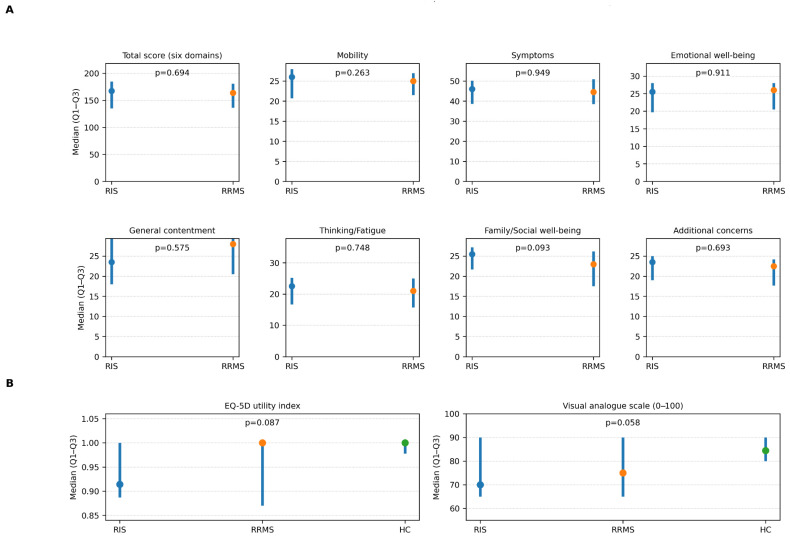 Figure 1
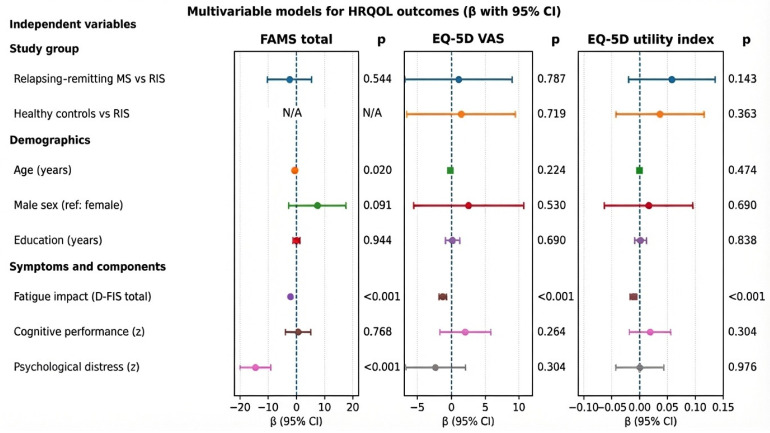 Figure 2
Peer Reviews
No public reviews on file for this paper yet. If you reviewed it on a platform where reviews are public (OpenReview, ICLR, NeurIPS, ICML), you can paste yours below so the community can read it here.
Videos
No videos yet. Explain this paper in a talk, walkthrough, or lecture? Add one.
Taxonomy
TopicsMultiple Sclerosis Research Studies · Long-Term Effects of COVID-19 · Systemic Sclerosis and Related Diseases