Beyond Handgrip: Associations Between Trunk Strength, Gait Speed, Resting Metabolic Rate, and Muscle Mass in Brazilian Older Women with Probable Sarcopenia
Lucas Ferreira de Souza Campos, Juliana de Alcantara Silva Fonseca, Ana Clara de Souza Oliveira, Guilherme Moreira, Leonardo de Souza Correa, Pedro Henrique de Almeida Louza, Ana Carolina Dutra Tavares, Luana Lopes de Souza, Raquel Carvalho Castiglione, Hércules Rezende Freitas

TL;DR
This study shows that trunk and lower limb strength assessments provide better insights into sarcopenia in older women than handgrip strength alone.
Contribution
The study introduces maximal isometric hip extension (MIHE) as a more comprehensive indicator of sarcopenia than traditional handgrip strength.
Findings
Maximal isometric hip extension (MIHE) is strongly correlated with resting metabolic rate and muscle mass in older women with probable sarcopenia.
Women with probable sarcopenia showed lower MIHE, slower gait speed, and reduced muscle mass compared to non-sarcopenic women.
Function-oriented evaluations like trunk strength and gait speed improve sarcopenia screening accuracy.
Abstract
Public health relevance—How does this work relate to a public health issue? Sarcopenia remains a significant public health challenge in aging populations, leading to reduced functional autonomy, metabolic health deterioration, and increased mortality risk among older women.Although handgrip strength is a standard diagnostic tool, it may not fully capture the functional status of muscle groups essential for postural control and locomotion, such as the trunk and lower extremities. Sarcopenia remains a significant public health challenge in aging populations, leading to reduced functional autonomy, metabolic health deterioration, and increased mortality risk among older women. Although handgrip strength is a standard diagnostic tool, it may not fully capture the functional status of muscle groups essential for postural control and locomotion, such as the trunk and lower extremities.…
Genes, proteins, chemicals, diseases, species, mutations and cell lines named across the full text — each resolved to its canonical identifier and authoritative record.
Click any figure to enlarge with its caption.
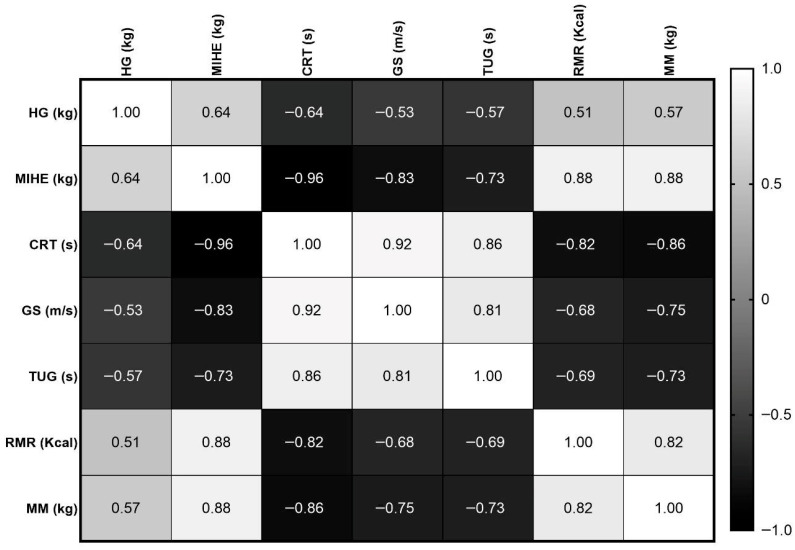 Figure 1
Peer Reviews
No public reviews on file for this paper yet. If you reviewed it on a platform where reviews are public (OpenReview, ICLR, NeurIPS, ICML), you can paste yours below so the community can read it here.
Videos
No videos yet. Explain this paper in a talk, walkthrough, or lecture? Add one.
Taxonomy
TopicsNutrition and Health in Aging · Balance, Gait, and Falls Prevention · Cerebral Palsy and Movement Disorders