Predictors and Patterns of Recurrence After a Watchful Waiting Approach following Clinical Complete Response to Neoadjuvant Radiochemotherapy for Esophageal Cancer
Sarah Gerber, Martin D. Berger, Hossein Hemmatazad, Pauline Aeschbacher, Dino Kröll, Daniel Candinas, Yves Borbély

TL;DR
This study identifies factors that predict cancer recurrence in patients with esophageal cancer who delay surgery after a complete response to initial treatment, helping to guide personalized follow-up care.
Contribution
The study identifies specific clinical and tumor-related predictors of recurrence in esophageal cancer patients managed with watchful waiting.
Findings
Adenocarcinoma, larger tumor size, and post-treatment symptoms like dysphagia and fatigue were linked to higher recurrence risk.
Nodal-positive patients showed metastatic recurrence, while nodal-negative patients did not experience distant recurrence.
Recurrence occurred in 60% of patients after a median of 202 days, but many could be successfully treated when it returned.
Abstract
Esophageal cancer is usually treated with chemotherapy and radiation followed by surgery, but surgery can be risky and cause serious complications. For some patients who respond completely to initial treatment, a “watchful waiting” approach—delaying or avoiding surgery unless the cancer returns—is increasingly considered. In this study, we analyzed patients managed with watchful waiting to identify factors linked to cancer recurrence. We found that having adenocarcinoma (one of the main types of esophageal cancer), larger tumor size, and signs of weakness or difficulty swallowing after initial treatment were associated with a higher risk of recurrence. Patients whose cancer did return could often be treated successfully. These findings may help guide follow-up care, identify high-risk patients early, and reduce unnecessary surgeries, improving quality of life while maintaining good…
Genes, proteins, chemicals, diseases, species, mutations and cell lines named across the full text — each resolved to its canonical identifier and authoritative record.
Click any figure to enlarge with its caption.
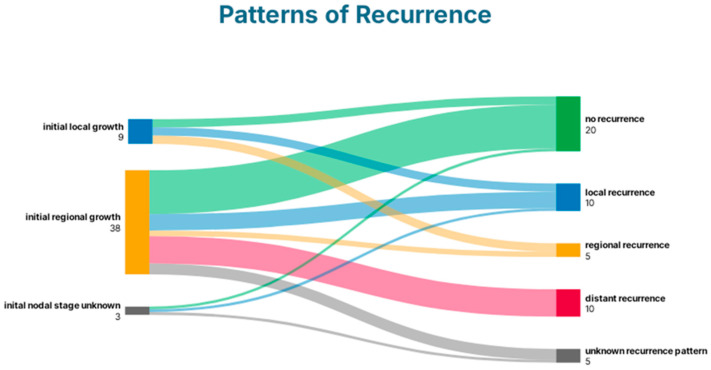 Figure 1
Peer Reviews
No public reviews on file for this paper yet. If you reviewed it on a platform where reviews are public (OpenReview, ICLR, NeurIPS, ICML), you can paste yours below so the community can read it here.
Videos
No videos yet. Explain this paper in a talk, walkthrough, or lecture? Add one.
Taxonomy
TopicsEsophageal Cancer Research and Treatment · Pancreatic and Hepatic Oncology Research · Colorectal and Anal Carcinomas