The Agreement Between Pulse Oximetry and Measured Arterial Oxygen Saturations in Postoperative Functionally Univentricular Patients
Fabio Savorgnan, Sebastian Acosta, Joshua Prabhu, Pranathi Pilla, Vikram Shah, Saul Flores, Rohit S. Loomba

TL;DR
Pulse oximeters overestimate blood oxygen levels in children with certain heart conditions, especially when oxygen is low, suggesting they shouldn't be relied on alone.
Contribution
The study reveals that arterial oxygen saturation level—not race—is the main factor affecting pulse oximeter accuracy in univentricular heart patients.
Findings
Pulse oximetry overestimates arterial oxygen saturation in univentricular patients, with bias increasing at lower saturation levels.
Arterial saturation levels explain 50% of the variance in measurement bias, more than race or surgical procedure.
Fontan physiology shows reduced overestimation by pulse oximetry compared to other procedures.
Abstract
What are the main findings? Pulse oximetry systematically overestimates arterial oxygen saturation in children with functionally univentricular circulation, with wide limits of agreement and worsening bias during hypoxemia.Arterial saturation level, rather than race, was the dominant determinant of measurement bias, with nonlinear overestimation increasing markedly at lower saturation ranges. Pulse oximetry systematically overestimates arterial oxygen saturation in children with functionally univentricular circulation, with wide limits of agreement and worsening bias during hypoxemia. Arterial saturation level, rather than race, was the dominant determinant of measurement bias, with nonlinear overestimation increasing markedly at lower saturation ranges. What is the implication of the main finding? In single-ventricle physiology, reliance on pulse oximetry alone may mask clinically…
Genes, proteins, chemicals, diseases, species, mutations and cell lines named across the full text — each resolved to its canonical identifier and authoritative record.
Click any figure to enlarge with its caption.
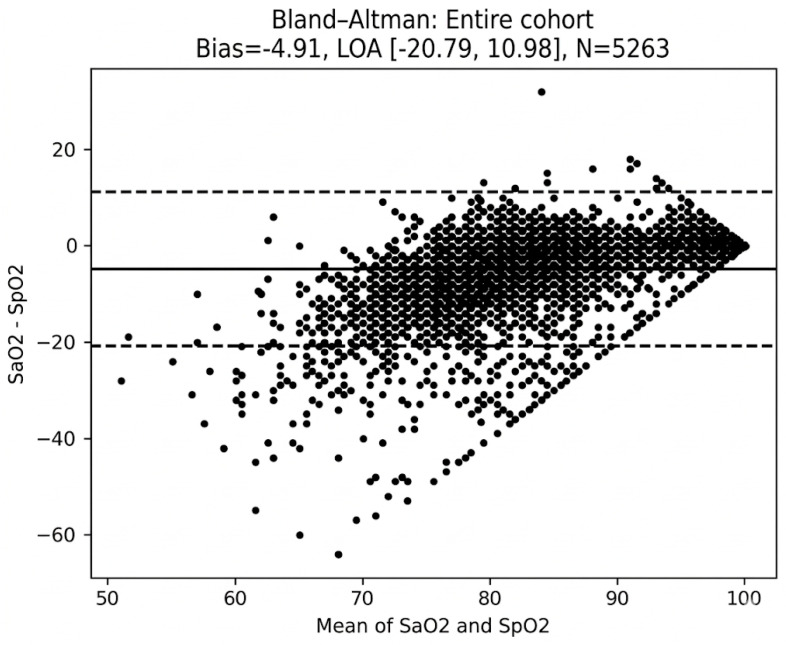 Figure 1
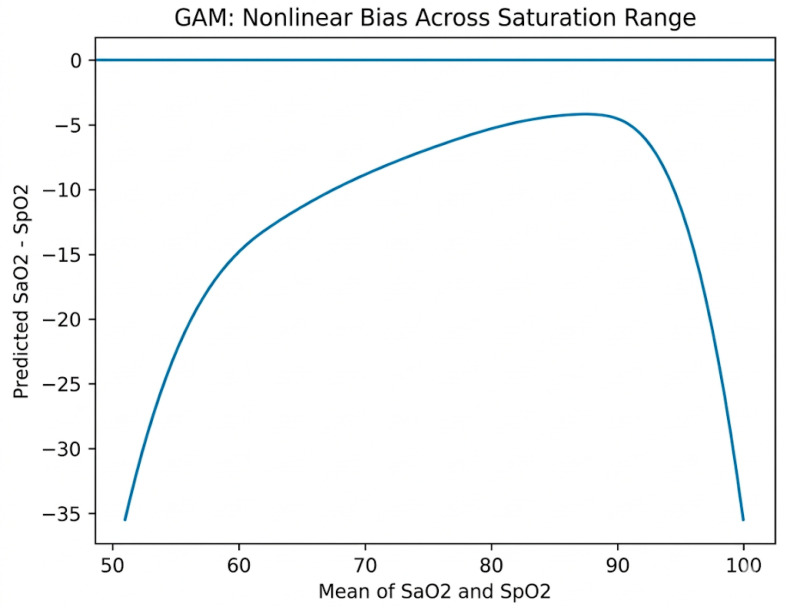 Figure 2
Peer Reviews
No public reviews on file for this paper yet. If you reviewed it on a platform where reviews are public (OpenReview, ICLR, NeurIPS, ICML), you can paste yours below so the community can read it here.
Videos
No videos yet. Explain this paper in a talk, walkthrough, or lecture? Add one.
Taxonomy
TopicsNon-Invasive Vital Sign Monitoring · Optical Imaging and Spectroscopy Techniques · Hemodynamic Monitoring and Therapy