A Prospective, International, Multicentre Registry of Patients Undergoing Segmental Mandibular Defect Reconstruction After Mandibular Resection for Tumours and Drug-Induced Osteonecrosis: A Study Protocol
Rüdiger M. Zimmerer, Tabea Pankow, Max Heiland, Julius Moratin, Wenko Smolka, Ali Modabber, Philippe Korn, Maria Mejia Nieto, Andreas Naros, Florian Thieringer, Rui Fernandes, Roderick Kim, Ashleigh Weyh, Eppo B. Wolvius, Mohemmed Khan, Andreas Thor, Marcel Ebeling

TL;DR
This study aims to collect real-world data on jawbone reconstruction surgeries for cancer and drug-related bone damage through an international patient registry.
Contribution
The novel contribution is establishing an international multicenter registry to systematically track outcomes of mandibular reconstruction for rare and drug-induced conditions.
Findings
The registry will prospectively follow ~300 patients over 36 months.
It will document treatment outcomes and adverse events for various mandibular reconstruction approaches.
The study will identify predictors of successful autologous reconstruction.
Abstract
Segmental mandibular resection may be indicated as a treatment in, for example, advanced stages of oral squamous cell carcinoma (OSCC). Osseous reconstruction of these defects is a fundamental part of static and dynamic masticatory rehabilitation, particularly when dental implants are required. The Segmental Mandibular Defect Reconstruction (SMDR) Registry aims to generate real-world evidence on SMDR through an international, prospective, multicentre case series designed as a registry. While OSCC is a common indication for segmental mandibular resection, the SMDR Registry also aims to capture outcomes for rarer mandibular conditions and the increasing number of collateral damage cases resulting from systemic medication therapies (antiresorptive drugs, immunotherapeutics) or irradiation, which may likewise lead to medication-related osteonecrosis of the mandible (MRONJ) or…
Genes, proteins, chemicals, diseases, species, mutations and cell lines named across the full text — each resolved to its canonical identifier and authoritative record.
Click any figure to enlarge with its caption.
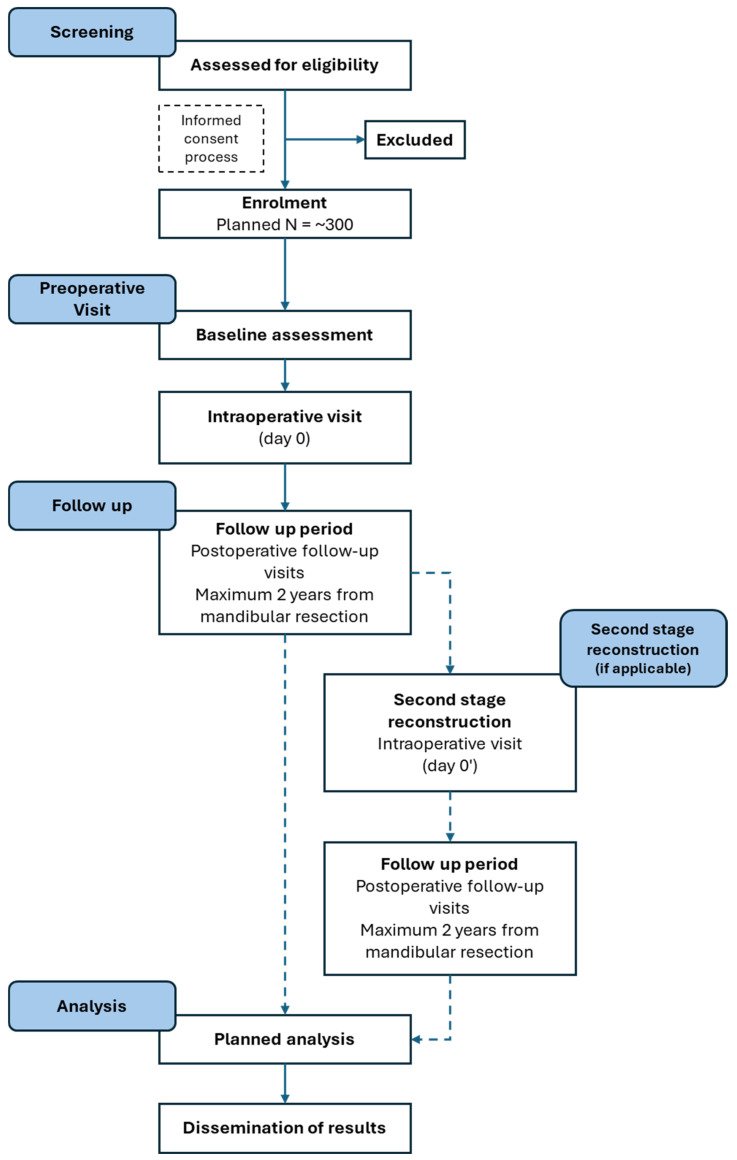 Figure 1
Peer Reviews
No public reviews on file for this paper yet. If you reviewed it on a platform where reviews are public (OpenReview, ICLR, NeurIPS, ICML), you can paste yours below so the community can read it here.
Videos
No videos yet. Explain this paper in a talk, walkthrough, or lecture? Add one.
Taxonomy
TopicsBone health and treatments · Oral health in cancer treatment · Reconstructive Surgery and Microvascular Techniques