The Arabic Lubben Social Network Scale-6: Psychometric Validation, Measurement Invariance, and Social Support Profiles in Arabic-Speaking Older Adults
Khaled Trabelsi, Waqar Husain, Hadeel Ghazzawi, Zahra Saif, Achraf Ammar, Haitham Jahrami

TL;DR
This study validated the Arabic version of a 6-item scale to measure social networks in older adults, showing it is reliable and useful for assessing social isolation.
Contribution
The study provides the first psychometric validation of the Arabic LSNS-6 and identifies distinct social support profiles in older Arabic-speaking adults.
Findings
The Arabic LSNS-6 showed good internal consistency (α = 0.83; ω = 0.84) and supported a two-factor structure.
Moderate convergent validity was found with perceived social support (r = 0.51).
Latent class analysis identified four distinct social support profiles among participants.
Abstract
This study aimed to translate, culturally adapt, and validate the Arabic version of the 6-Item Lubben Social Network Scale (LSNS-6). The LSNS-6 was translated, culturally adapted, and administered, alongside the Medical Outcomes Study Social Support Survey (MOS-SSS), to 327 Arabic-speaking adults aged 60 years and older. Internal consistency was examined using Cronbach’s alpha and McDonald’s omega. Confirmatory factor analysis (CFA) tested the hypothesized two-factor structure (Family and Friends), and measurement invariance was evaluated across key sociodemographic and lifestyle variables. Convergent validity was assessed through correlations with MOS-SSS domains. Item response theory (IRT) analyses examined item discrimination and threshold parameters. Latent class analysis (LCA) explored whether the LSNS-6 could identify subgroups with distinct patterns of social connectedness and…
Genes, proteins, chemicals, diseases, species, mutations and cell lines named across the full text — each resolved to its canonical identifier and authoritative record.
Click any figure to enlarge with its caption.
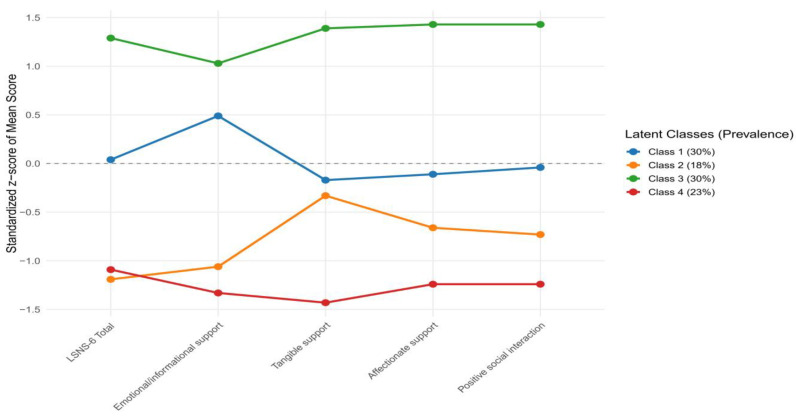 Figure 1
Peer Reviews
No public reviews on file for this paper yet. If you reviewed it on a platform where reviews are public (OpenReview, ICLR, NeurIPS, ICML), you can paste yours below so the community can read it here.
Videos
No videos yet. Explain this paper in a talk, walkthrough, or lecture? Add one.
Taxonomy
TopicsHealth disparities and outcomes · Technology Use by Older Adults · Impact of Technology on Adolescents