Self-Perceived Quality of Life and Physical Activity Levels Through Accelerometry in Young People with Intellectual Disabilities
María Menchén-Rubio, Diana Ruiz-Vicente, Ester Jiménez-Ormeño, Teresa García-Pastor

TL;DR
Young adults with intellectual disabilities report lower quality of life and less physical activity than their peers, but physical activity levels don't seem to affect their quality of life.
Contribution
This study identifies unique patterns of physical activity and quality of life in young adults with intellectual disabilities using objective and self-reported measures.
Findings
Young adults with intellectual disabilities reported lower quality of life in social and environmental domains.
They engaged in less light physical activity compared to non-disabled peers.
Vigorous physical activity was linked to better physical quality of life in non-disabled individuals but not in those with intellectual disabilities.
Abstract
What are the main findings? Young adults with intellectual disability showed significantly lower self-perceived quality of life—particularly in the social and environmental domains—and lower levels of light physical activity compared to their peers with no disability.No associations were found between accelerometer-measured physical activity and quality of life in the group with intellectual disability, whereas vigorous physical activity showed a positive association with the physical QoL domain in the group with no disability. Young adults with intellectual disability showed significantly lower self-perceived quality of life—particularly in the social and environmental domains—and lower levels of light physical activity compared to their peers with no disability. No associations were found between accelerometer-measured physical activity and quality of life in the group with…
Genes, proteins, chemicals, diseases, species, mutations and cell lines named across the full text — each resolved to its canonical identifier and authoritative record.
Click any figure to enlarge with its caption.
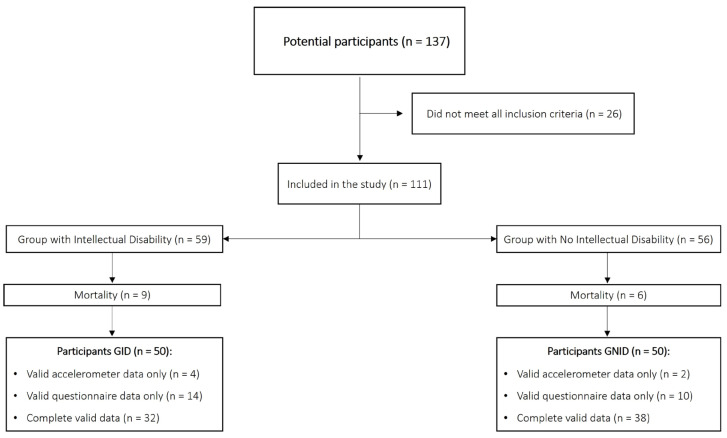 Figure 1
Peer Reviews
No public reviews on file for this paper yet. If you reviewed it on a platform where reviews are public (OpenReview, ICLR, NeurIPS, ICML), you can paste yours below so the community can read it here.
Videos
No videos yet. Explain this paper in a talk, walkthrough, or lecture? Add one.
Taxonomy
TopicsDown syndrome and intellectual disability research · Inclusion and Disability in Education and Sport · Cerebral Palsy and Movement Disorders