Exact Response Theory for Delay Equations
Federico Gollinucci, Enrico Ortu, Lamberto Rondoni

TL;DR
This paper extends a method for predicting system responses to perturbations to include systems with delayed dynamics.
Contribution
The paper adapts exact response theory for time-lagged systems using an augmented phase space approach.
Findings
The delay-dependent dynamics can be mapped into an autonomous system in an augmented phase space.
The comparison between linear and exact response approaches is explored for a specific kernel choice.
Abstract
The exact response theory, also known as Transient Time Correlation Function formalism, is a powerful method concerning how observables respond to a given perturbation of the dynamics of the systems of interest, and it extends linear response theory to generic (autonomous) dynamical systems. Its main ingredient is the so-called dissipation function. In this paper, we adapt this theory for time-lagged systems, and we illustrate its applicability considering simple examples of delay equations, with different memory terms. Adopting the technique already used for time deterministic as well as stochastic time-dependent perturbations, the dynamics is described in a higher dimensional phase space, in which the delay-dependent dynamics is mapped into an augmented phase space: the new dynamics is proven to be autonomous and suitable for the exact responses to be computed. In addition, we explore…
Click any figure to enlarge with its caption.
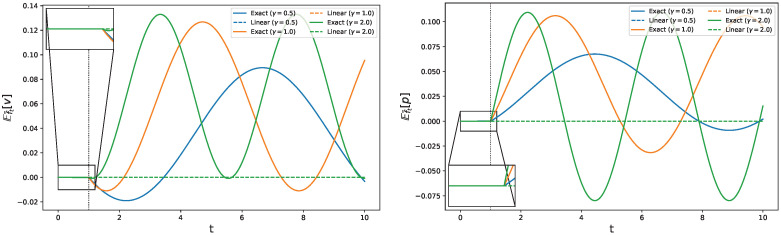 Figure 1
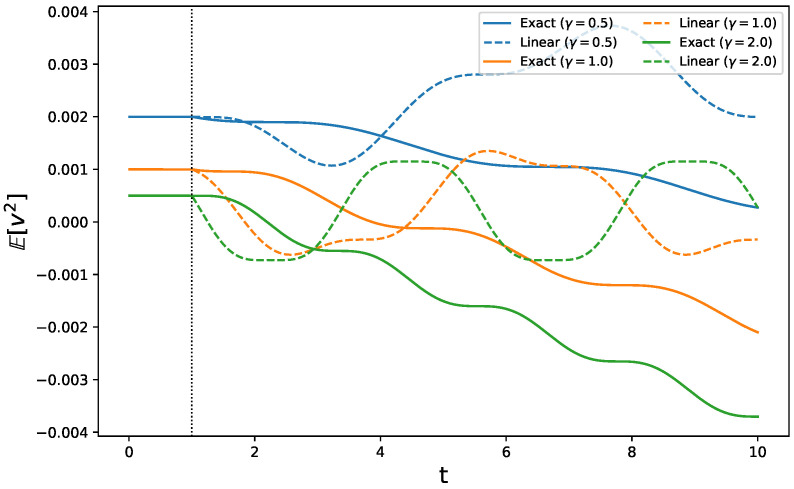 Figure 2
Peer Reviews
No public reviews on file for this paper yet. If you reviewed it on a platform where reviews are public (OpenReview, ICLR, NeurIPS, ICML), you can paste yours below so the community can read it here.
Videos
No videos yet. Explain this paper in a talk, walkthrough, or lecture? Add one.
Taxonomy
Topicsstochastic dynamics and bifurcation · Gene Regulatory Network Analysis · Advanced Thermodynamics and Statistical Mechanics