AI Agents as Universal Task Solvers
Alessandro Achille, Stefano Soatto

TL;DR
This paper explores how AI agents can learn to solve new tasks efficiently by focusing on the algorithmic structure of past data rather than just memorizing it.
Contribution
The paper introduces a theoretical framework for transductive inference that connects learning to the algorithmic information shared between tasks.
Findings
Optimal speed-up in solving new tasks is linked to the algorithmic information shared with training data.
Transductive inference is most beneficial when the data-generating mechanism is complex.
Naïve scaling of models can lead to inefficient, brute-force solutions without transferable strategies.
Abstract
We describe AI agents as stochastic dynamical systems and frame the problem of learning to reason as in transductive inference: Rather than approximating the distribution of past data as in classical induction, the objective is to capture its algorithmic structure so as to reduce the time needed to solve new tasks. In this view, information from past experience serves not only to reduce a model’s uncertainty, as in Shannon’s classical theory, but to reduce the computational effort required to find solutions to unforeseen tasks. Working in the verifiable setting, where a checker or reward function is available, we establish three main results. First, we show that the optimal speed-up for a new task is tightly related to the algorithmic information it shares with the training data, yielding a theoretical justification for the power-law scaling empirically observed in reasoning models.…
Click any figure to enlarge with its caption.
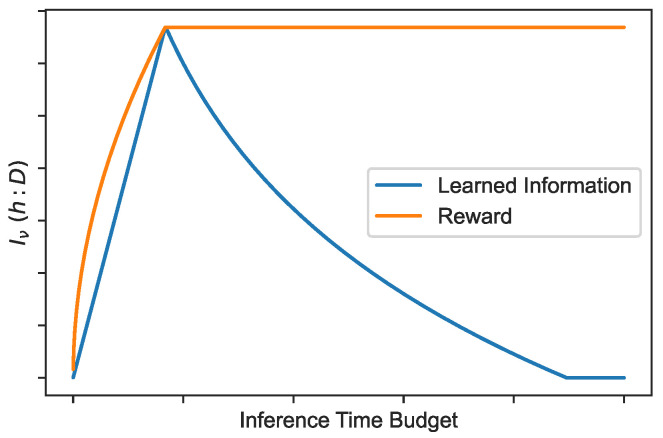 Figure 1
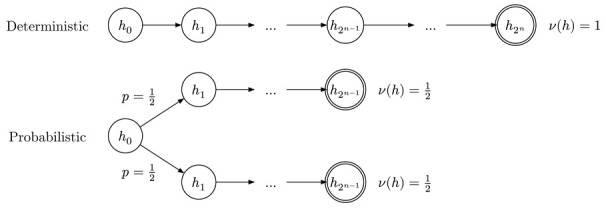 Figure 2
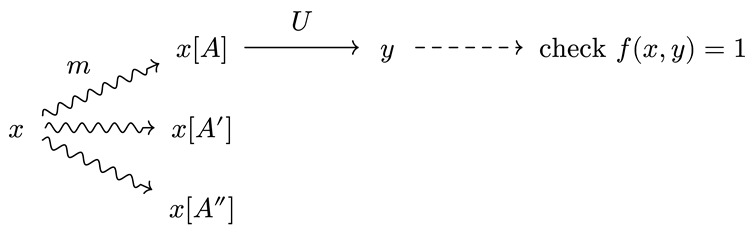 Figure 3
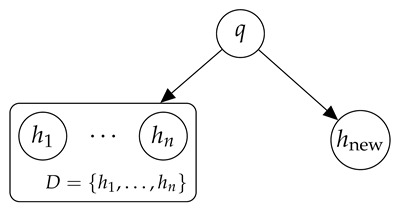 Figure 4
Peer Reviews
No public reviews on file for this paper yet. If you reviewed it on a platform where reviews are public (OpenReview, ICLR, NeurIPS, ICML), you can paste yours below so the community can read it here.
Videos
No videos yet. Explain this paper in a talk, walkthrough, or lecture? Add one.
Taxonomy
TopicsExplainable Artificial Intelligence (XAI) · Embodied and Extended Cognition · Computability, Logic, AI Algorithms