End-of-Induction Response and Tolerability of High-Risk Neuroblastoma Treated with Chemoimmunotherapy—Modified N7 Regimen with Dinutuximab Beta
Evelyn R. Lu, Calvin P. L. Hoo, Ho Ming Cheung, I. W. C. Wong, K. F. Kevin Fung, Sylvia L. Y. Chang, Anselm C. W. Lee, Eric C. H. Fu, Dennis T. L. Ku, Jeffrey P. W. Yau, Matthew M. K. Shing, Christy Y. K. Mak, Anthony P. Y. Liu, Godfrey C. F. Chan

TL;DR
This study shows that combining chemotherapy with dinutuximab beta is effective and safe for treating high-risk neuroblastoma in children.
Contribution
The study introduces a modified chemoimmunotherapy regimen with dinutuximab beta during induction treatment for high-risk neuroblastoma.
Findings
78% of patients achieved tumor response at the primary site and 100% at metastatic sites.
Grade 3 or higher toxicities were observed but manageable in all patients.
78% of patients achieved a modified Curie score of ≤2 on MIBG scan.
Abstract
High-risk neuroblastoma is an aggressive childhood cancer where intensive induction chemotherapy is a cornerstone of treatment. This study evaluated a novel strategy of integrating a targeted immunotherapy agent, dinutuximab beta, concurrently with a modified induction chemotherapy backbone. The primary aims were to assess the preliminary efficacy of this combination in achieving tumour response and to evaluate its safety and tolerability in a clinical setting. The findings demonstrate a high rate of tumour regression with a manageable adverse event profile, supporting the feasibility of this chemoimmunotherapy approach. This research provides a foundational clinical evidence base that may influence future treatment protocols and justifies larger, confirmatory trials to establish its role in improving survival outcomes for paediatric neuroblastoma patients. Background: The integration…
Genes, proteins, chemicals, diseases, species, mutations and cell lines named across the full text — each resolved to its canonical identifier and authoritative record.
Click any figure to enlarge with its caption.
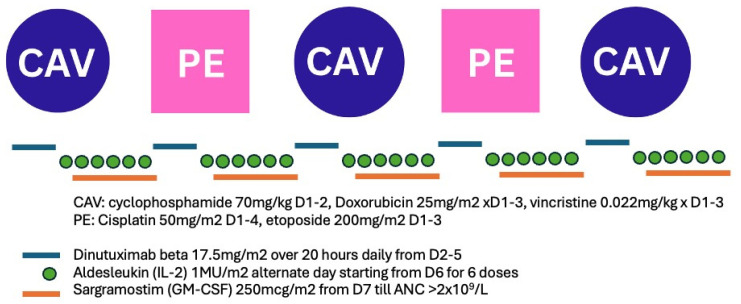 Figure 1
Peer Reviews
No public reviews on file for this paper yet. If you reviewed it on a platform where reviews are public (OpenReview, ICLR, NeurIPS, ICML), you can paste yours below so the community can read it here.
Videos
No videos yet. Explain this paper in a talk, walkthrough, or lecture? Add one.
Taxonomy
TopicsNeuroblastoma Research and Treatments · Cancer therapeutics and mechanisms · Cancer Research and Treatments