An FAK Kinase/Scaffold Mode-Switch in Dormancy and Resistance
Changchang Sun, Qiuting Feng, Yiyang Zhao, Qihan Dong, Ling Bi

TL;DR
This paper explores how FAK protein switches between two modes to help dormant cancer cells survive treatment and later regrow, suggesting new therapies that degrade FAK could improve cancer outcomes.
Contribution
The paper introduces a novel conceptual framework of FAK as a mode-switch between kinase and scaffold functions, linking it to cancer dormancy and resistance.
Findings
FAK's kinase activity (Mode I) promotes cancer cell reactivation and growth.
FAK's scaffold function (Mode II) protects dormant cells and is not targeted by current inhibitors.
PROTACs that degrade FAK may be needed to eliminate persistent cancer cells.
Abstract
Cancer recurrence often occurs because “dormant” tumor cells stop dividing to survive chemotherapy and reactivate later. This process involves Focal Adhesion Kinase (FAK) and its partner YAP. In this review, we propose that FAK acts as a functional switch: “Mode I” drives reactivation and cell growth, while “Mode II” acts as a structural shield that protects dormant cells. Most approved FAK inhibitors target only its kinase activity (Mode I) and do not dismantle the scaffold-dependent survival architecture (Mode II). We suggest that next-generation therapies capable of degrading the FAK protein entirely (PROTACs) may be required to remove this shield and eliminate persistent cancer cells. Late relapses are one of the most frustrating aspects of cancer treatment. They are frequently driven by dormant tumor cells and drug-tolerant persisters (DTPs) that survive therapy and later re-enter…
Genes, proteins, chemicals, diseases, species, mutations and cell lines named across the full text — each resolved to its canonical identifier and authoritative record.
Click any figure to enlarge with its caption.
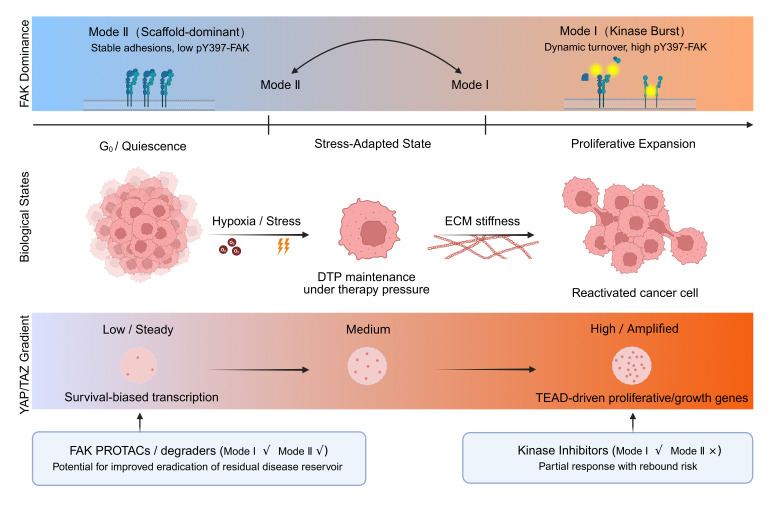 Figure 1
Peer Reviews
No public reviews on file for this paper yet. If you reviewed it on a platform where reviews are public (OpenReview, ICLR, NeurIPS, ICML), you can paste yours below so the community can read it here.
Videos
No videos yet. Explain this paper in a talk, walkthrough, or lecture? Add one.
Taxonomy
TopicsHippo pathway signaling and YAP/TAZ · Cellular Mechanics and Interactions · Cell Adhesion Molecules Research