Factor Structure and Measurement Invariance Across Gender of the Eating Disorder Examination Questionnaire—Short Form in Italian Workers
Nicola Magnavita, Carlo Chiorri

TL;DR
This study evaluates the Italian version of a questionnaire for eating disorders in workers, finding it reliable but with some gender-related differences.
Contribution
The study provides evidence for the structural validity of the Italian EDE-QS in occupational settings and identifies gender-related item bias.
Findings
The Italian EDE-QS shows a unidimensional structure with high internal consistency and strong construct replicability.
Measurement invariance was partial, with differential item functioning observed in some items between genders.
Women scored slightly higher than men, but overall associations with variables were consistent across genders.
Abstract
Eating disorders (EDs) are complex conditions that can significantly affect health and productivity, yet their assessment in occupational settings remains underexplored. This study aimed to evaluate the psychometric properties of the Italian version of the Eating Disorder Examination Questionnaire—Short Form (EDE-QS) among 1912 workers undergoing health surveillance. Using an Item Response Theory framework, we tested dimensionality, reliability, and measurement invariance across gender, applying a graded response model to assess item discrimination and threshold parameters. Results supported an approximate unidimensional structure with excellent internal consistency (ω ≈ 0.95) and strong indices of factor score determinacy and construct replicability. Measurement invariance analyses indicated configural and metric invariance but not full scalar invariance, due to differential item…
Genes, proteins, chemicals, diseases, species, mutations and cell lines named across the full text — each resolved to its canonical identifier and authoritative record.
Click any figure to enlarge with its caption.
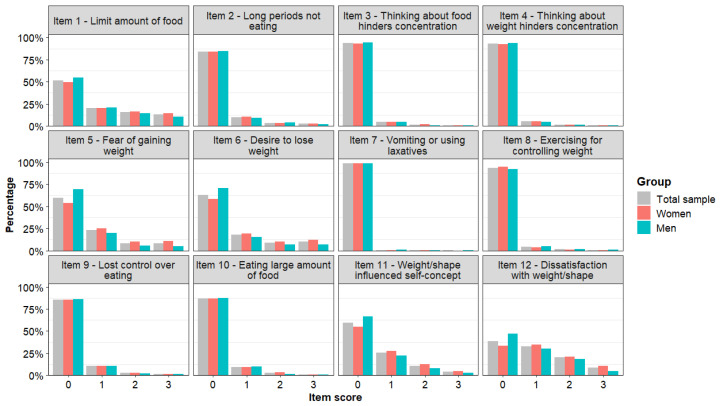 Figure 1
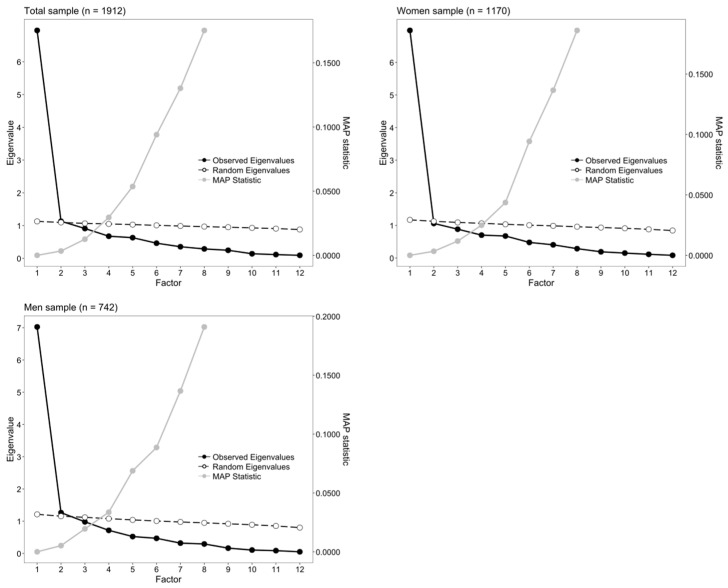 Figure 2
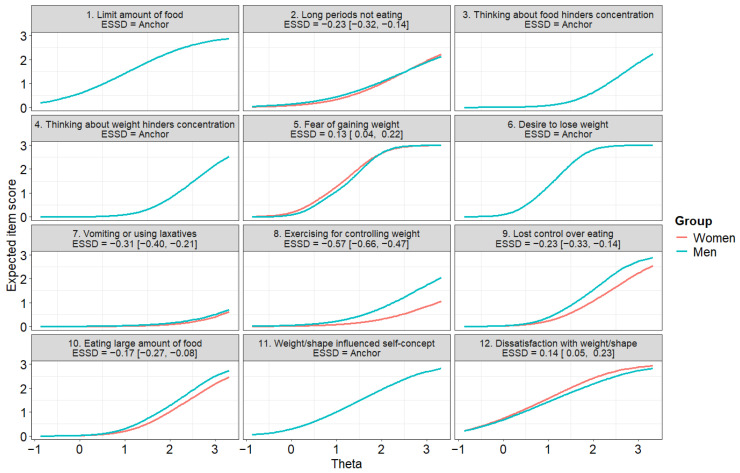 Figure 3
Peer Reviews
No public reviews on file for this paper yet. If you reviewed it on a platform where reviews are public (OpenReview, ICLR, NeurIPS, ICML), you can paste yours below so the community can read it here.
Videos
No videos yet. Explain this paper in a talk, walkthrough, or lecture? Add one.
Taxonomy
TopicsEating Disorders and Behaviors · Child Nutrition and Feeding Issues · Temporomandibular Joint Disorders