A Channel-Independent Anchor Graph-Regularized Broad Learning System for Industrial Soft Sensors
Zhiyi Zhang, Mingyi Yang, Cheng Xie, Zhigang Xu, Pengfei Yin

TL;DR
This paper introduces a new machine learning system for industrial applications that handles complex data efficiently and accurately.
Contribution
The novel CI-GBLS system uses channel independence and graph regularization to improve efficiency and accuracy in industrial modeling.
Findings
CI-GBLS achieves high prediction accuracy and efficiency on complex industrial data.
The model completes training within seconds, suitable for real-time applications.
It effectively captures nonlinear dynamics and spatial coupling relationships.
Abstract
To address the nonlinear dynamics and strong multivariate coupling inherent in complex industrial data, while overcoming the high computational costs and deployment challenges of deep learning, this paper proposes a Channel-Independent Anchor Graph-Regularized Broad Learning System (CI-GBLS). First, a Channel Independence (CI) strategy is introduced: by constructing physically isolated feature channels, multivariate inputs are orthogonally decomposed, enabling the model to mine the intrinsic temporal evolutionary patterns of each variable. Building upon this, enhancement nodes are constructed using Radial Basis Functions (RBFs) to capture nonlinear dynamics; moreover, RBF cluster centers are reused as graph anchors to design an efficient manifold regularization algorithm. This algorithm embeds the intrinsic geometric structure of the data into the learning objective via reduced rank…
Click any figure to enlarge with its caption.
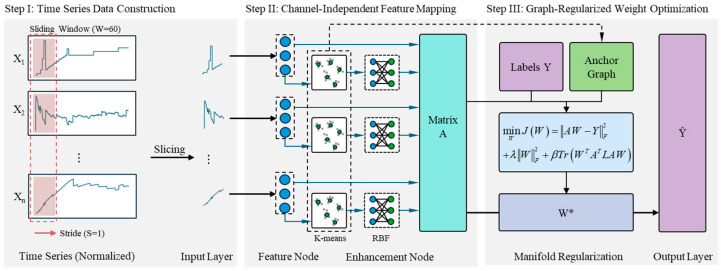 Figure 1
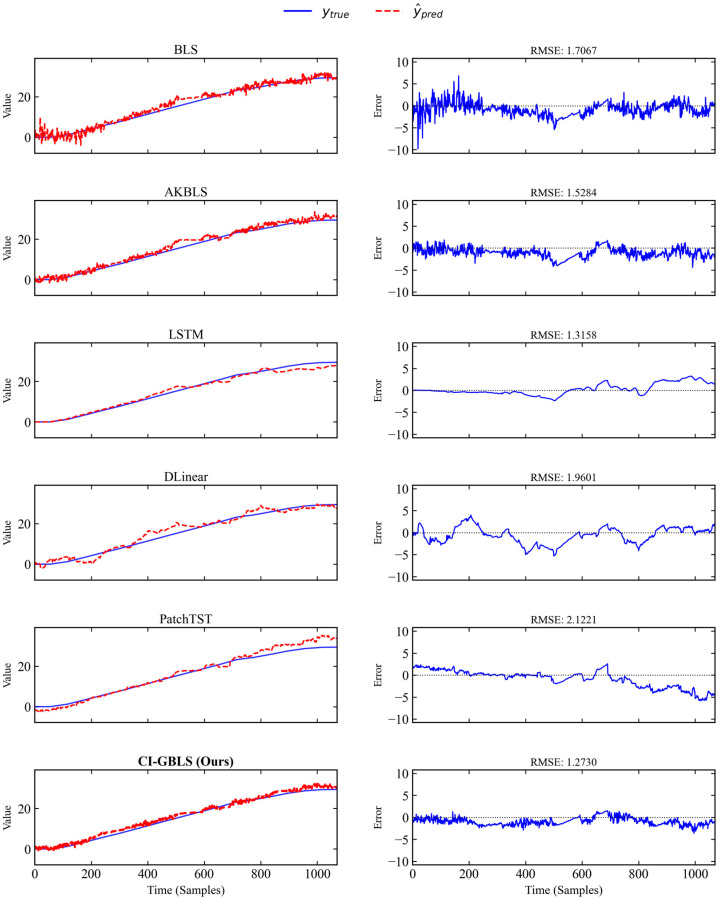 Figure 2
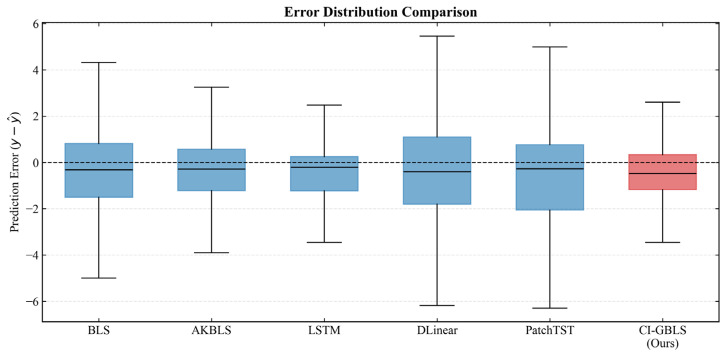 Figure 3
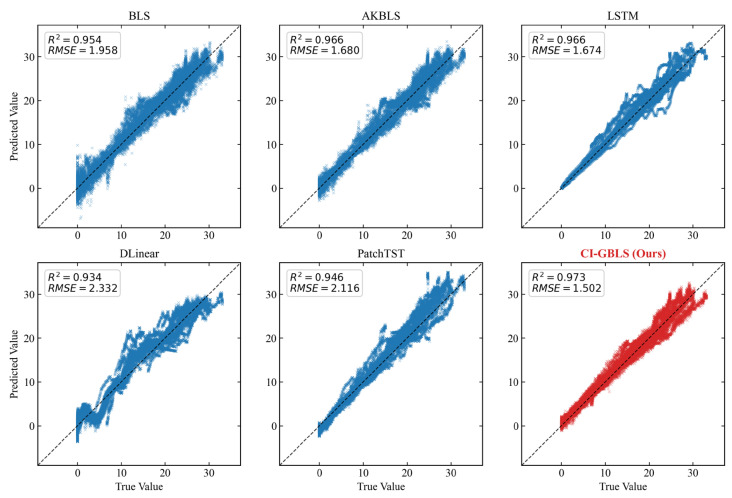 Figure 4
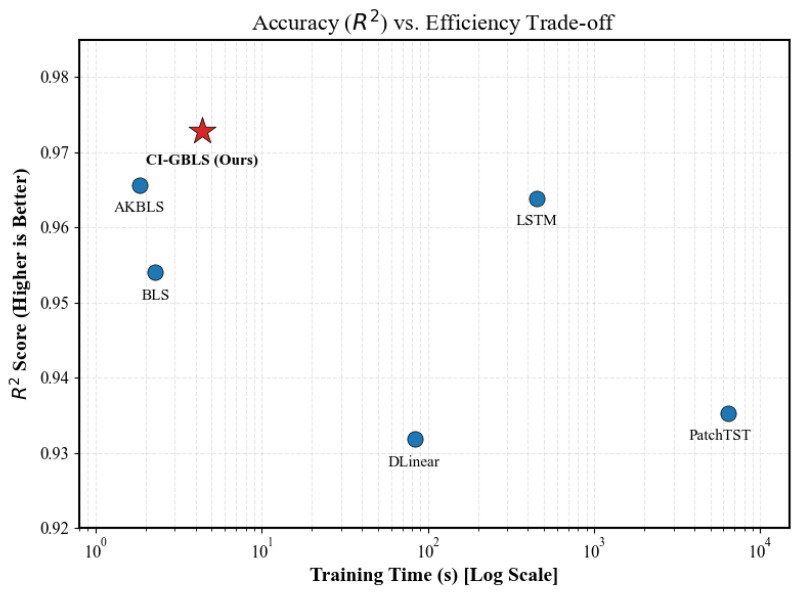 Figure 5
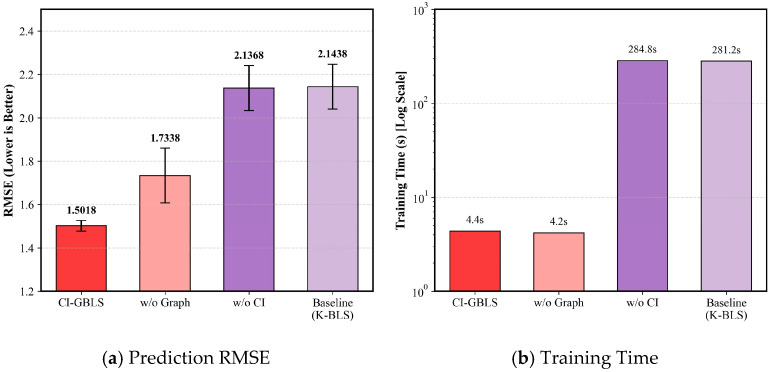 Figure 6
 Figure 7
Peer Reviews
No public reviews on file for this paper yet. If you reviewed it on a platform where reviews are public (OpenReview, ICLR, NeurIPS, ICML), you can paste yours below so the community can read it here.
Videos
No videos yet. Explain this paper in a talk, walkthrough, or lecture? Add one.
Taxonomy
TopicsMachine Learning and ELM · Fault Detection and Control Systems · Machine Fault Diagnosis Techniques