On the Communication–Key Rate Region of Hierarchical Vector Linear Secure Aggregation
Jiawen Lv, Xiang Zhang, Zhou Li

TL;DR
This paper explores secure aggregation in a two-hop hierarchical network for federated learning, ensuring privacy while optimizing communication rates.
Contribution
The paper introduces a novel hierarchical secure aggregation framework with optimal communication rates and explicit linear coding.
Findings
Hierarchical architectures achieve optimal communication rates for secure aggregation.
The proposed coding scheme reduces the server-side masking burden significantly.
Information-theoretic bounds are derived and matched with an achievable scheme.
Abstract
Motivated by heterogeneous data distributions and task-dependent aggregation requirements in federated learning, we study information-theoretic secure aggregation of linear functions over a two-hop hierarchical network. The system comprises an aggregation server, an intermediate layer of U relays, and UV users, where each relay serves a disjoint cluster of V users. Each relay observes all uplink transmissions within its cluster and forwards a coded message to the server. The server is authorized to compute a prescribed linear function F of the users’ inputs with zero error, while being prevented from learning any additional information about an unauthorized linear function G. Moreover, each relay must obtain no information about any non-trivial linear function Bu of the inputs in its own cluster. We define the communication rates on both hops as the number of transmitted symbols per…
Click any figure to enlarge with its caption.
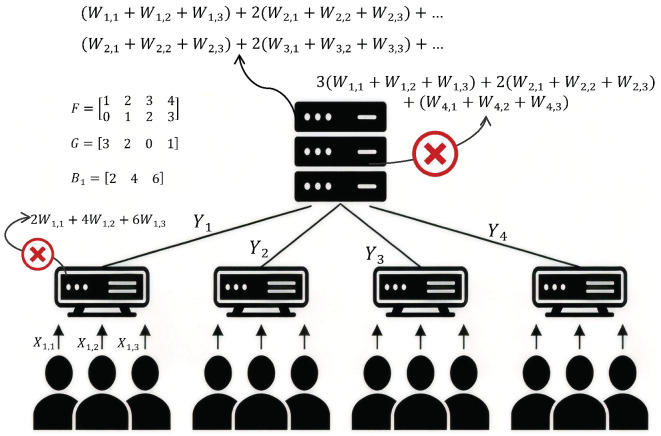 Figure 1
Peer Reviews
No public reviews on file for this paper yet. If you reviewed it on a platform where reviews are public (OpenReview, ICLR, NeurIPS, ICML), you can paste yours below so the community can read it here.
Videos
No videos yet. Explain this paper in a talk, walkthrough, or lecture? Add one.
Taxonomy
TopicsWireless Communication Security Techniques · Cooperative Communication and Network Coding · Privacy-Preserving Technologies in Data