Anomalous Foramina Through the Greater Wing of the Sphenoid Bone: A Radio-Anatomical Study on a Cohort of Dry Skulls from the Interbellum Period Using MDCT
Andra-Ioana Baloiu, Octavian Munteanu, Andrei Dorian Soficaru, Iuliana-Raluca Gheorghe, Andreea-Nicoleta Marinescu, Ioan-Andrei Petrescu, Răzvan Stănciulescu, Iulian Mirel Slavu, Florin Mihail Filipoiu

TL;DR
This study used CT scans to examine the presence of two small skull openings in a collection of dry skulls, finding significant anatomical variability.
Contribution
The study provides new prevalence data on the foramina of Arnold and Vesalius using high-resolution MDCT on a historical skull collection.
Findings
The foramen of Arnold was present in 29% of skulls, with bilateral presence in 6.6%.
The foramen of Vesalius was present in 69.8% of skulls, with bilateral presence in 44.6%.
Abstract
Background: The foramen of Arnold (FA) and foramen of Vesalius (FV) are two inconstant small openings through the greater wing of the sphenoid bone. When FA is present, the lesser petrosal nerve passes through it. FV usually contains an emissary vein that connects the cavernous sinus to the pterygoid plexus. Objectives: To assess the presence, unilaterally or bilaterally, of the aforementioned inconstant foramina in order to gain a better insight into the anatomic variability of the middle cranial fossa. Methods: We analyzed five hundred random unenhanced CT examinations of human dry skulls from the “Francisc I. Rainer” Craniological Collection of the Human Anthropological Institute in Bucharest, Romania. The collection holds substantial anthropological and radiological value, as dry skulls allow the use of higher spatial-resolution imaging parameters and thus better detection of the…
Genes, proteins, chemicals, diseases, species, mutations and cell lines named across the full text — each resolved to its canonical identifier and authoritative record.
Click any figure to enlarge with its caption.
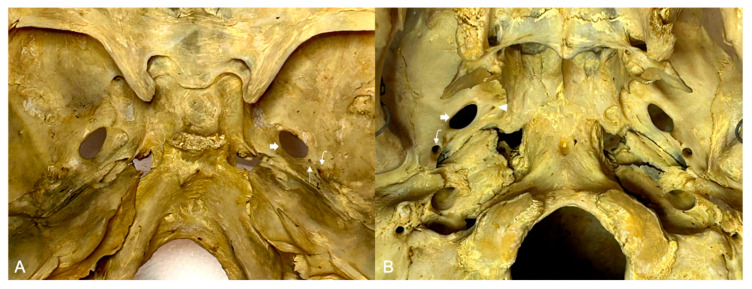 Figure 1
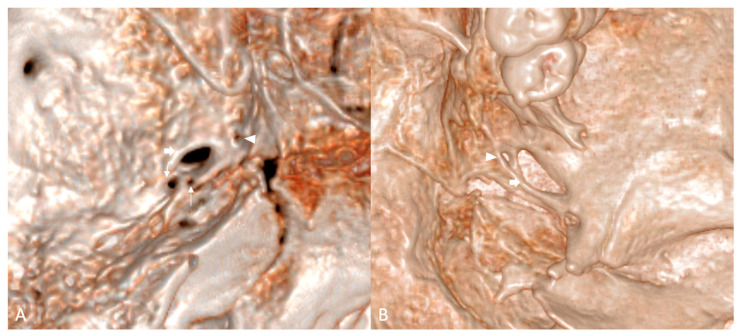 Figure 2
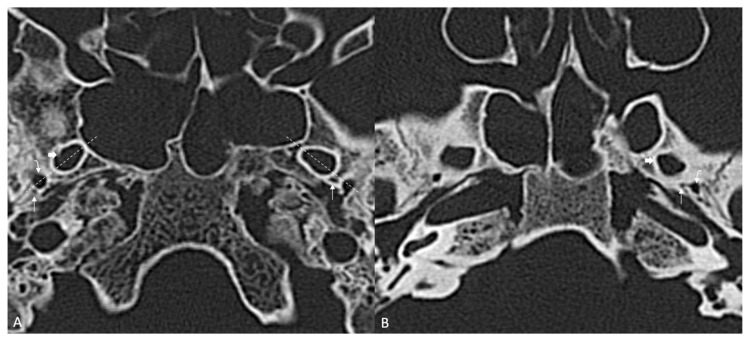 Figure 3
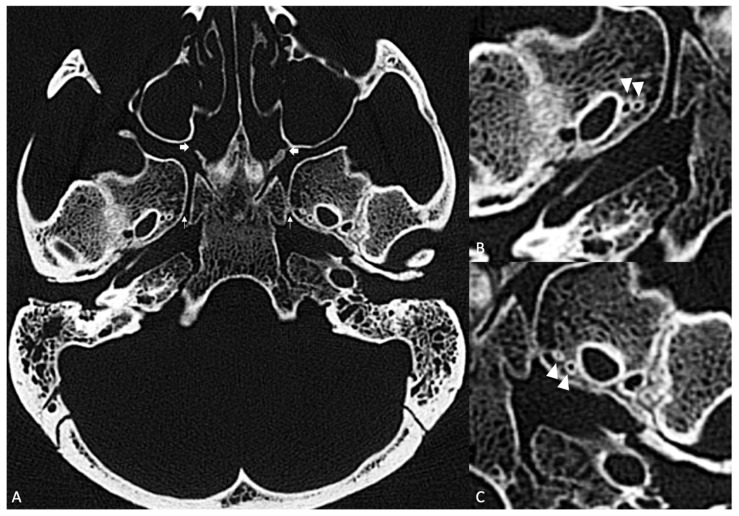 Figure 4
Peer Reviews
No public reviews on file for this paper yet. If you reviewed it on a platform where reviews are public (OpenReview, ICLR, NeurIPS, ICML), you can paste yours below so the community can read it here.
Videos
No videos yet. Explain this paper in a talk, walkthrough, or lecture? Add one.
Taxonomy
TopicsForensic Anthropology and Bioarchaeology Studies · Head and Neck Surgical Oncology · Trigeminal Neuralgia and Treatments