Reorganization of Spinal Cord Microarchitecture by Bioluminescent Optogenetic and Rehabilitative Interventions
Tatyana Ageeva, Rezeda Shigapova, Aizilya Bilalova, Elizaveta Plotnikova, Amina Akmanova, Albert Rizvanov, Yana Mukhamedshina

TL;DR
This study explores how combining motor training with bioluminescent optogenetics affects spinal cord recovery after injury in rats.
Contribution
The study reveals distinct mechanisms of microarchitectural remodeling in spinal cord injury recovery using bioluminescent optogenetics and motor training.
Findings
BL-OG stimulation showed improved step accuracy and reduced spine abnormalities compared to TMT alone.
BL-OG preserved PNN architecture and altered GPC-4 expression in specific spinal cord laminae.
Rehabilitation and BL-OG engage distinct but overlapping mechanisms of synaptic remodeling.
Abstract
Spinal cord injury (SCI) induces persistent locomotor deficits that are closely associated with maladaptive structural plasticity of spinal neuronal circuits. Although motor rehabilitation improves functional outcomes, the cellular substrates underlying rehabilitation-induced recovery remain incompletely understood, particularly in relation to activity-dependent neuromodulation strategies. Here, we investigated how treadmill-based motor training (TMT) and its combination with bioluminescent optogenetic (BL-OG) stimulation of Hb9 (homebox 9)-positive motoneurons and excitatory interneurons selectively modulate microarchitectural plasticity in the injured rat spinal cord. At the level of gross locomotor assessment, Basso, Beattie and Bresnahan (BBB) scores were comparable between the BL-OG and SCI+TMT groups. Although no statistically significant differences in the total score in rung…
Genes, proteins, chemicals, diseases, species, mutations and cell lines named across the full text — each resolved to its canonical identifier and authoritative record.
Click any figure to enlarge with its caption.
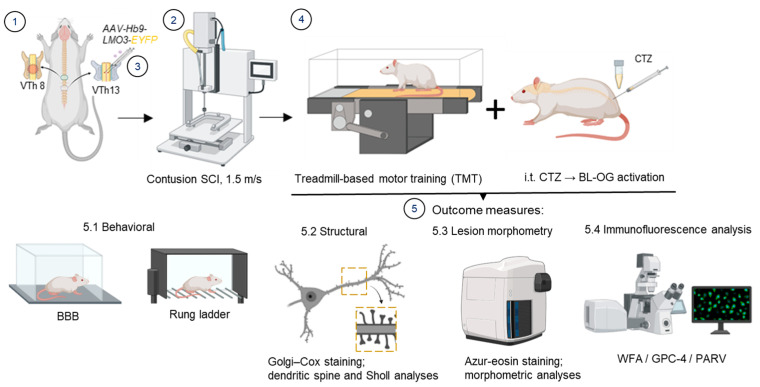 Figure 1
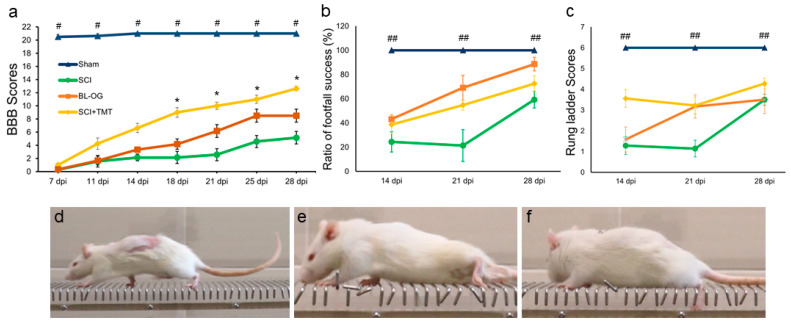 Figure 2
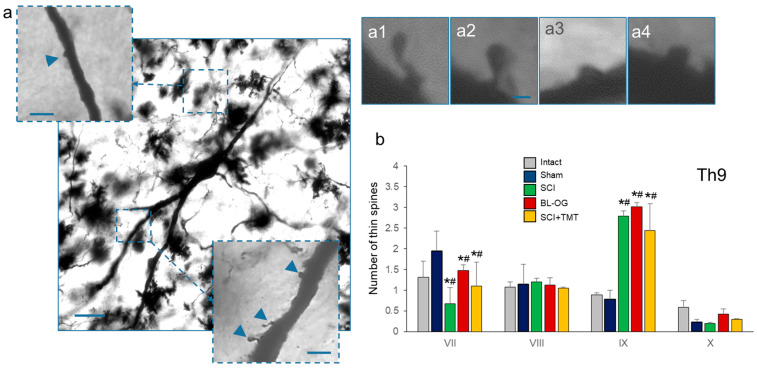 Figure 3
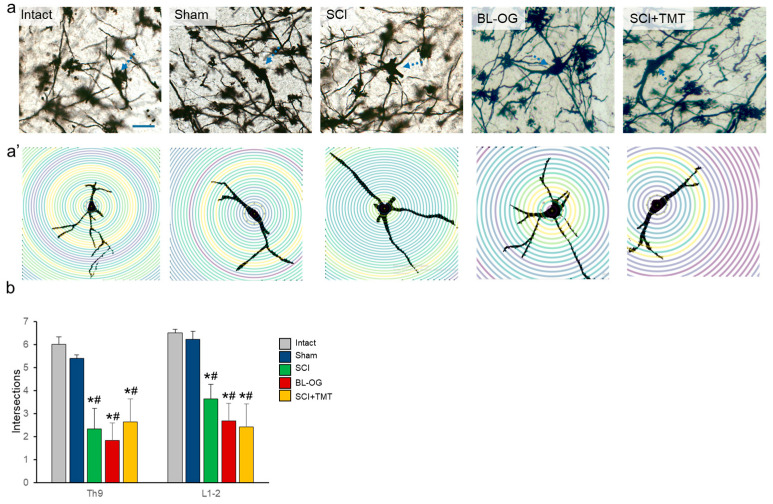 Figure 4
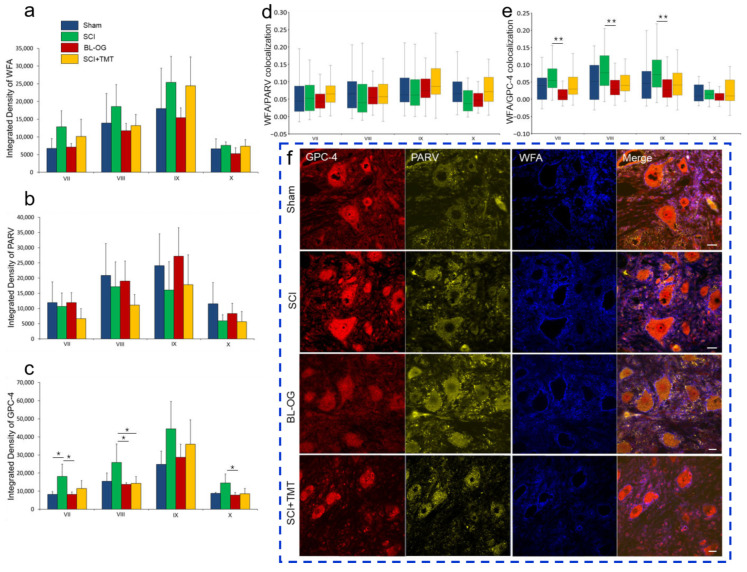 Figure 5
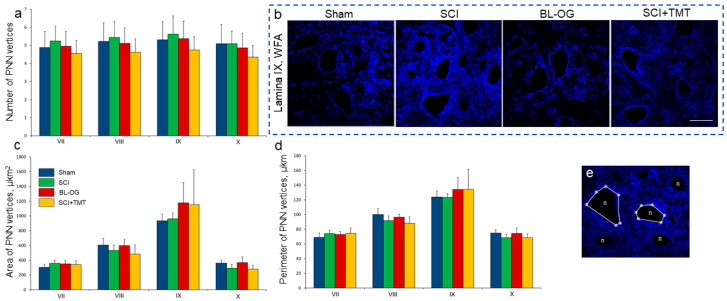 Figure 6
Peer Reviews
No public reviews on file for this paper yet. If you reviewed it on a platform where reviews are public (OpenReview, ICLR, NeurIPS, ICML), you can paste yours below so the community can read it here.
Videos
No videos yet. Explain this paper in a talk, walkthrough, or lecture? Add one.
Taxonomy
TopicsPhotoreceptor and optogenetics research · Planarian Biology and Electrostimulation · Laser Applications in Dentistry and Medicine