Evaluating the Use and Feasibility of Indocyanine Green (ICG) as a Beacon of Precision in Sentinel Node Biopsy for Breast Cancer from an Oncoplastic Practice in India
Chaitanyanand B. Koppiker, Rupa Mishra, Vaibhav Jain, Sneha Bhandari, Namrata Athavale, Nutan Jumle, Chetan Deshmukh, Beenu Varghese, Upendra Dhar, Anushree Vartak, Pallavi Daphale, Laleh Busheri, Vishesha Lulla, Sneha Joshi

TL;DR
This study shows that indocyanine green (ICG) is a safe and effective alternative to radioactive tracers for sentinel node biopsy in breast cancer, especially in resource-limited settings like India.
Contribution
The study presents the largest Indian cohort evaluating ICG for sentinel lymph node biopsy and demonstrates its high accuracy and feasibility in low-resource settings.
Findings
ICG achieved a 100% identification rate in upfront surgeries when used alone.
ICG had comparable or better accuracy than traditional tracers, with low false-negative rates.
ICG is a practical alternative in resource-limited settings due to its non-radioactive nature and favorable oncological outcomes.
Abstract
Accurate staging of the axillary lymph nodes is essential for guiding treatment in breast cancer. Sentinel lymph node biopsy (SLNB) is the standard method for evaluating lymph node involvement and traditionally uses radioactive tracers combined with blue dye. However, this approach requires access to nuclear medicine facilities, which are often limited in many low- and middle-income countries (LMICs). In this study, we analyzed outcomes from 678 breast cancer patients treated at an oncoplastic breast surgery unit in India over a 10-year period, representing the largest reported Indian cohort evaluating indocyanine green (ICG) for SLNB. Our findings show that ICG demonstrated identification rates and accuracy comparable to or better than conventional tracers, with excellent node retrieval and very low false-negative rates, both in upfront surgery and after neoadjuvant therapy. When used…
Genes, proteins, chemicals, diseases, species, mutations and cell lines named across the full text — each resolved to its canonical identifier and authoritative record.
Click any figure to enlarge with its caption.
 Figure 1
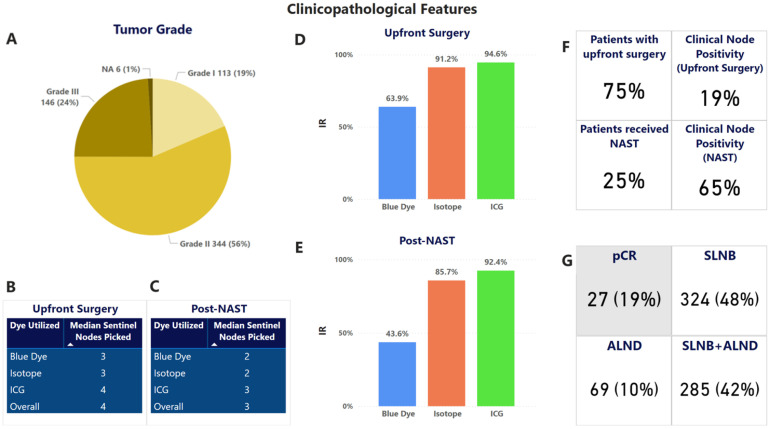 Figure 2
 Figure 3
 Figure 4
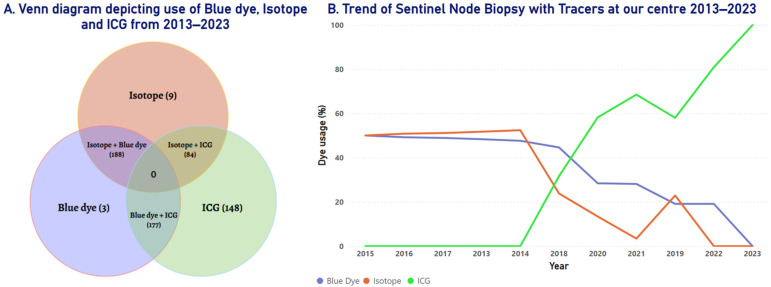 Figure 5
Peer Reviews
No public reviews on file for this paper yet. If you reviewed it on a platform where reviews are public (OpenReview, ICLR, NeurIPS, ICML), you can paste yours below so the community can read it here.
Videos
No videos yet. Explain this paper in a talk, walkthrough, or lecture? Add one.
Taxonomy
TopicsBreast Cancer Treatment Studies · Breast Lesions and Carcinomas · Male Breast Health Studies