An Invariant Measure for Differential Entropy: From Kullback–Leibler Divergence to Scale-Invariant Information Theory
Félix Truong, Alexandre Giuliani

TL;DR
This paper introduces a new way to calculate entropy that remains consistent even when data scales change, solving a long-standing issue in information theory.
Contribution
The novel contribution is a practical computational method for an invariant measure of entropy using k-nearest neighbor distances and affine transformation invariance proofs.
Findings
Entropy normalized by the median of k-nearest neighbor distances is invariant under affine transformations.
The non-negativity of the resulting entropy was validated empirically across various distributions.
The method extends to multivariate settings, enabling scale-invariant mutual information estimation.
Abstract
Shannon’s differential entropy for continuous variables suffers from a fundamental limitation: it is not invariant under scale transformations. This makes entropy values dependent on the choice of measurement units rather than reflecting intrinsic properties of distributions. While Jaynes proposed the limiting density of discrete points (LDDP) as a theoretical solution, a concrete method for computing the required invariant measure has been lacking. This paper establishes a rigorous connection between Kullback–Leibler divergence and the invariant measure, providing theoretical proofs of invariance under affine transformations and a practical computational method. We prove that entropy normalized by the median of k-nearest neighbor distances is invariant under affine transformations (Theorems 1 and 2). The non-negativity of the resulting entropy has been validated empirically across all…
Click any figure to enlarge with its caption.
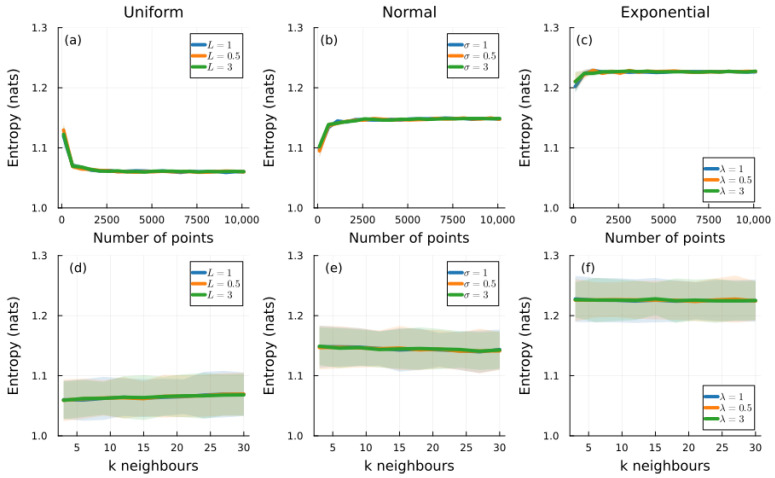 Figure 1
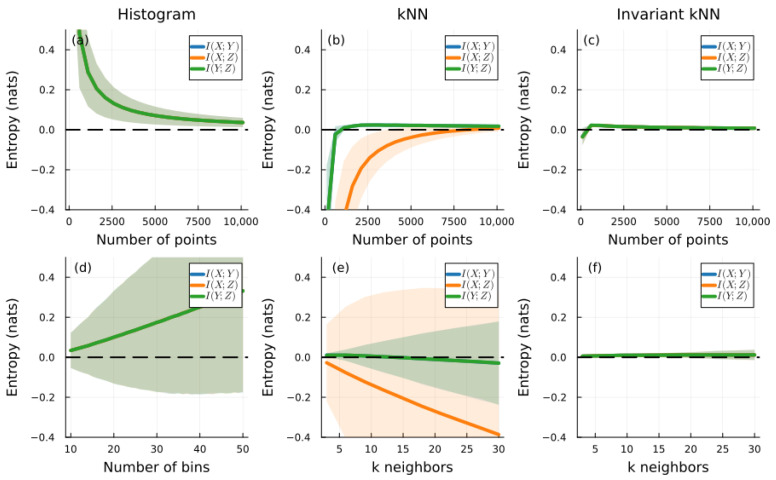 Figure 2
Peer Reviews
No public reviews on file for this paper yet. If you reviewed it on a platform where reviews are public (OpenReview, ICLR, NeurIPS, ICML), you can paste yours below so the community can read it here.
Videos
No videos yet. Explain this paper in a talk, walkthrough, or lecture? Add one.
Taxonomy
TopicsStatistical Mechanics and Entropy · Complex Systems and Time Series Analysis · Morphological variations and asymmetry