Oxidative Stress and the KEAP1/NRF2 Axis in Saphenous Vein: Implications for Graft Patency
Georgia R. Layton, Em Marston, Hannah L. Musa, Shameem Ladak, Alice Copperwheat, Akintoye Oluwanifemi, Ibrahim Antoun, Mustafa Zakkar

TL;DR
This review explores how the KEAP1/NRF2 pathway responds to oxidative stress in saphenous vein grafts, which could help improve their long-term success after heart surgery.
Contribution
The paper highlights the KEAP1/NRF2 pathway's role in vein graft disease and identifies KEAP1 inhibition as a potential therapeutic target.
Findings
NRF2 intersects with multiple pathways involved in vein graft pathology, including inflammation and smooth muscle proliferation.
Protandim treatment in human saphenous vein tissue reduced oxidative stress markers and increased antioxidant enzyme activity.
NRF2 activation under arterial cyclic stretch can paradoxically drive proliferation through p62-mediated KEAP1 sequestration.
Abstract
Vein graft disease remains a significant limitation to the long-term patency of venous conduits following coronary artery bypass grafting. Early oxidative stress, triggered by ischaemia–reperfusion injury and haemodynamic changes following the implantation of veins into the arterial circulation, disrupts endothelial integrity and initiates inflammation, apoptosis, and maladaptive remodelling. The KEAP1-NRF2 axis is a central regulator of cellular antioxidant responses; however, its role in the development of vein graft disease remains poorly defined. This narrative review aimed to summarise what is known about NRF2/KEAP1 signalling in modulating vein graft pathology. Methods: A systematic search of PubMed was conducted to identify original research studies examining the NRF2/KEAP1 pathway in human saphenous vein tissue in vivo or ex vivo. Narrative synthesis was performed due to limited…
Genes, proteins, chemicals, diseases, species, mutations and cell lines named across the full text — each resolved to its canonical identifier and authoritative record.
Click any figure to enlarge with its caption.
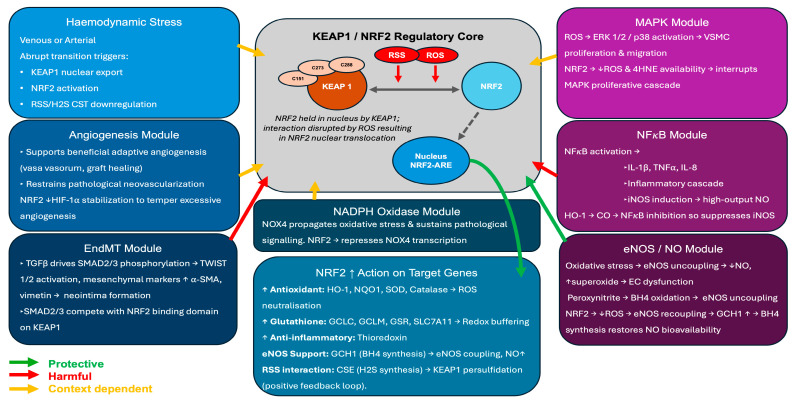 Figure 1
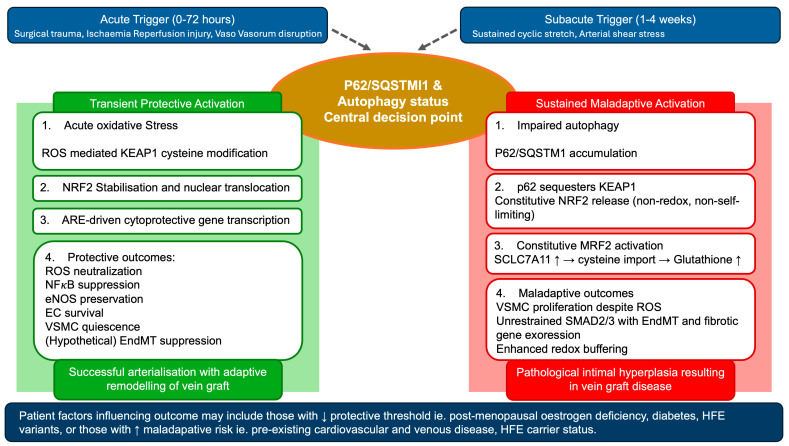 Figure 2
Peer Reviews
No public reviews on file for this paper yet. If you reviewed it on a platform where reviews are public (OpenReview, ICLR, NeurIPS, ICML), you can paste yours below so the community can read it here.
Videos
No videos yet. Explain this paper in a talk, walkthrough, or lecture? Add one.
Taxonomy
TopicsGenomics, phytochemicals, and oxidative stress · Ion Channels and Receptors · Plant-derived Lignans Synthesis and Bioactivity