The Scaled Hirshfeld Partitioning: Mathematical Development and Information-Theoretic Foundation
Farnaz Heidar-Zadeh

TL;DR
This paper introduces a new method for calculating atomic charges in molecules that improves accuracy while remaining computationally efficient.
Contribution
The paper introduces the scaled Hirshfeld partitioning method, which improves upon the original Hirshfeld approach with a mathematically rigorous and efficient framework.
Findings
The scaled Hirshfeld method produces larger atomic charges than the original Hirshfeld method.
The new method provides better descriptions of molecular dipole moments and electrostatic potentials.
The method is computationally efficient and ensures size consistency and a unique solution.
Abstract
Atomic charges play a central role in the analysis of molecular electronic structure and are widely used in the development of computational models. We introduce a simple and computationally efficient extension of Hirshfeld’s 1977 stockholder partitioning method, called scaled Hirshfeld, in which neutral proatom densities are scaled to construct a promolecular density better adapted to the molecular electron density. We present a fixed-point iterative algorithm to compute the proatom scaling coefficients and show that this formulation is equivalent to the information-theoretic additive variational Hirshfeld method with a minimal basis. This equivalence establishes a rigorous mathematical foundation for the scaled Hirshfeld method and ensures size consistency as well as the existence of a unique solution. Numerical results demonstrate that the proposed approach yields charges larger than…
Click any figure to enlarge with its caption.
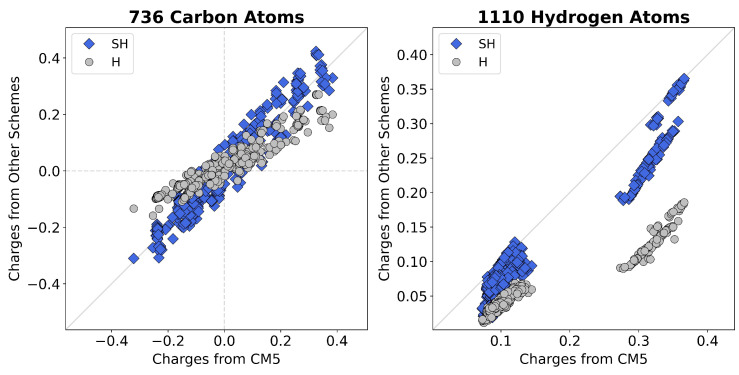 Figure 1
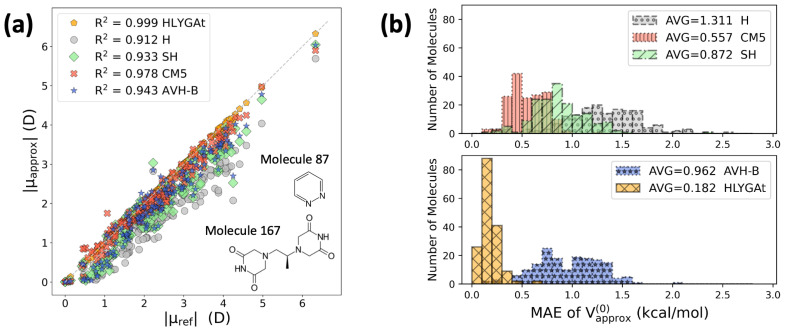 Figure 2
Peer Reviews
No public reviews on file for this paper yet. If you reviewed it on a platform where reviews are public (OpenReview, ICLR, NeurIPS, ICML), you can paste yours below so the community can read it here.
Videos
No videos yet. Explain this paper in a talk, walkthrough, or lecture? Add one.
Taxonomy
TopicsAdvanced Chemical Physics Studies · Machine Learning in Materials Science · Advanced Physical and Chemical Molecular Interactions