Biomechanical Applications of Finite Element Analysis in Orthodontics: A Scoping Review of Force Distribution, Tooth Movement, and Mechanical Performance
Valenciana-Solís Jesús Antonio, Gaitán-Fonseca César, Flores Héctor, Zavala-Alonso Verónica, Bermúdez-Jiménez Carlos, Martínez-Torres Carlos, Pozos-Guillén Amaury

TL;DR
This review explores how finite element analysis is used in orthodontics to study forces, tooth movement, and tissue responses, highlighting its potential and current limitations.
Contribution
The paper provides a scoping review of FEA applications in orthodontics, identifying trends and gaps in methodological approaches.
Findings
FEA is increasingly used to evaluate biomechanical behavior in orthodontic treatments.
Lack of standardization and validation limits the clinical applicability of FEA findings.
FEA is mainly used for descriptive purposes like visualizing stress and strain distributions.
Abstract
Background/Objectives: Clinical and scientific professionalization in orthodontics requires a comprehensive understanding of the biomechanical principles governing force generation and distribution produced by orthodontic appliances, beyond purely esthetic considerations. In this context, finite element analysis (FEA) has emerged as a fundamental computational tool for the detailed evaluation of the biomechanical behavior of the dentoalveolar system. The aim of this study was to map and synthesize the available scientific evidence on the application of FEA in the assessment of force distribution, tooth movement, and the mechanical response of periodontal tissues during orthodontic treatment. Methods: Original studies published between 2020 and 2025 that relied exclusively on computational simulations using FEA were included. Eligible studies addressed orthodontic biomechanics, including…
Genes, proteins, chemicals, diseases, species, mutations and cell lines named across the full text — each resolved to its canonical identifier and authoritative record.
Click any figure to enlarge with its caption.
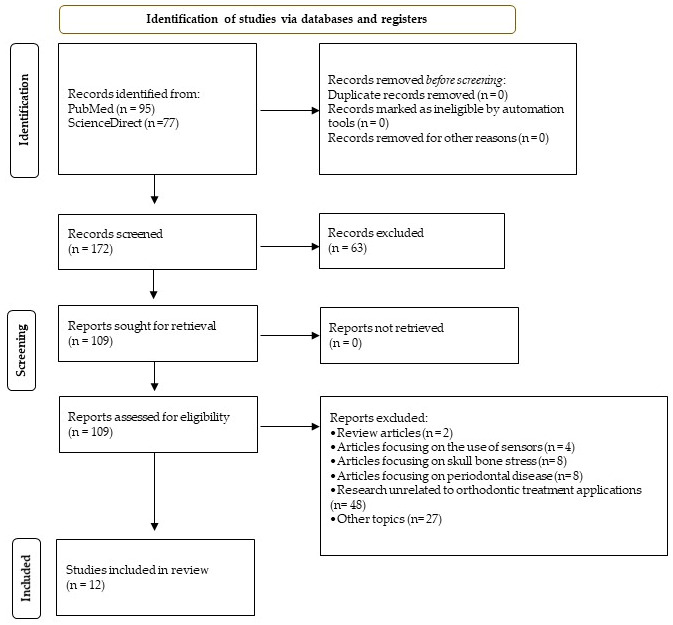 Figure 1
Peer Reviews
No public reviews on file for this paper yet. If you reviewed it on a platform where reviews are public (OpenReview, ICLR, NeurIPS, ICML), you can paste yours below so the community can read it here.
Videos
No videos yet. Explain this paper in a talk, walkthrough, or lecture? Add one.
Taxonomy
TopicsOrthodontics and Dentofacial Orthopedics · Dental materials and restorations · Dental Implant Techniques and Outcomes