Bladder Preservation with Concurrent Chemoradiotherapy Following Complete Response to Induction Systemic Therapy in Patients with Muscle-Invasive Bladder Cancer: A Review of the Existing Literature
Georgios Nikiforos Ntoumas, Andromachi Kougioumtzopoulou, Dimitra Desse, Charalambos Fragkoulis, Georgios Papadopoulos, Efthymios Kostouros, Dimitra Michaletou, Vassileios Kouloulias, Anna Zygogianni, Ioannis Georgakopoulos

TL;DR
Some bladder cancer patients who respond well to initial treatment may avoid surgery by using chemotherapy and radiotherapy, preserving bladder function without compromising survival.
Contribution
This review evaluates the feasibility and outcomes of bladder-preserving chemoradiotherapy in muscle-invasive bladder cancer patients achieving complete response to initial therapy.
Findings
Bladder-preserving chemoradiotherapy enabled 50–97% of responders to retain their bladder after complete response to initial therapy.
Long-term survival rates for these patients were favorable, with 3- to 5-year overall survival ranging from 65% to 89%.
Treatment-related toxicity was generally acceptable, with severe late toxicity being uncommon.
Abstract
Muscle-invasive bladder cancer (MIBC) mandates aggressive treatment with neoadjuvant systemic therapy followed by radical cystectomy for surgical candidates. However, a noteworthy subset of patients responds very well to initial therapy, and for these patients, it may be possible to treat MIBC with a combination of chemotherapy and radiotherapy, omitting cystectomy. Studies show this approach is generally safe, effective, and can preserve bladder function in selected patients. Improved induction treatments, advanced imaging techniques, and blood or urine biomarkers are awaited to better identify patients who can avoid cystectomy, without compromising oncological outcomes. Background/Objectives: The standard surgical treatment of muscle-invasive bladder cancer (MIBC) comprises neoadjuvant systemic therapy followed by radical cystectomy (RC). However, a notable number of patients achieve…
Genes, proteins, chemicals, diseases, species, mutations and cell lines named across the full text — each resolved to its canonical identifier and authoritative record.
Click any figure to enlarge with its caption.
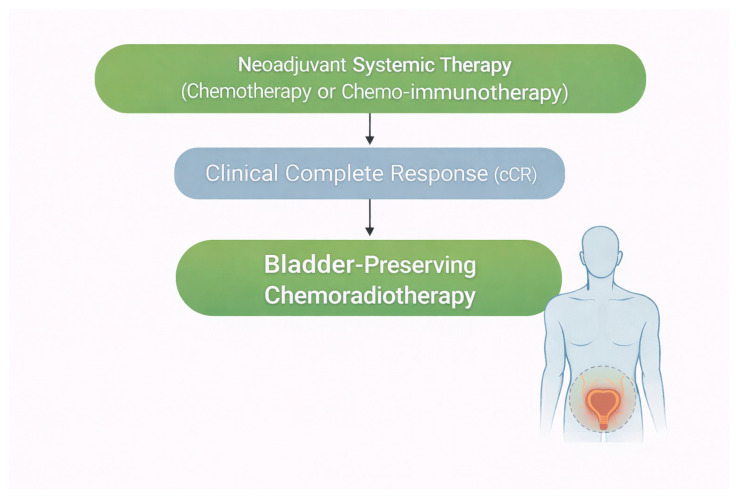 Figure 1
 Figure 2
Peer Reviews
No public reviews on file for this paper yet. If you reviewed it on a platform where reviews are public (OpenReview, ICLR, NeurIPS, ICML), you can paste yours below so the community can read it here.
Videos
No videos yet. Explain this paper in a talk, walkthrough, or lecture? Add one.
Taxonomy
TopicsBladder and Urothelial Cancer Treatments · Urinary and Genital Oncology Studies · Tissue Engineering and Regenerative Medicine