Association of Fetal Growth Retardation with Postnatal Osteoprotegerin Concentrations and Aortic Intima–Media Thickness
Ageliki A. Karatza, Eirini Kostopoulou, Sotirios Fouzas, Nikolaos Antonakopoulos, Xenophon Sinopidis, Dimitra Kritikou, Alexandra Efthymiadou, Gabriel Dimitriou, Dionysios Chrysis

TL;DR
This study finds that fetal growth retardation is linked to higher levels of a protein called OPG and thicker artery walls in newborns, suggesting early signs of future heart disease.
Contribution
The study is the first to show a link between fetal growth retardation and elevated OPG levels along with increased aortic intima–media thickness in newborns.
Findings
Infants with fetal growth retardation had significantly higher OPG levels on both the second and fifth day of life compared to controls.
FGR was associated with increased aortic intima–media thickness, indicating early signs of atherosclerosis.
A strong positive correlation between OPG and aortic intima–media thickness was observed, especially on the fifth day of life.
Abstract
Background: Fetal Growth Retardation (FGR) is considered a risk factor for atherosclerosis and coronary artery disease in adulthood. Osteoprotegerin (OPG), a member of the tumor necrosis factor receptor superfamily, is reported to be elevated in atherosclerosis. Objectives: In this case-control study, we investigated whether FGR affects postnatal OPG serum concentrations and the possible association between OPG levels and aortic intima–media thickness (aIMT), an index of preclinical atherosclerosis. Methods: We studied 30 infants with FGR and 30 appropriate for gestational age (AGA) infants matched for gestational age and sex. Quantitative determination of plasma OPG was performed via enzyme immunoassay on the second (DOL2) and fifth (DOL5) day of life. aIMT was measured in the distal abdominal aorta and adjusted for aortic lumen diameter. Results: Infants with FGR had significantly…
Genes, proteins, chemicals, diseases, species, mutations and cell lines named across the full text — each resolved to its canonical identifier and authoritative record.
Click any figure to enlarge with its caption.
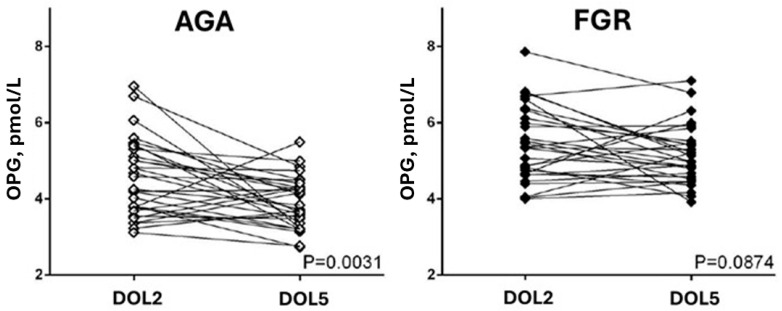 Figure 1
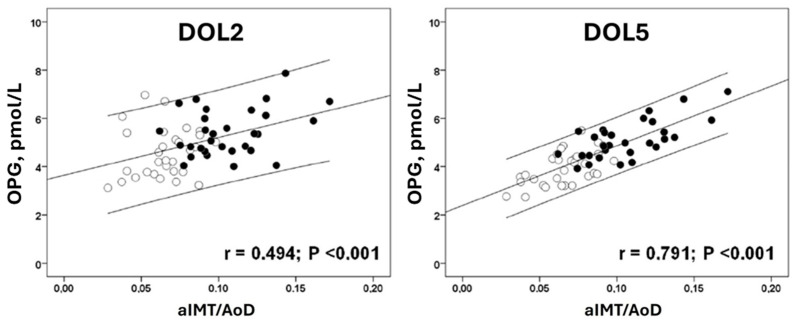 Figure 2
Peer Reviews
No public reviews on file for this paper yet. If you reviewed it on a platform where reviews are public (OpenReview, ICLR, NeurIPS, ICML), you can paste yours below so the community can read it here.
Videos
No videos yet. Explain this paper in a talk, walkthrough, or lecture? Add one.
Taxonomy
TopicsBone Metabolism and Diseases · Bone health and osteoporosis research · Preterm Birth and Chorioamnionitis