Rare Combination of Partial ARCAPA and Dual LAD: Insights into Complex Coronary Variants
Chiara Morelli, Francesca Troise, Alessia Spitaleri, Sterpeta Guerra, Nicola Maggialetti

TL;DR
A rare combination of two unusual heart artery structures was identified in a patient, offering insights into how such anomalies can coexist without causing symptoms.
Contribution
The paper presents a rare case of coexisting coronary artery anomalies that may explain an asymptomatic clinical presentation.
Findings
A patient had a type II double left anterior descending artery and a partial anomalous origin from the pulmonary artery.
The combination of these anomalies may have limited ischemic burden, resulting in an asymptomatic state.
The case emphasizes the importance of recognizing rare coronary anatomies for accurate diagnosis.
Abstract
This case report highlights the coexistence of two rare coronary artery anomalies assessed by computed coronary tomography angiography (CCTA). We present the case of a 51-year-old hypertensive patient with a type II double left anterior descending artery (LAD) and an anomalous infundibular branch originating from the pulmonary artery (partial ARCAPA). This association may have contributed to a limited ischemic burden, explaining the patient’s asymptomatic state. Knowledge of these rare coronary anatomies is essential for accurate diagnosis and management.
Genes, proteins, chemicals, diseases, species, mutations and cell lines named across the full text — each resolved to its canonical identifier and authoritative record.
Click any figure to enlarge with its caption.
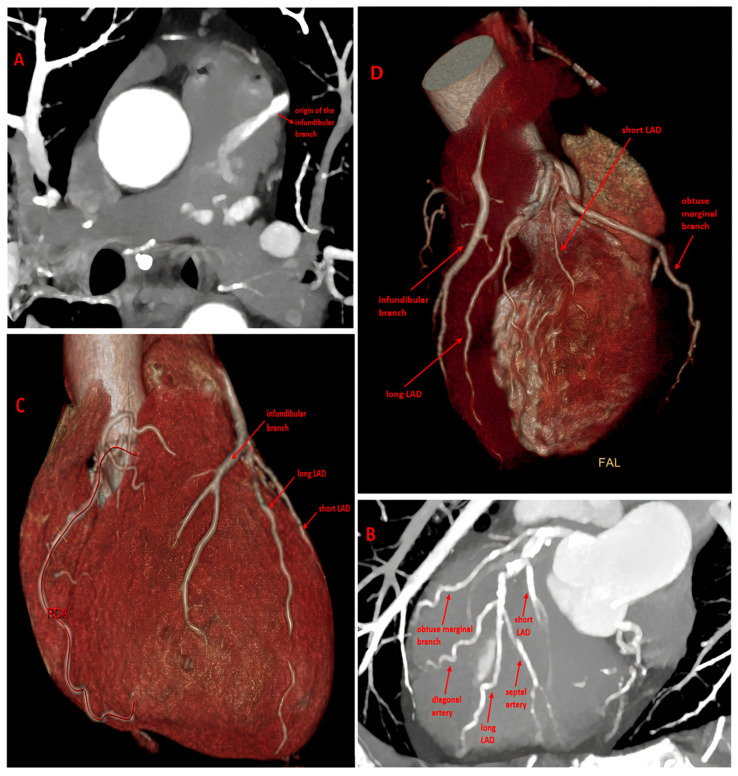 Figure 1
Peer Reviews
No public reviews on file for this paper yet. If you reviewed it on a platform where reviews are public (OpenReview, ICLR, NeurIPS, ICML), you can paste yours below so the community can read it here.
Videos
No videos yet. Explain this paper in a talk, walkthrough, or lecture? Add one.
Taxonomy
TopicsCoronary Artery Anomalies · Cardiovascular Issues in Pregnancy · Congenital Heart Disease Studies