Embedding Clinical Reasoning into an Undergraduate Medical Curriculum: A Multi-Stakeholder Perspective
Martine Chamberland, Isabelle Boulais, Jean Setrakian, Linda Bergeron, Tim Dubé

TL;DR
This study explores how a clinical reasoning curriculum was experienced by students and educators in an undergraduate medical program.
Contribution
The study provides empirical insights into the implementation and impact of a deliberately designed clinical reasoning curriculum.
Findings
Stakeholders identified global coherence and interdisciplinary integration as key factors in clinical reasoning development.
Cognitive load and time constraints were significant challenges for students.
Active teaching methods were found to promote clinical reasoning skills.
Abstract
Medical educators agree on the importance of teaching clinical reasoning (CR) at the undergraduate level with a deliberate curricular approach. Despite recent recommendations on how to reach this objective, there are limited empirical data on how it unfolds once implemented. This study advanced the understanding of how a deliberately designed CR curriculum was experienced and contributed to students’ CR development. Our study sought to add to the conversation on undergraduate CR curricula by providing data that could be relevant and applicable across other learning contexts. We conducted a qualitative descriptive study in the context of a competency-based medical program that is interdisciplinary, with spiral integration. Through nine focus groups, we sought the experience of curriculum designers, teachers, and students on how the CR curriculum embedded into the program contributes to…
Click any figure to enlarge with its caption.
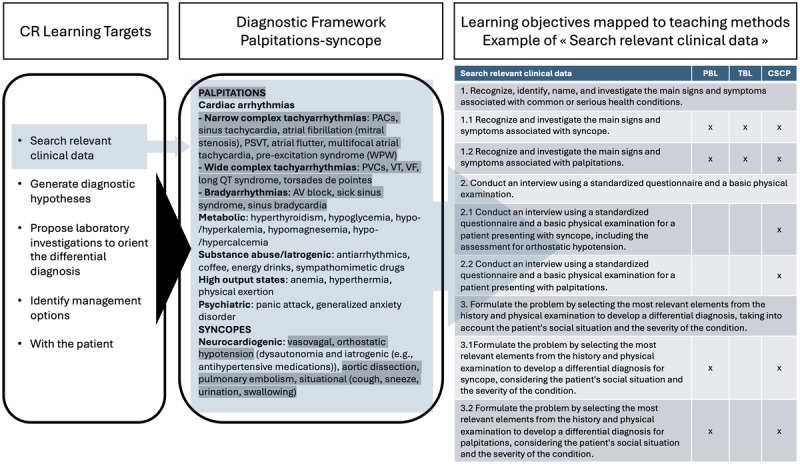 Figure 1
Peer Reviews
No public reviews on file for this paper yet. If you reviewed it on a platform where reviews are public (OpenReview, ICLR, NeurIPS, ICML), you can paste yours below so the community can read it here.
Videos
No videos yet. Explain this paper in a talk, walkthrough, or lecture? Add one.
Taxonomy
TopicsClinical Reasoning and Diagnostic Skills · Innovations in Medical Education · Simulation-Based Education in Healthcare