Certified Private Relational Time from Entanglement
Karl Svozil

TL;DR
The paper introduces a quantum method to define time using entangled particles, showing that relational time can be certified as private and unpredictable.
Contribution
The novel contribution is the concept of 'Certified Private Time' derived from quantum entanglement and Bell tests.
Findings
Quantum predictions for coincidence tick rates exceed classical benchmarks by up to 13.6% at specific angles.
Relational time-stamp records can be certified as private and unpredictable using Bell tests.
Abstract
We introduce an “entangled clock” in which time is defined operationally by discrete measurement registrations on a singlet state. Locally, each party’s tick rate is fixed by the unbiased marginals. The nontrivial resource is the relational (coincidence-tick) stream: because the singlet’s information budget is entirely exhausted by joint properties, the only definite temporal structure resides in the correlations between the two parties. Operationally, after exchanging time tags and outcomes, Alice and Bob identify synchronized events (that is, the ++ channel) and thereby obtain a joint tick record. Comparing the ++ coincidence rate R(θ)=P++(a→,b→) to Peres’ isotropic bomb-fragment local-hidden-variable model (yielding Rcl(θ)=θ/(2π)), we find that for obtuse analyzer separations the quantum prediction exceeds this natural classical benchmark, with a maximal relative excess of about…
Click any figure to enlarge with its caption.
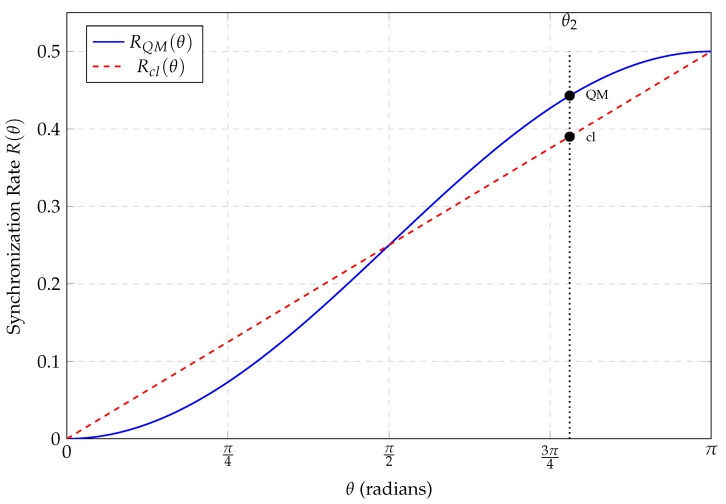 Figure 1
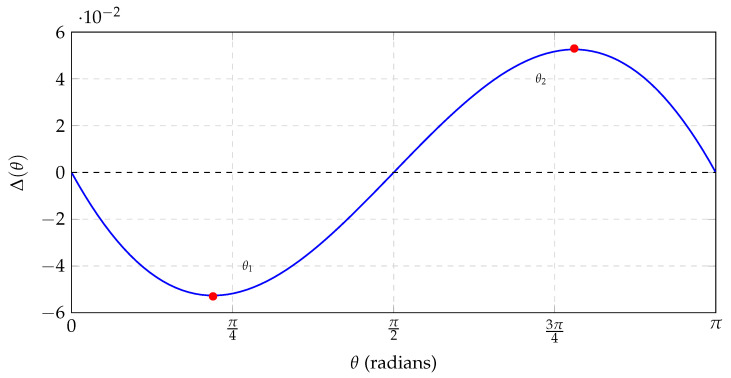 Figure 2
Peer Reviews
No public reviews on file for this paper yet. If you reviewed it on a platform where reviews are public (OpenReview, ICLR, NeurIPS, ICML), you can paste yours below so the community can read it here.
Videos
No videos yet. Explain this paper in a talk, walkthrough, or lecture? Add one.
Taxonomy
TopicsQuantum Mechanics and Applications · Quantum Information and Cryptography · Quantum Computing Algorithms and Architecture