An Information-Theoretic Analysis of High-Frequency Load Disaggregation
Gabriel Arquelau Pimenta Rodrigues, André Luiz Marques Serrano, Geraldo Pereira Rocha Filho, Vinícius Pereira Gonçalves, Rodolfo Ipolito Meneguette

TL;DR
This paper uses information theory to analyze how well different appliances can be identified from combined power signals, showing that mutual information predicts how accurately appliances can be detected.
Contribution
The paper introduces an information-theoretic framework to quantify appliance observability and disaggregation difficulty in high-frequency NILM.
Findings
Appliances with high mutual information, like hair dryers, have lower estimation errors in disaggregation.
Conditional mutual information reveals asymmetric masking effects, with laptop chargers being dominant interferers.
Normalized mutual information strongly correlates with disaggregation error (Spearman rs=−0.81, p=0.015).
Abstract
High-frequency non-intrusive load monitoring provides detailed harmonic information for appliances’ power disaggregation, and machine-learning approaches have demonstrated good performance in this task. However, these methods provide little transparency regarding the information structure of the aggregate signal. To address this, this paper models NILM as a coding-decoding process and applies information-theoretic measures to quantify uncertainty, recoverability, temporal contribution, and inter-appliance masking effects in aggregate signals. In the analyzed dataset, transfer entropy suggests negligible temporal gains, which is consistent with the observed effectiveness of pointwise models such as Random Forest. Moreover, conditional mutual information emphasizes the asymmetric masking relationships between appliances, with the laptop charger acting as a dominant interferer in the…
Genes, proteins, chemicals, diseases, species, mutations and cell lines named across the full text — each resolved to its canonical identifier and authoritative record.
Click any figure to enlarge with its caption.
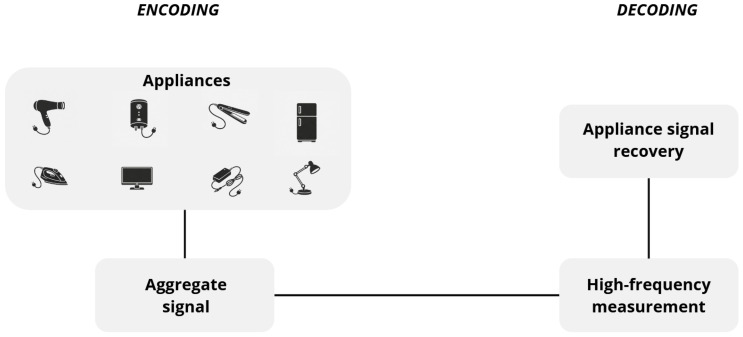 Figure 1
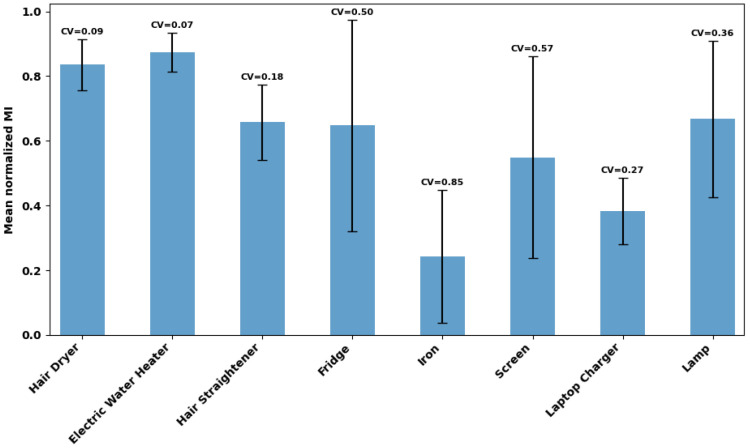 Figure 2
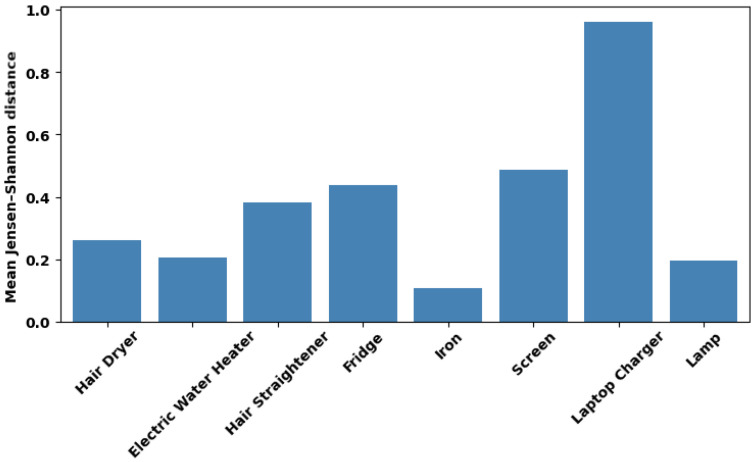 Figure 3
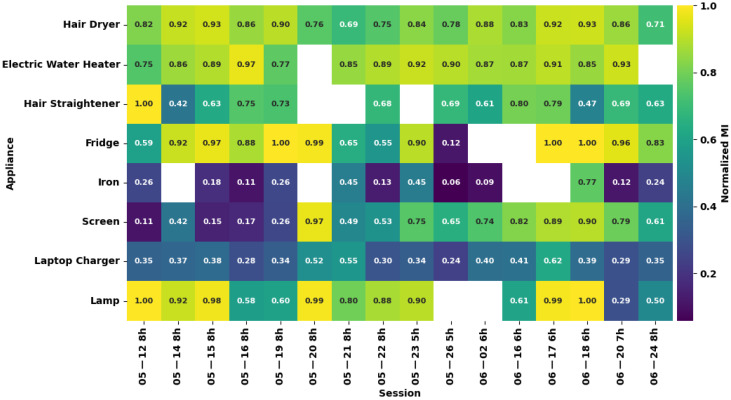 Figure 4
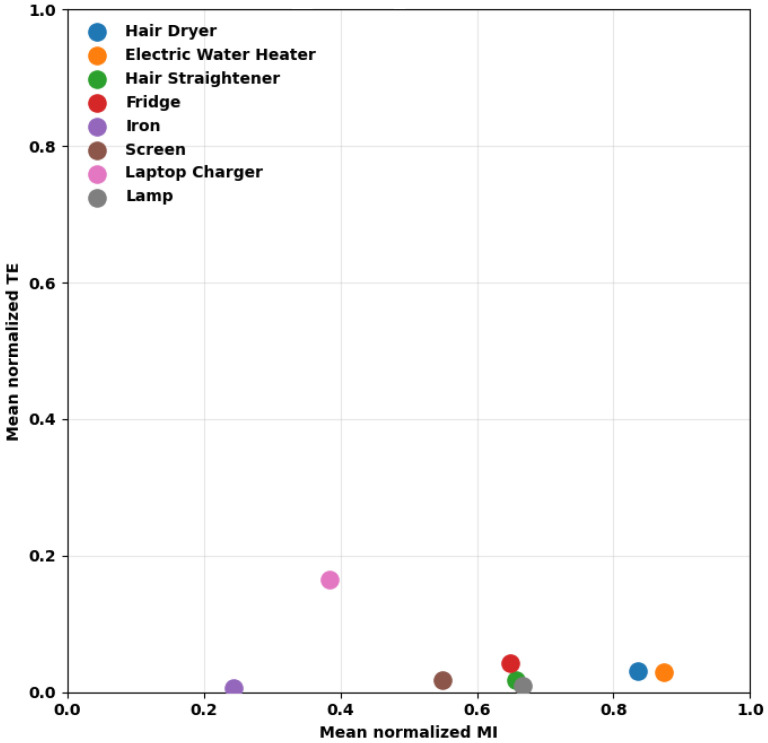 Figure 5
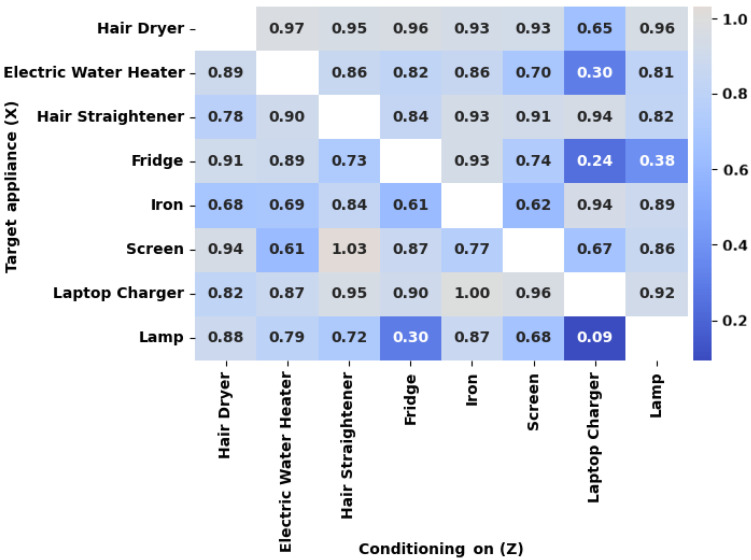 Figure 6
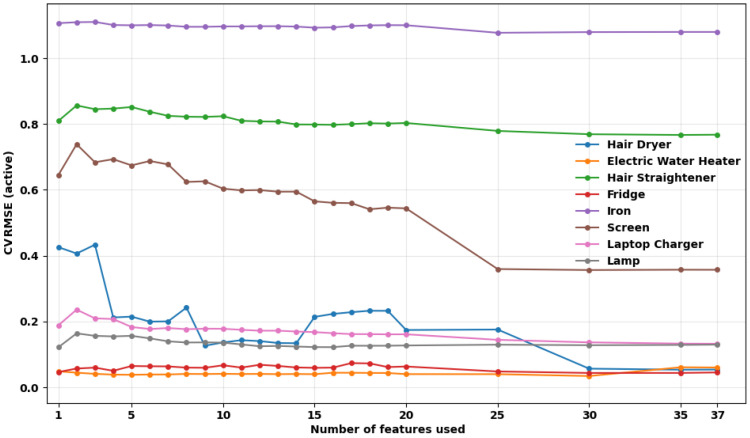 Figure 7
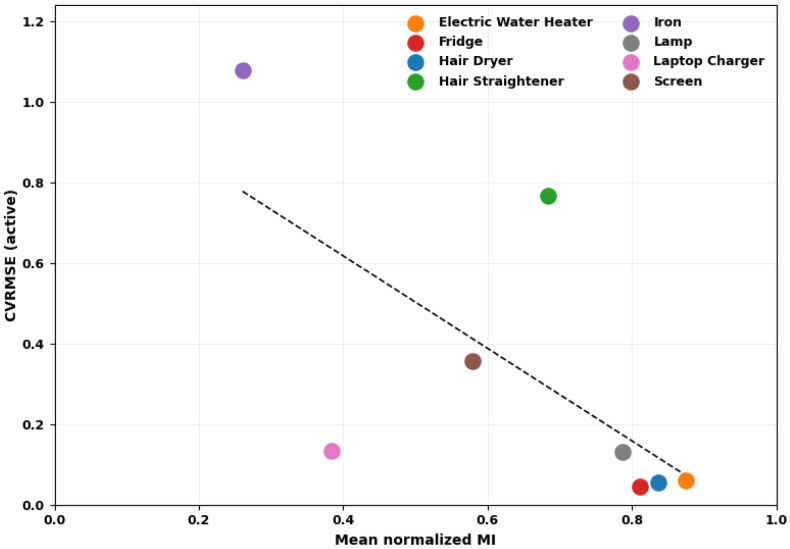 Figure 8
Peer Reviews
No public reviews on file for this paper yet. If you reviewed it on a platform where reviews are public (OpenReview, ICLR, NeurIPS, ICML), you can paste yours below so the community can read it here.
Videos
No videos yet. Explain this paper in a talk, walkthrough, or lecture? Add one.
Taxonomy
TopicsSmart Grid Energy Management · Advanced Battery Technologies Research · Building Energy and Comfort Optimization