Disability Community Perspectives on Participation in Research and Studying Positive Health
Melissa M. Murphy, Judy L. Aschner, Paige S. Ryals, Ana Joselyn Barahona, Jennifer Lyman, Ashley Harris Whaley, Rachel Byrne, Nathalie L. Maitre

TL;DR
People with disabilities are underrepresented in health research despite supporting it, and redefining 'positive health' could improve their inclusion and the relevance of research outcomes.
Contribution
The paper presents a roadmap for redefining positive health outcomes and improving disability inclusion in research through stakeholder perspectives.
Findings
Only about 25% of people with disabilities participate in non-disability-specific research.
Up to 30% of disability stakeholders report being excluded from research due to their disability.
Disability stakeholders emphasize the need to reframe positive health outcomes to better align with childhood-onset disability contexts.
Abstract
What are the main findings? Despite >80% of people with lived experience of disability endorsing health outcomes research, only about a quarter (1/4) of people report participating in non-disability-specific research and about a quarter (1/4) to a third (1/3) report having been excluded from research because of a disability.Conceptualizations of positive health outcomes that include “absence of disease” need to be reframed in a way that accounts for childhood-onset disability—i.e., biological impairments/conditions that alter one’s power and capacity to act in the world. Despite >80% of people with lived experience of disability endorsing health outcomes research, only about a quarter (1/4) of people report participating in non-disability-specific research and about a quarter (1/4) to a third (1/3) report having been excluded from research because of a disability. Conceptualizations…
Genes, proteins, chemicals, diseases, species, mutations and cell lines named across the full text — each resolved to its canonical identifier and authoritative record.
Click any figure to enlarge with its caption.
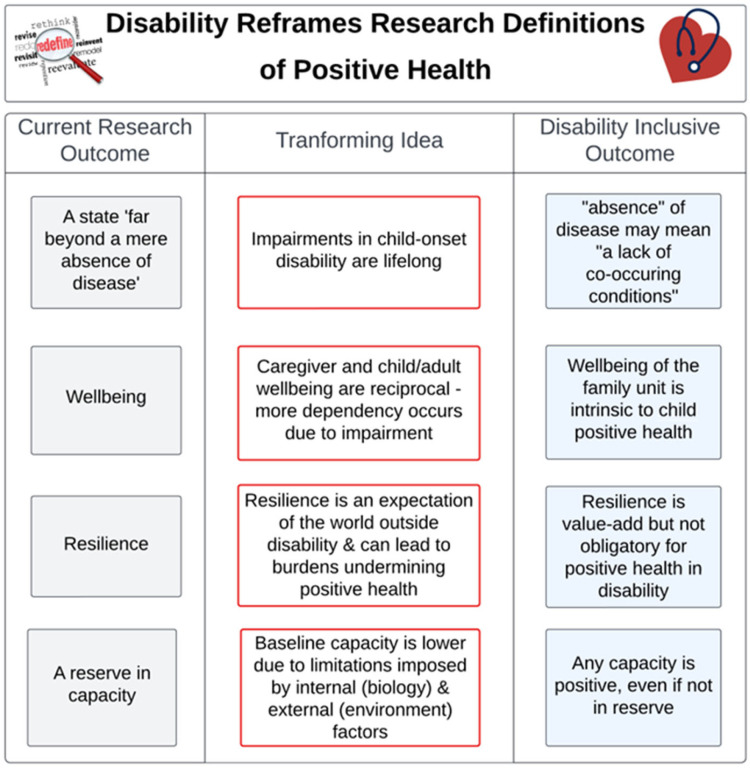 Figure 1
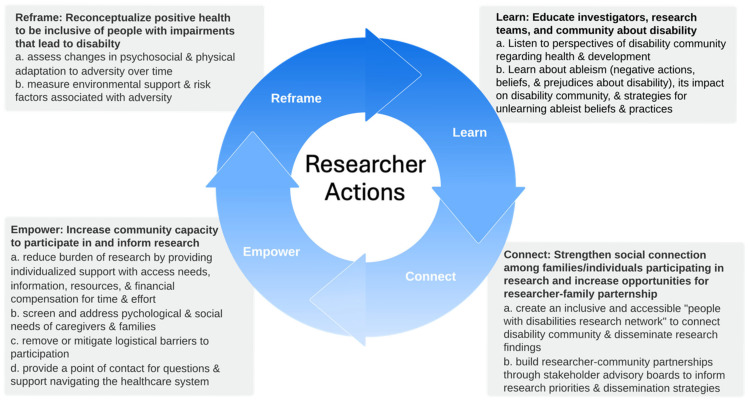 Figure 2
Peer Reviews
No public reviews on file for this paper yet. If you reviewed it on a platform where reviews are public (OpenReview, ICLR, NeurIPS, ICML), you can paste yours below so the community can read it here.
Videos
No videos yet. Explain this paper in a talk, walkthrough, or lecture? Add one.
Taxonomy
TopicsCerebral Palsy and Movement Disorders · Disability Rights and Representation · Down syndrome and intellectual disability research