Molecular and Microenvironmental Mechanisms of Malignant Transformation in Benign Salivary Gland Tumors: Implications for Oral Squamous Cell Carcinoma
Panagiotis Giasimakopoulos, Danai Mylona, Aggelos Diafas, Ioannis Stamoulopoulos, Konstantinos Markou

TL;DR
This paper reviews how benign salivary gland tumors can turn cancerous, highlighting shared mechanisms with oral squamous cell carcinoma that could improve diagnosis and treatment.
Contribution
The paper provides a comprehensive review of molecular and microenvironmental mechanisms linking benign salivary gland tumors to malignant transformation and oral squamous cell carcinoma.
Findings
Recurrent genetic alterations like PLAG1, HMGA2, TP53, and ERBB2 are associated with malignant transformation.
Epigenetic changes, including CpG island hypermethylation, contribute to tumor progression.
Angiogenesis and a 'cold' immune microenvironment are key features in tumor development.
Abstract
Malignant transformation of benign salivary gland tumors represents a critical biological process that provides valuable insights into head and neck carcinogenesis, with potential implications for oral squamous cell carcinoma (OSCC). Understanding the molecular, epigenetic, and microenvironmental mechanisms underlying this transition is essential for improving early diagnosis, risk stratification, and personalized management strategies. This study presents a comprehensive narrative review of the current literature focusing on benign salivary gland tumors with malignant potential, particularly pleomorphic adenoma and carcinoma ex pleomorphic adenoma, emphasizing molecular alterations, angiogenesis, and tumor microenvironment dynamics. A structured literature search was conducted across major biomedical databases, including PubMed and Scopus, selecting studies that addressed genetic…
Genes, proteins, chemicals, diseases, species, mutations and cell lines named across the full text — each resolved to its canonical identifier and authoritative record.
Click any figure to enlarge with its caption.
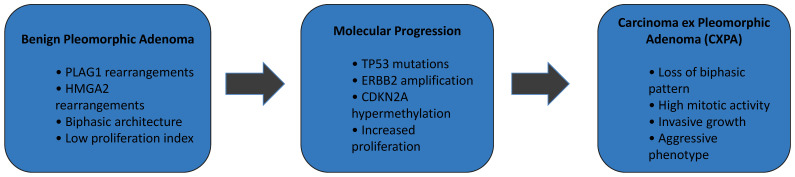 Figure 1
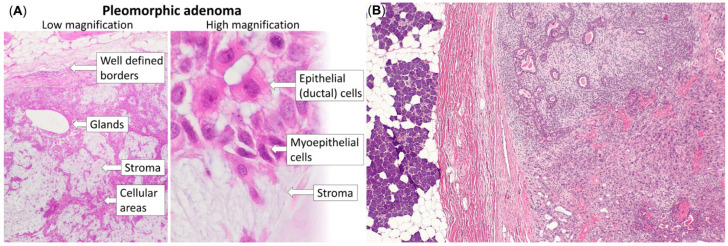 Figure 2
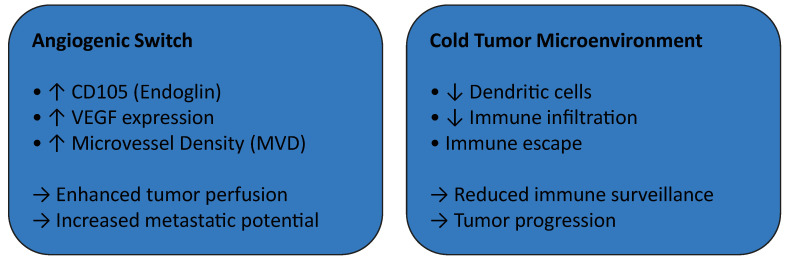 Figure 3
 Figure 4
Peer Reviews
No public reviews on file for this paper yet. If you reviewed it on a platform where reviews are public (OpenReview, ICLR, NeurIPS, ICML), you can paste yours below so the community can read it here.
Videos
No videos yet. Explain this paper in a talk, walkthrough, or lecture? Add one.
Taxonomy
TopicsSalivary Gland Tumors Diagnosis and Treatment · Salivary Gland Disorders and Functions · Head and Neck Cancer Studies