Safety and Pharmacokinetics of Nirsevimab in Japanese Infants: Primary Analysis of the Open-Label JUBILUS Trial
Masaaki Mori, Susannah Leach, Maria Learoyd, Divya Vijapur, Sam Sadow, Deidre Wilkins, Yoshifusa Abe, Kazushige Ikeda, Hirokazu Kanegane, Zempei Kano, Hiroyuki Moriuchi, Jun Muneuchi, Ryuta Nishikomori, Kaoru Okazaki, Therese Takas, Ayako Sakaguchi, Tonya Villafana

TL;DR
A study found that nirsevimab is safe and effective in Japanese infants at risk for severe respiratory infections.
Contribution
The study confirms nirsevimab's safety and pharmacokinetic profile in Japanese infants, supporting its use in this population.
Findings
Nirsevimab was well-tolerated with no safety concerns observed in Japanese infants.
Serum concentrations of nirsevimab were consistent with previously established efficacy levels.
Abstract
In Japanese infants aged ≤12 months at risk for severe respiratory syncytial virus-associated lower respiratory tract infections who received two doses of nirsevimab 5–6 months apart, no safety concerns or anti-drug antibodies occurred. Nirsevimab serum concentrations were consistent with those previously demonstrated to be efficacious in healthy preterm and term infants.
Genes, proteins, chemicals, diseases, species, mutations and cell lines named across the full text — each resolved to its canonical identifier and authoritative record.
Click any figure to enlarge with its caption.
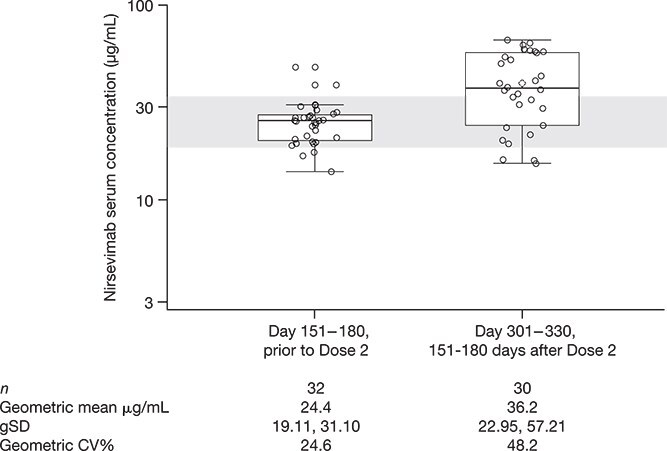 Figure 1
Peer Reviews
No public reviews on file for this paper yet. If you reviewed it on a platform where reviews are public (OpenReview, ICLR, NeurIPS, ICML), you can paste yours below so the community can read it here.
Videos
No videos yet. Explain this paper in a talk, walkthrough, or lecture? Add one.
Taxonomy
TopicsRespiratory viral infections research · Pharmaceutical studies and practices · Immunodeficiency and Autoimmune Disorders