Cerebrovascular Reactivity Assessment with Breath-Hold Functional MRI in Patients with Moyamoya Angiopathy: Which Time Period to Analyze?
Leonie Zerweck, Uwe Klose, Constantin Roder, Nadia Khan, Philipp T. Meyer, Ulrike Ernemann, Till-Karsten Hauser

TL;DR
This study finds that using short time periods during breath-hold fMRI improves the accuracy of cerebrovascular reactivity assessments in Moyamoya Angiopathy patients.
Contribution
The study identifies optimal time periods for analyzing breath-hold fMRI data to improve agreement with PET scans in Moyamoya Angiopathy.
Findings
Short time periods (±0s and ±1s) showed the highest agreement between bh-fMRI and [15O]water PET.
Agreement was significantly higher for short time periods compared to longer ones (≥ ±2s).
Inter-rater agreement was almost perfect for most time periods, except TPcereb.max ±1s.
Abstract
Background/Objectives: Quantifying cerebrovascular reactivity (CVR) is essential for stroke risk assessment in patients with Moyamoya Angiopathy (MMA). Breath-hold functional MRI (bh-fMRI) is an easily implementable method to assess CVR. Determining the optimal time period of the BOLD signal for analyzing the best bh-fMRI data quality remains an open question. Methods: A retrospective analysis of 46 bh-fMRI data sets of MMA patients was conducted. The percentage BOLD signal changes were evaluated at different time periods (time point of the maximum cerebellar signal peak (TPcereb. max) ± 0 s, TPcereb. max ± 1 s, TPcereb. max ± 2 s, TPcereb. max ± 3 s, TPcereb. max ± 4 s, TPcereb. max ± 5 s). The agreement between the bh-fMRI maps and [15O]water PET maps was independently and consensually rated on a 4-point Likert scale (1 = poor, 2 = moderate, 3 = good, 4 = excellent) and compared with…
Genes, proteins, chemicals, diseases, species, mutations and cell lines named across the full text — each resolved to its canonical identifier and authoritative record.
Click any figure to enlarge with its caption.
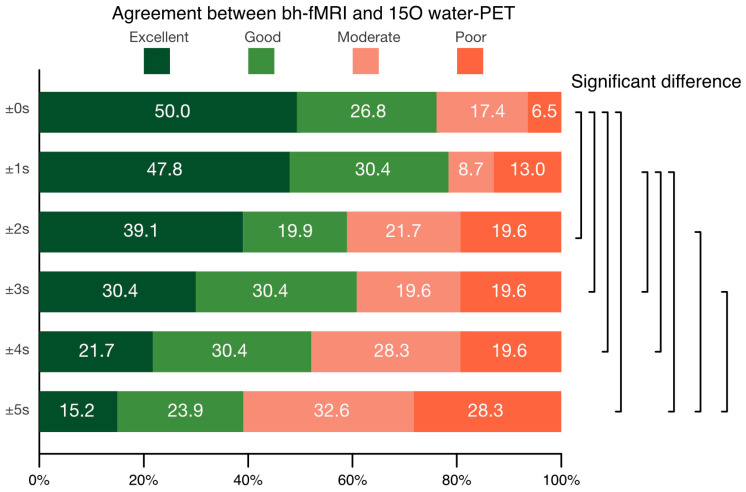 Figure 1
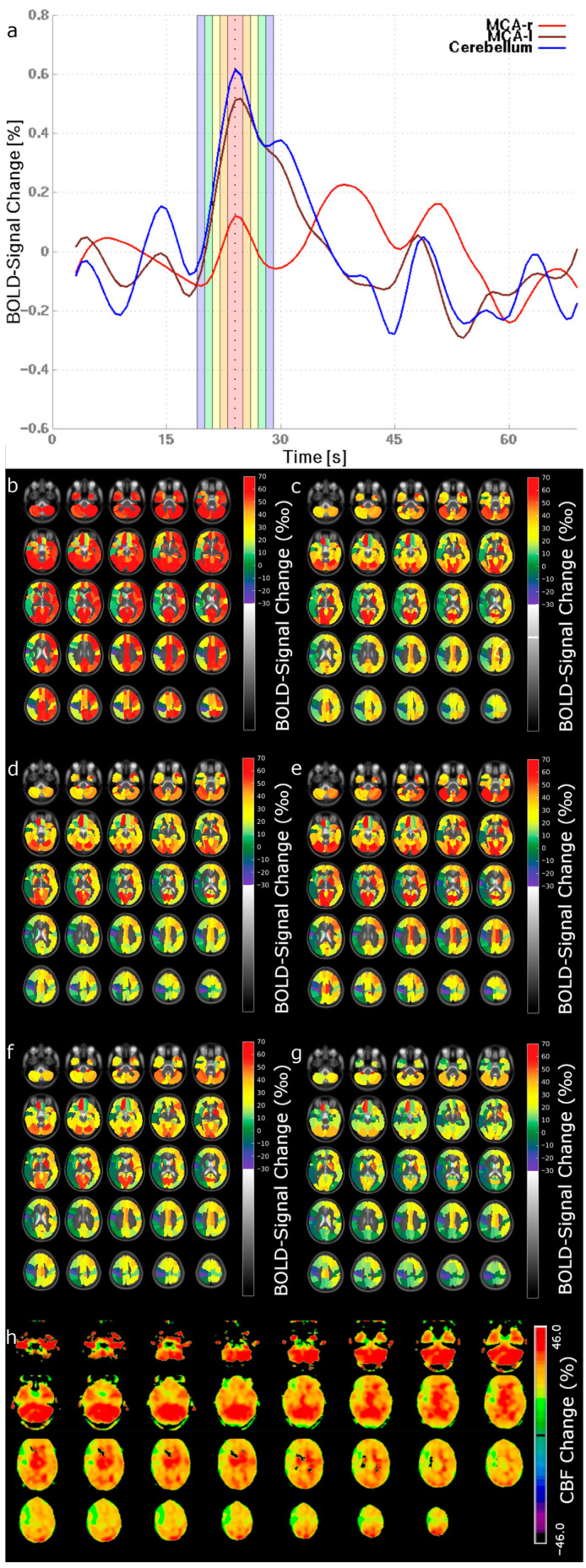 Figure 2
Peer Reviews
No public reviews on file for this paper yet. If you reviewed it on a platform where reviews are public (OpenReview, ICLR, NeurIPS, ICML), you can paste yours below so the community can read it here.
Videos
No videos yet. Explain this paper in a talk, walkthrough, or lecture? Add one.
Taxonomy
TopicsMoyamoya disease diagnosis and treatment · Advanced MRI Techniques and Applications · Neurological and metabolic disorders