ABR Features in Ski-Slope Hearing Loss for Hearing Threshold Estimation: A Comparative Clinical Study of Click and CE-Chirp Stimuli
Davide Brotto, Giuseppe Impalà, Elisa Lovato, Elena Mazzaro, Marco Maculan, Elisabetta Zanoletti, Nicole Galoforo, Patrizia Trevisi

TL;DR
This study compares click and CE-Chirp stimuli for estimating hearing thresholds in adults and children with ski-sloping hearing loss, finding that CE-Chirp offers better threshold estimation and neural synchrony.
Contribution
The study provides new insights into the performance of CE-Chirp versus click stimuli in ski-sloping hearing loss, particularly in pediatric populations.
Findings
CE-Chirp stimulation yields lower ABR thresholds and stronger correlations with behavioral audiometric measures in adults with ski-sloping hearing loss.
CE-Chirp is associated with shorter wave V latencies and larger amplitudes in hearing-impaired children.
Discrepancies between click- and CE-Chirp-derived thresholds may require frequency-specific assessments for accurate diagnosis.
Abstract
Background: Auditory brainstem responses (ABRs) are widely used for objective hearing threshold estimation in both adults and children. Click and CE-Chirp stimuli differ substantially in cochlear activation and neural synchrony, yet their relative performance in patients with ski-sloping hearing loss remains insufficiently characterized, particularly with regard to pediatric diagnostic implications. Methods: This study compared ABRs elicited by click and CE-Chirp stimuli in adults with ski-sloping sensorineural hearing loss. The same comparison was also performed in a pediatric cohort including hearing-impaired and normal-hearing children. Adult subjects were further stratified according to audiometric configuration (DROP 1 kHz vs. DROP 2 kHz). ABR thresholds, wave V latency, amplitude, and detectability were analyzed across stimulus types and intensity levels. Associations between ABR…
Genes, proteins, chemicals, diseases, species, mutations and cell lines named across the full text — each resolved to its canonical identifier and authoritative record.
Click any figure to enlarge with its caption.
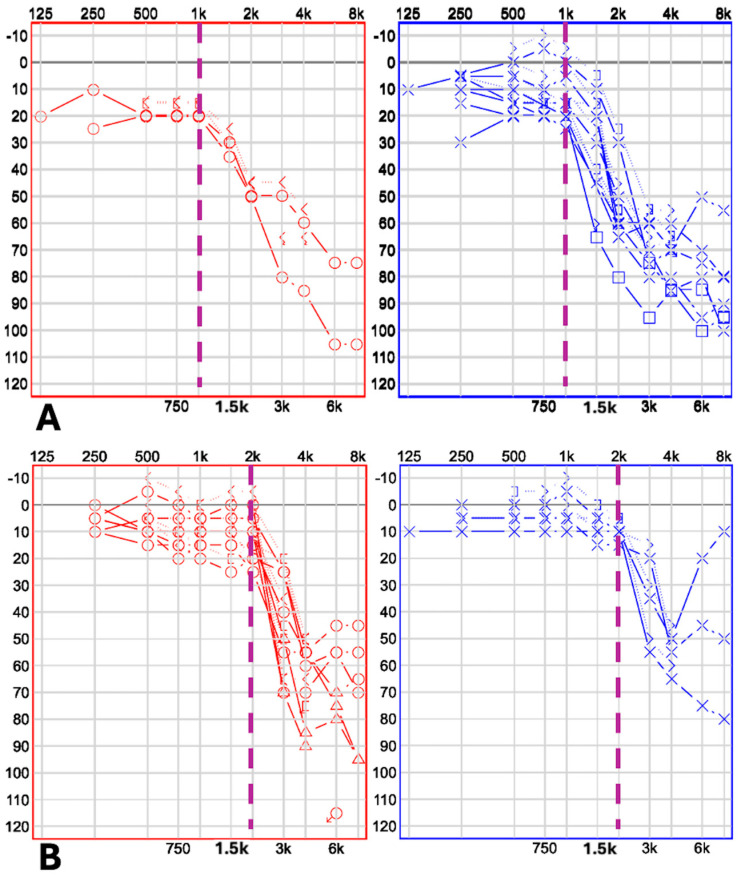 Figure 1
Peer Reviews
No public reviews on file for this paper yet. If you reviewed it on a platform where reviews are public (OpenReview, ICLR, NeurIPS, ICML), you can paste yours below so the community can read it here.
Videos
No videos yet. Explain this paper in a talk, walkthrough, or lecture? Add one.
Taxonomy
TopicsHearing, Cochlea, Tinnitus, Genetics · Vestibular and auditory disorders · Hearing Loss and Rehabilitation