Formulation and Characterization of Edible Bigel Inks for Structuring Fat Alternatives in 3D-Printed Foods
Konstantina Zampouni, Theocharis Salamandrakis, Triantafyllia Biza, Thomas Moschakis, Eugenios Katsanidis

TL;DR
Researchers developed edible bigel inks for 3D food printing that can mimic fat structures while reducing fat content.
Contribution
The study introduces tunable, fat-reduced bigel inks with improved printability and shape fidelity for 3D food applications.
Findings
Bigel inks with 50:50 OG:HG ratios showed bicontinuous structures and optimal viscoelastic properties for printing.
Intermediate OG content in BG inks resulted in moderate extrusion forces and improved structural recovery (up to ≈60%).
Thermal analysis confirmed phase coexistence and structural integrity at printing temperatures.
Abstract
Bigels (BGs) are promising biphasic systems for extrusion-based 3D food printing inks. In this study, BG inks were formulated by combining a 6% beeswax—4% monoglycerides oleogel (OG) with a 4% gelatin—1% guar gum hydrogel (HG). The BGs were formulated at OG:HG ratios of 10:90 up to 50:50. The effect of the OG:HG ratio on appearance, microstructure, extrusion, rheological and thermal characteristics was investigated to assess printability and shape fidelity. All formulations showed no signs of phase separation during storage, while changes in color were observed with increasing OG content, suggesting modifications in phase distribution and light-scattering behavior. Increasing the OG content induced a transition from OG-in-HG systems to a bicontinuous structure at a 50:50 ratio. All inks showed shear-thinning behavior (G′ > G″) and viscoelastic properties suitable for 3D printing. BG…
Genes, proteins, chemicals, diseases, species, mutations and cell lines named across the full text — each resolved to its canonical identifier and authoritative record.
Click any figure to enlarge with its caption.
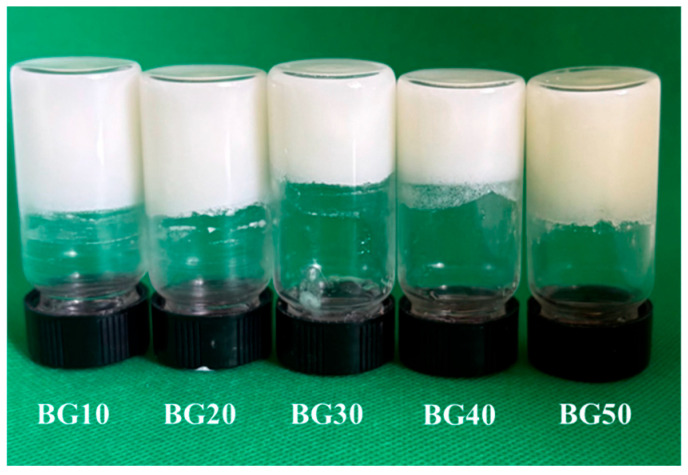 Figure 1
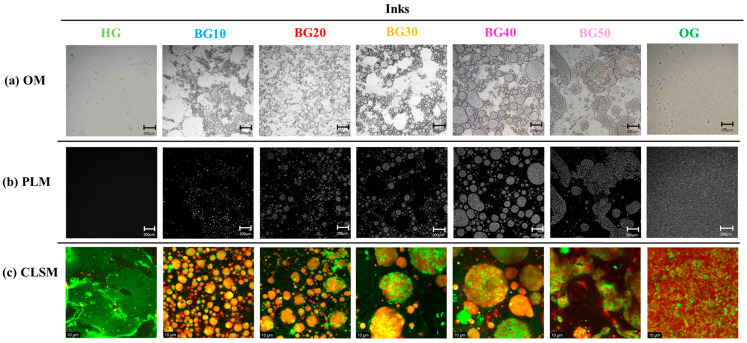 Figure 2
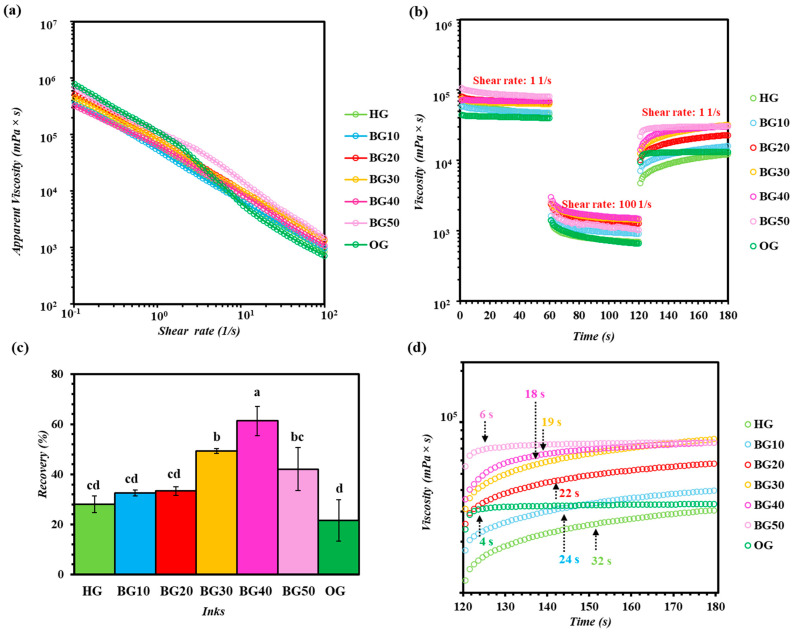 Figure 3
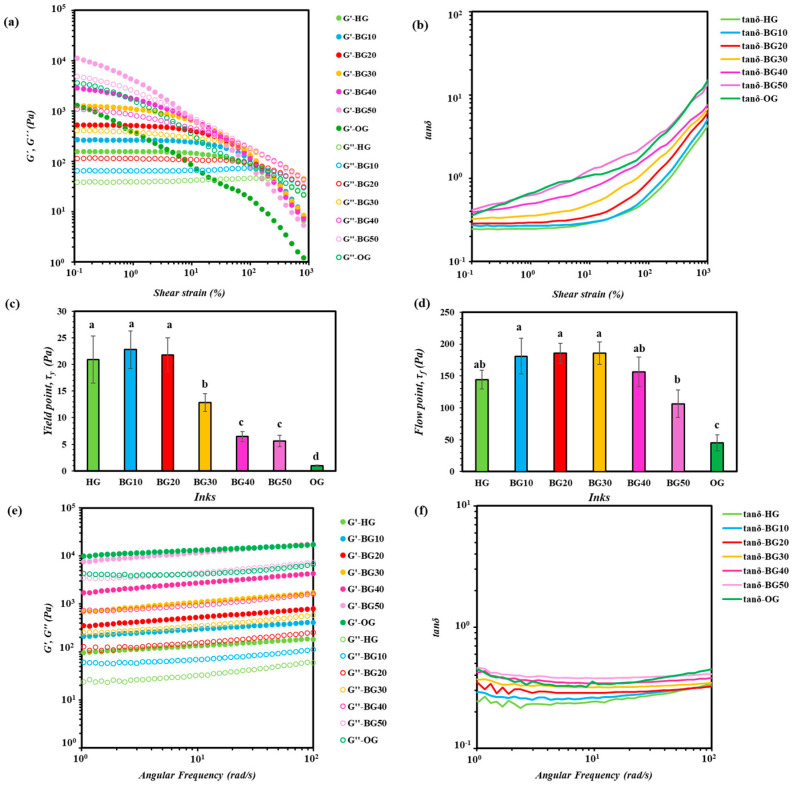 Figure 4
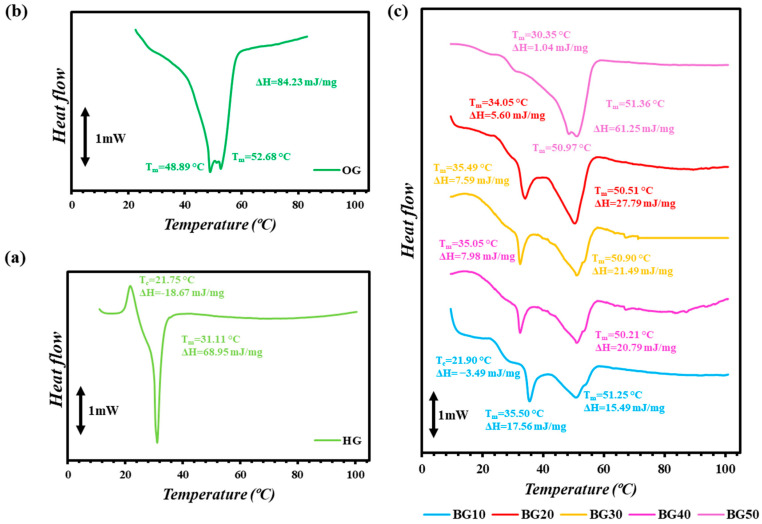 Figure 5
Peer Reviews
No public reviews on file for this paper yet. If you reviewed it on a platform where reviews are public (OpenReview, ICLR, NeurIPS, ICML), you can paste yours below so the community can read it here.
Videos
No videos yet. Explain this paper in a talk, walkthrough, or lecture? Add one.
Taxonomy
Topics3D Printing in Biomedical Research · Food Chemistry and Fat Analysis · Nanocomposite Films for Food Packaging