Opportunistic and Organized Cervical Cancer Screening: Impact on Lesion Severity and Surgical Outcomes in 9830 Cervical Conizations
Mario Preti, Niccolò Gallio, Silvano Costa, Fulvio Borella, Paola Armaroli, Pedro Vieira-Baptista, Federica Zamagni, Federica Bevilacqua, Paola Garutti, Daniele Tota, Eleonora Robba, Ilaria Barbierato, Benedetta Pollano, Samuel Joseph Gardner-Medwin, Sara Babich

TL;DR
Organized cervical cancer screening detects severe lesions earlier and reduces invasive cancer risk compared to opportunistic screening.
Contribution
This study demonstrates that organized screening significantly lowers invasive cancer rates and reduces the severity of cervical lesions compared to opportunistic screening.
Findings
Organized screening patients had a 1.1% invasive cancer rate versus 2.7% in opportunistic screening.
HPV-based screening in organized models detected smaller high-grade lesions than cytology-based methods.
Organized screening was associated with a two-fold lower risk of invasive cancer compared to opportunistic screening.
Abstract
Objectives: To assess the impact of organized (OgS) versus opportunistic screening (OpS) on grade, extent, and surgical management of cervical lesions, and to evaluate human papillomavirus (HPV)-based versus cytology-based screening within OgS. Methods: This retrospective study analyzed 9830 women undergoing conization (1992–2021). Data included screening modality, histology, cervical intraepithelial neoplasia grade 3 (CIN3) linear extension, and cone volume. Statistical analysis employed chi-square test, Student’s t-tests, Cochran–Armitage test for trend, and Firth’s penalized multivariate logistic regression to identify independent predictors of invasive disease. Results: Of 9830 patients, 5097 (52%) were referred from OgS and 4733 (48%) from OpS. OgS patients were significantly older (40.0 vs. 37.0 years; p < 0.001). In the final decade, OgS achieved a significantly lower rate of…
Genes, proteins, chemicals, diseases, species, mutations and cell lines named across the full text — each resolved to its canonical identifier and authoritative record.
Click any figure to enlarge with its caption.
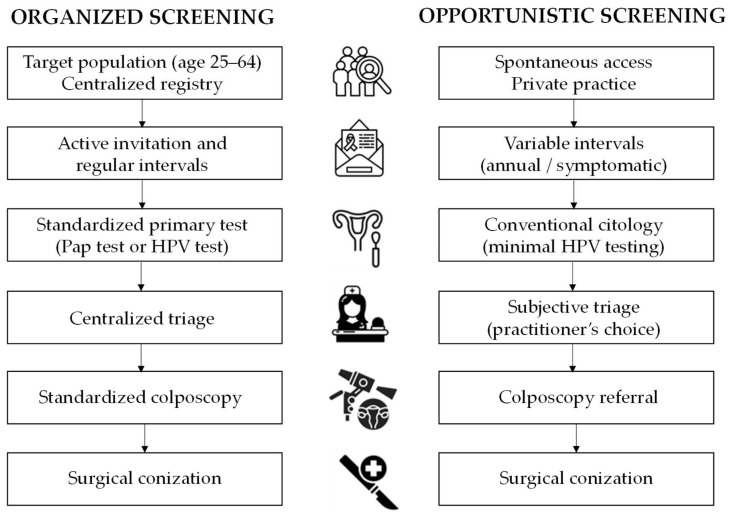 Figure 1
 Figure 2
 Figure 3
 Figure 4
 Figure 5
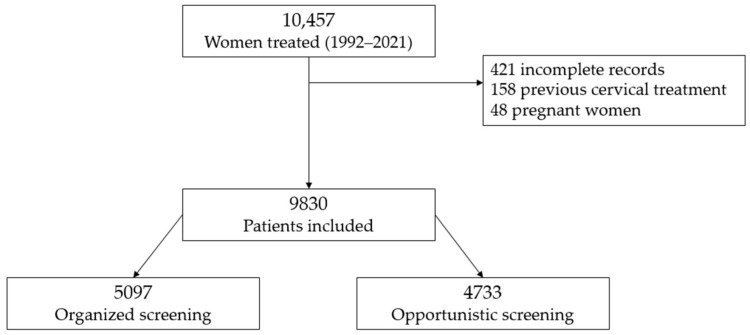 Figure 6
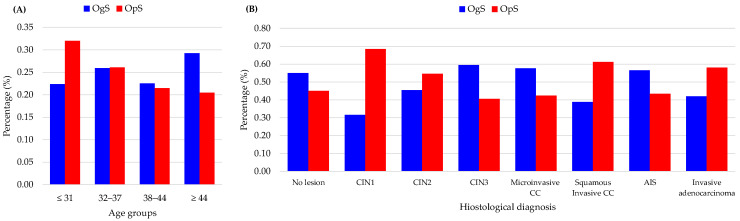 Figure 7
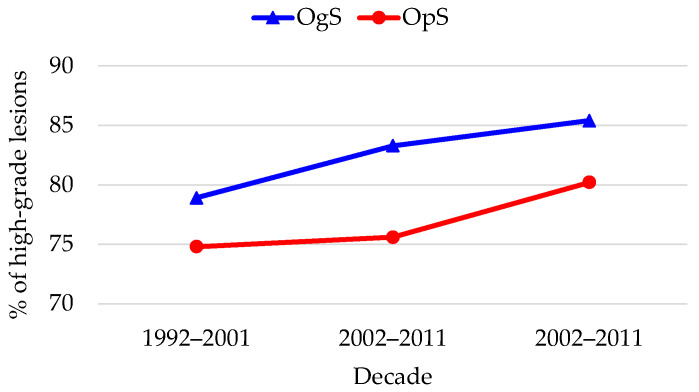 Figure 8
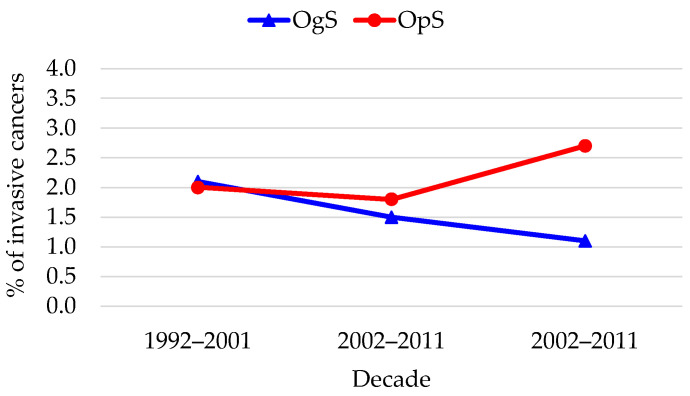 Figure 9
Peer Reviews
No public reviews on file for this paper yet. If you reviewed it on a platform where reviews are public (OpenReview, ICLR, NeurIPS, ICML), you can paste yours below so the community can read it here.
Videos
No videos yet. Explain this paper in a talk, walkthrough, or lecture? Add one.
Taxonomy
TopicsCervical Cancer and HPV Research · Endometrial and Cervical Cancer Treatments · Reproductive tract infections research