Understanding Acceptance of Genome-Edited Crops and Foods: The Role of Trust, Attitudes, and Perceived Literacy in Italy
Michele Paleologo, Alessandra Lanubile, Marco Camardo Leggieri, Paolo Gomarasca, Guendalina Graffigna

TL;DR
This study explores how trust, attitudes, and knowledge influence Italian consumers' willingness to buy genome-edited foods.
Contribution
It reveals that trust in science alone is insufficient and that perceived literacy moderates the relationship between trust and acceptance.
Findings
Trust in science predicts more favorable attitudes toward genome editing.
Attitudes strongly influence willingness to buy genome-edited foods.
Higher perceived literacy strengthens the negative effect of trust on willingness to buy.
Abstract
Genome-editing (GE) techniques are gaining relevance in the agri-food system for their potential to enhance crop resilience and sustainability, raising questions about consumer acceptance and responsible innovation. Understanding public willingness to buy (WTB) GE foods is therefore essential. While trust in science is often cited as a key driver, its effects are not straightforward. This study examines mechanisms linking trust in science to WTB GE foods, testing the mediating role of attitudes and the moderating role of perceived literacy. A cross-sectional online survey was conducted with a representative sample of Italian adults. Using structural equation modelling, we tested three models: a mediation model, a model including a direct path between trust and WTB, and a moderated model incorporating perceived literacy. Trust predicted more favourable attitudes toward GE, and attitudes…
Click any figure to enlarge with its caption.
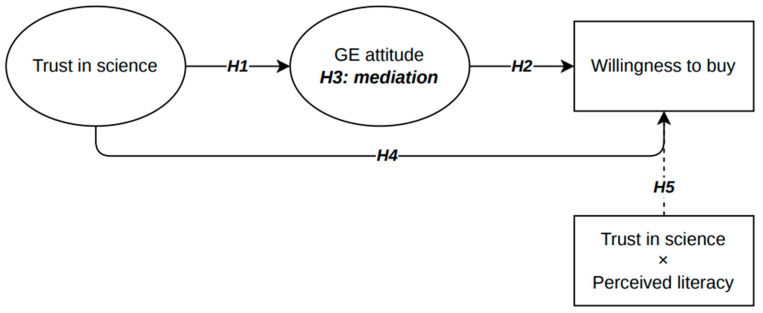 Figure 1
 Figure 2
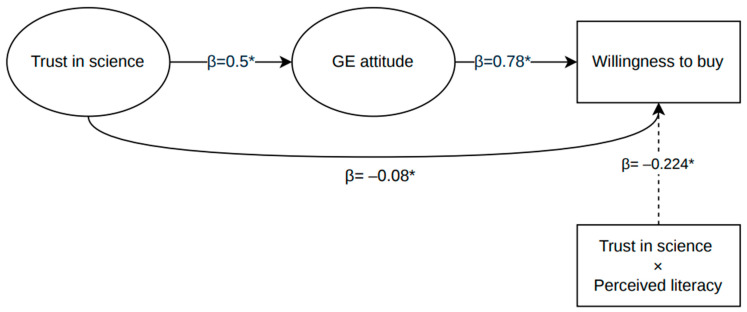 Figure 3
Peer Reviews
No public reviews on file for this paper yet. If you reviewed it on a platform where reviews are public (OpenReview, ICLR, NeurIPS, ICML), you can paste yours below so the community can read it here.
Videos
No videos yet. Explain this paper in a talk, walkthrough, or lecture? Add one.
Taxonomy
TopicsGenetically Modified Organisms Research · CRISPR and Genetic Engineering · Organic Food and Agriculture