Tail-Latency-Aware Federated Learning with Pinching Antenna: Latency, Participation, and Placement
Yushen Lin, Zhiguo Ding

TL;DR
This paper introduces a new approach to reduce delays in wireless federated learning by optimizing antenna placement and client participation.
Contribution
The paper introduces a novel framework combining PA placement and client sampling to minimize time-to-accuracy in FL.
Findings
Optimizing PA placement and client participation reduces synchronization delays in FL.
A two-class phase transition occurs where slow clients stop participating under high heterogeneity.
Simulation results confirm the effectiveness of the proposed method in improving wall-clock accuracy.
Abstract
Straggler synchronization is a dominant wall-clock bottleneck in synchronous wireless federated learning (FL). Under non-IID data, however, aggressively sampling only fast clients may significantly slow convergence due to statistical heterogeneity. This paper studies PASS-enabled FL, where a radiating pinching antenna (PA) can be activated at an arbitrary position along a dielectric waveguide to reshape uplink latencies. We consider a joint optimization of PA placement and client participation to minimize a proxy for time-to-accuracy, coupling the exact expected maximum round latency via order statistics with a heterogeneity-aware statistical-efficiency proxy. We derive first-order optimality conditions that reveal an explicit tail-latency premium in the KKT recursion, quantifying how latency gaps are amplified by maximum-order-statistic synchronization. Under a latency-class structure,…
Click any figure to enlarge with its caption.
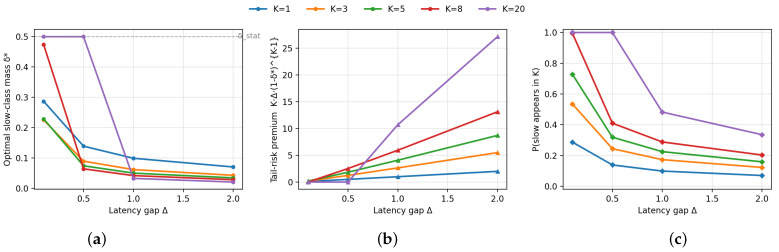 Figure 1
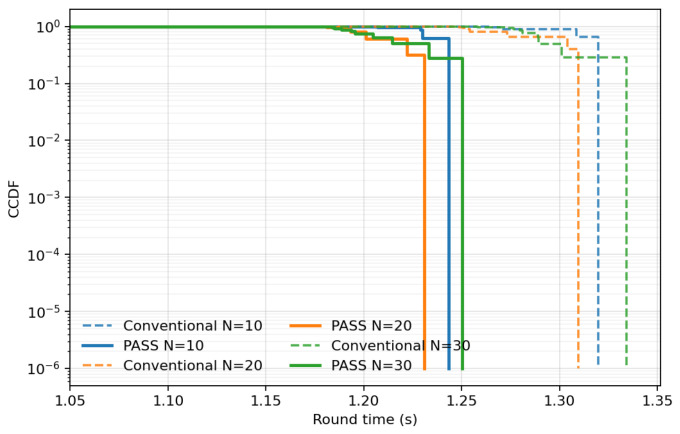 Figure 2
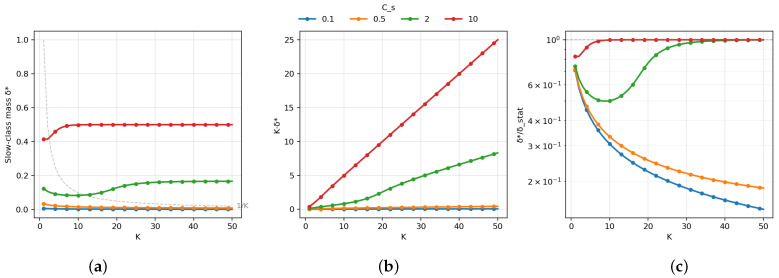 Figure 3
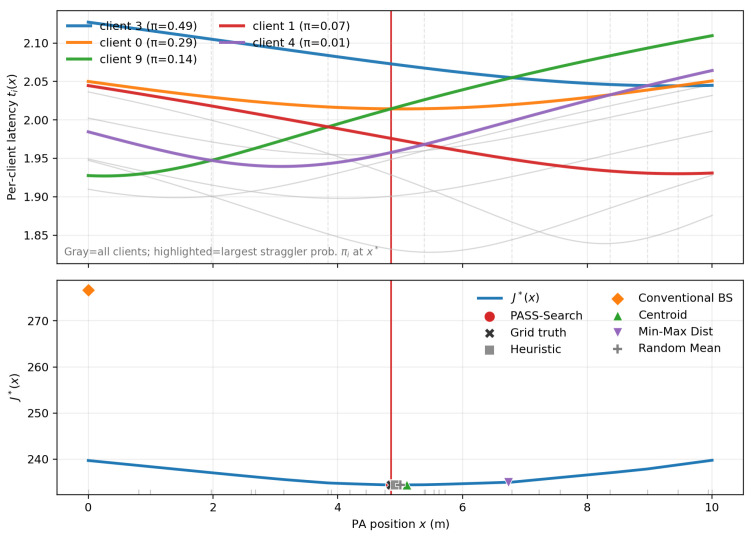 Figure 4
 Figure 5
 Figure 6
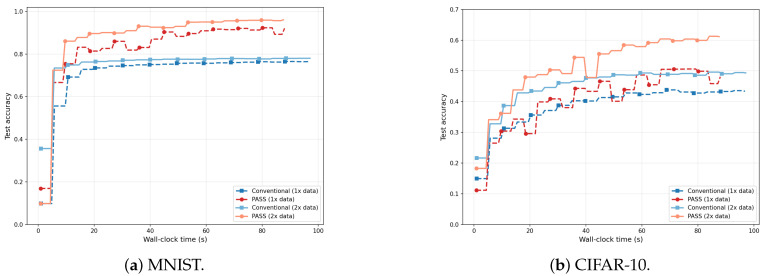 Figure 7
Peer Reviews
No public reviews on file for this paper yet. If you reviewed it on a platform where reviews are public (OpenReview, ICLR, NeurIPS, ICML), you can paste yours below so the community can read it here.
Videos
No videos yet. Explain this paper in a talk, walkthrough, or lecture? Add one.
Taxonomy
TopicsPrivacy-Preserving Technologies in Data · Network Time Synchronization Technologies · Wireless Networks and Protocols