Maternal Misperception of Child Body Size and Its Association with Information-Seeking Opportunities and Information Sources in Japanese Preschool Children
Tomomi Kobayashi, Kemal Sasaki, Yuki Tada, Yasuyo Wada, Tetsuji Yokoyama

TL;DR
Many Japanese mothers misjudge their preschool children's body size, and using healthcare providers as an information source is linked to overestimation.
Contribution
This study identifies healthcare providers as a unique factor associated with maternal overestimation of child body size in Japan.
Findings
Maternal misperception of child body size is common among Japanese preschool children.
Using healthcare providers as an information source is independently linked to maternal overestimation of child body size.
Abstract
What are the main findings? Maternal misperception of child body size, including both overestimation and underestimation, is prevalent among Japanese preschool children.Use of healthcare providers as an information source was independently associated with maternal overestimation of child body size. Maternal misperception of child body size, including both overestimation and underestimation, is prevalent among Japanese preschool children. Use of healthcare providers as an information source was independently associated with maternal overestimation of child body size. What are the implications of the main findings? Contact with healthcare providers may reflect maternal concern regarding child growth and warrants further investigation in longitudinal studies.Support strategies that help caregivers interpret objective growth indicators are needed to reduce maternal misperceptions.…
Click any figure to enlarge with its caption.
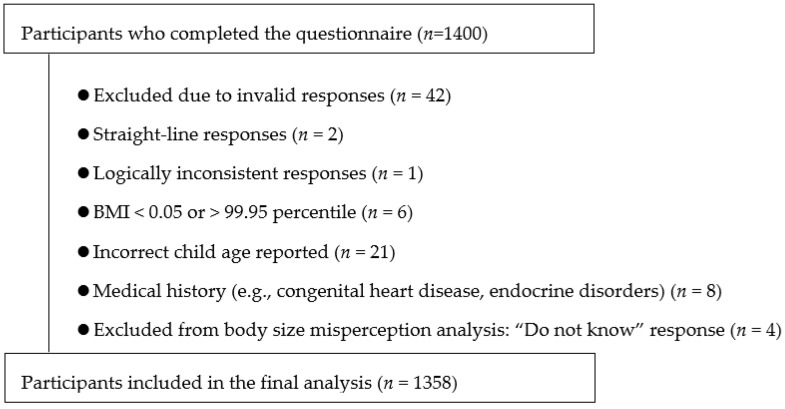 Figure 1
Peer Reviews
No public reviews on file for this paper yet. If you reviewed it on a platform where reviews are public (OpenReview, ICLR, NeurIPS, ICML), you can paste yours below so the community can read it here.
Videos
No videos yet. Explain this paper in a talk, walkthrough, or lecture? Add one.
Taxonomy
TopicsObesity, Physical Activity, Diet · Child Nutrition and Water Access · Health Literacy and Information Accessibility