Modern Pathology-Driven Strategies in Neoadjuvant Immunotherapy for Head and Neck Squamous Cell Carcinoma: From Residual Tumor Quantification to Spatial and AI-Based Biomarkers
Annabella Di Mauro, Rossella De Cecio, Saverio Simonelli, Margherita Cerrone, Rosalia Anna Rega, Maria Luisa Marciano, Monica Pontone, Imma D’arbitrio, Francesco Perri, Gerardo Ferrara

TL;DR
This paper reviews how pathology assessments after pre-surgery immunotherapy can better predict treatment success in head and neck cancer.
Contribution
It highlights novel pathology-driven strategies, including digital tools and immune profiling, to evaluate treatment response in neoadjuvant immunotherapy.
Findings
Pathological response assessment is more reliable than imaging for evaluating treatment effectiveness in head and neck cancer.
Digital pathology and AI improve the reproducibility and detail of residual disease and immune architecture analysis.
Residual tumor quantification and immune-related changes provide insights into tumor clearance and resistance mechanisms.
Abstract
Oral cancer is often treated with surgery, but new strategies are exploring treatments given before surgery to shrink the tumor and stimulate the immune system. In this setting, traditional imaging does not always accurately show how much cancer remains. Careful examination of the removed tissue under the microscope provides more reliable information about treatment effectiveness. This review explains how pathologists can measure the amount of residual cancer cells and recognize immune-related changes within the tumor bed. We also discuss how modern technologies, such as digital pathology and molecular profiling, can improve response evaluation and help guide personalized treatment decisions. By standardizing how treatment response is assessed, clinicians may better identify patients who can safely receive less aggressive therapy and those who need additional treatment. This approach…
Genes, proteins, chemicals, diseases, species, mutations and cell lines named across the full text — each resolved to its canonical identifier and authoritative record.
Click any figure to enlarge with its caption.
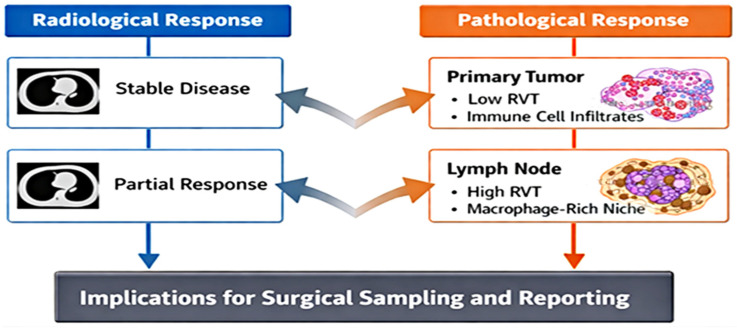 Figure 1
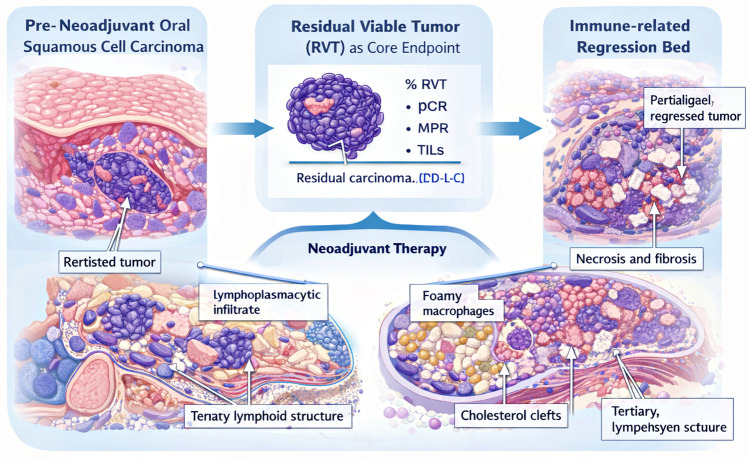 Figure 2
Peer Reviews
No public reviews on file for this paper yet. If you reviewed it on a platform where reviews are public (OpenReview, ICLR, NeurIPS, ICML), you can paste yours below so the community can read it here.
Videos
No videos yet. Explain this paper in a talk, walkthrough, or lecture? Add one.
Taxonomy
TopicsHead and Neck Cancer Studies · Single-cell and spatial transcriptomics · Esophageal Cancer Research and Treatment