Changing Complication Profiles in the Era of Robotic Ivor Lewis Esophagectomy: A Comparative Analysis of Open, Hybrid, and Fully Robotic Techniques
Sebastian Weberskirch, Neele Wilkens, Ann-Kathrin Eichelmann, Jennifer Merten, Nader El-Sourani, Mazen A. Juratli, Andreas Pascher, Jens Peter Hoelzen

TL;DR
Robotic esophagectomy improves cancer surgery outcomes but has unique risks like higher chylothorax rates, which may be linked to more extensive lymph node removal.
Contribution
The study identifies a new complication profile specific to robotic esophagectomy, particularly increased chylothorax due to radical lymphadenectomy.
Findings
Fully robotic surgery had a 12.4% chylothorax rate compared to 2.5% in open surgery.
Robotic approaches reduced neo-esophagus–airway fistulas to 0.6% from 4.9% in open surgery.
Lymphatic leakage in chylothorax cases originated from abdominal lymphadenectomy, not thoracic duct injury.
Abstract
Robot-assisted minimally invasive esophagectomy (RAMIE) is increasingly used in esophageal cancer surgery because it improves surgical precision and facilitates more extensive lymphadenectomy. However, robotic surgery may also be associated with a distinct complication profile. In this retrospective single-center study, we analyzed 407 consecutive patients undergoing Ivor Lewis esophagectomy using open, hybrid robotic, or fully robotic techniques. We focused on three clinically relevant complications: paraconduit herniation, chylothorax, and neo-esophagus–airway fistula. Fully robotic surgery was associated with a significantly higher chylothorax rate, whereas neo-esophagus–airway fistulas occurred significantly less often compared with open surgery. Lymphangiography in persistent chylothorax cases confirmed an intact thoracic duct, suggesting transhiatal lymphatic leakage from the…
Genes, proteins, chemicals, diseases, species, mutations and cell lines named across the full text — each resolved to its canonical identifier and authoritative record.
Click any figure to enlarge with its caption.
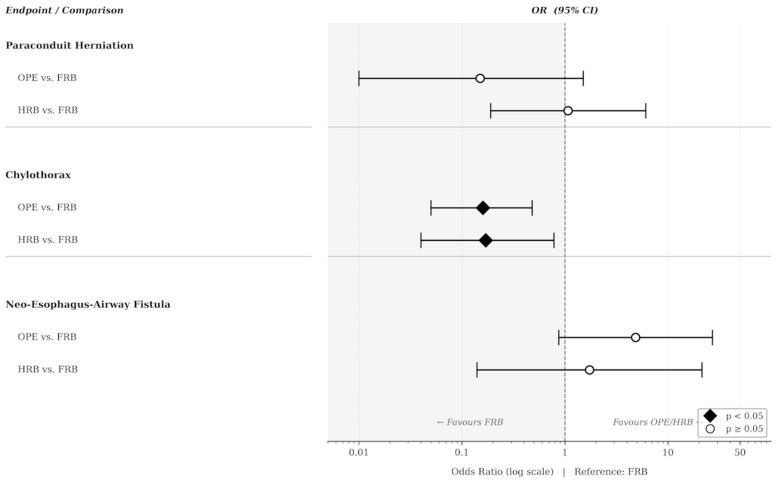 Figure 1
Peer Reviews
No public reviews on file for this paper yet. If you reviewed it on a platform where reviews are public (OpenReview, ICLR, NeurIPS, ICML), you can paste yours below so the community can read it here.
Videos
No videos yet. Explain this paper in a talk, walkthrough, or lecture? Add one.
Taxonomy
TopicsEsophageal Cancer Research and Treatment · Esophageal and GI Pathology · Pleural and Pulmonary Diseases