Outcome of People with Parkinson’s Disease Treated with Levodopa-Entacapone-Carbidopa Intestinal Gel Who Failed Previous Subcutaneous Foslevodopa/Foscarbidopa
Diego Santos García, Inés Legarda, Tamara M. González Fernández, Ana Rodríguez Sanz, Maria Isabel Morales-Casado, Alejandro Peral, Nuria Caballol, María Álvarez Sauco, Iria Campos Rodríguez, Déborah Alonso Modino, Lydia López Manzanares, Jesús Olivares Romero

TL;DR
This study shows that switching to LECIG can improve motor symptoms and reduce 'Off' time in Parkinson's patients who did not respond well to fLD/fCD.
Contribution
The first detailed description of outcomes for Parkinson's patients switching from fLD/fCD to LECIG.
Findings
LECIG significantly reduced 'Off' time and improved motor symptoms in patients.
There was a trend toward improved quality of life and non-motor symptoms.
LECIG was well tolerated with only one patient dropping out due to dementia-related complications.
Abstract
What are the main findings? The reasons for the change and the outcome of patients treated with fLD/fCD who switched to LECIG are described in detail for the first time.The response to LECIG was favorable, with significant reduction of “Off” time and improvement in motor symptoms with a trend towards improvement in quality of life and NMS burden, as well as an adequate tolerability profile. The reasons for the change and the outcome of patients treated with fLD/fCD who switched to LECIG are described in detail for the first time. The response to LECIG was favorable, with significant reduction of “Off” time and improvement in motor symptoms with a trend towards improvement in quality of life and NMS burden, as well as an adequate tolerability profile. What are the implications of the main findings? LECIG could be an alternative therapeutic option in PwP who failed fLD/fCD.These…
Genes, proteins, chemicals, diseases, species, mutations and cell lines named across the full text — each resolved to its canonical identifier and authoritative record.
Click any figure to enlarge with its caption.
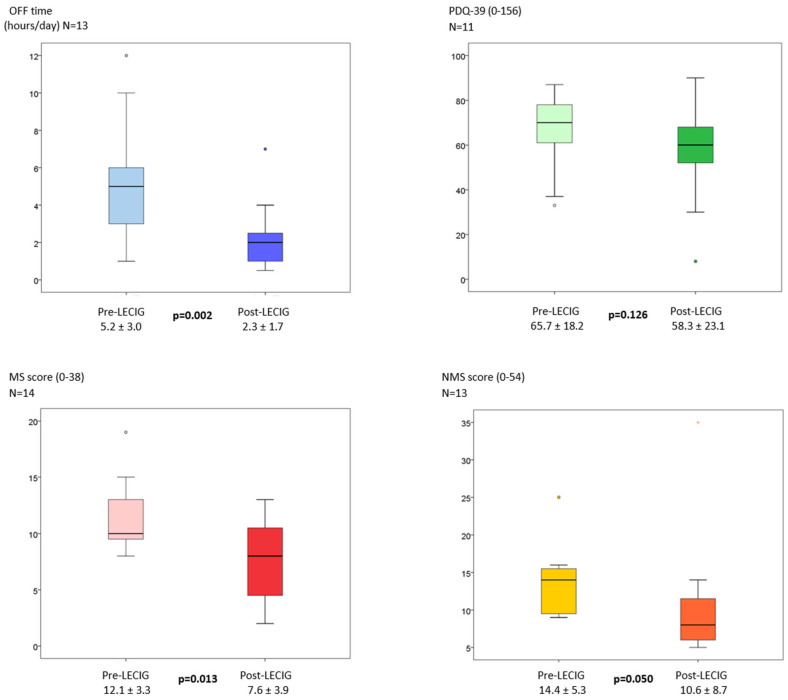 Figure 1
Peer Reviews
No public reviews on file for this paper yet. If you reviewed it on a platform where reviews are public (OpenReview, ICLR, NeurIPS, ICML), you can paste yours below so the community can read it here.
Videos
No videos yet. Explain this paper in a talk, walkthrough, or lecture? Add one.
Taxonomy
TopicsParkinson's Disease Mechanisms and Treatments · Neurological disorders and treatments · Restless Legs Syndrome Research
1. Introduction
Device-aided therapies (DATs) in Parkinson’s disease (PD) are advanced treatment modalities used when oral or transdermal medications no longer provide adequate control of motor fluctuations or dyskinesias [1]. For many years, three DATs have been used in many countries: deep brain stimulation (DBS), levodopa-carbidopa intestinal gel (LCIG) infusion, and continuous subcutaneous apomorphine infusion (CSAI) [2]. However, new formulations such as foslevodopa-foscarbidopa (fLD/fCD), a prodrug-based subcutaneous infusion, and levodopa-carbidopa-entacapone intestinal gel (LECIG) have emerged with the aim to provide continuous dopaminergic stimulation and reduce device-related complications [3]. In particular, fLD/fCD offers a non-surgical, continuous, and adjustable alternative to existing DATs such as LCIG and DBS for patients with advanced PD and motor fluctuations not adequately controlled by oral medication. Clinical trials have demonstrated that continuous subcutaneous fLD/fCD significantly increases “On” time without troublesome dyskinesia and reduces “Off” time compared to oral immediate-release levodopa/carbidopa, with benefits observed as early as the first post-baseline assessment and sustained over 12 weeks [4]. Given its ease of implementation and the good profile of levodopa in terms of safety and effectiveness, fLD/fCD is a good DAT option in many patients with PD, being the most frequently used option currently in Spain [5,6]. However, adverse events such as infusion site reactions (erythema, pain, cellulitis, edema), which are generally mild to moderate and manageable with site rotation and aseptic technique, or others related to the drug (visual hallucinations, psychosis, etc.) may lead to discontinuation of the treatment in some cases [4,7]. LECIG can be an alternative option for people with PD (PwP) who failed fLD/fCD, and in fact, a prospective, international, non-interventional phase IV study (SWITCH-ON) designed to assess the effectiveness of LECIG on the reduction in “Off” time from baseline at 12 months in PwP who failed fLD/fCD, is ongoing.
To date, no data has been published on the outcome of patients with PD treated with fLD/fCD who switch to LECIG. Here, we report our experience in Spain with PwP treated with LECIG who had previously failed subcutaneous fLD/fCD.
2. Materials and Methods
PwP treated with LECIG in Spain until 30 November 2025, who previously failed fLD/fCD, were included in this multicenter, longitudinal, retrospective, observational study. An in-person visit (post-LECIG) was conducted in different centers of Spain from 1 December 2025, to 10 January 2026, to assess patients already receiving LECIG and to collect data on their outcome. During this visit, the patient signed the informed consent form. Information on sociodemographic aspects, comorbidity, factors related to PD, and treatment including levodopa equivalent daily dose (LEDD) [8], fLD/fCD failure, and LECIG indication, was retrospectively collected.
The change from pre-LECIG (Vpre) to post-LECIG (Vpost) in the mean daily “Off” time, Unified Parkinson’s Disease Rating Scale (UPDRS) part III, health-related quality of life (PDQ-39 [39-item Parkinson’s Disease Questionnaire] total score), motor symptoms burden, and non-motor symptoms (NMS) burden were assessed. Specifically, Vpre was considered to be at the time of LECIG indication by the neurologist (before starting therapy), patients in some cases were on fLD/fCD (direct switch to LECIG) or others were on oral medication (previous abandonment). Vpost was considered to be when the patient was already receiving LECIG, with a variable time depending on the visit made and the start date. To assess motor symptoms burden, a motor symptoms score (MSs) [5,6] with a range from 0 to 38 was calculated, being the result of the sum of the score of “daily Off time” (from 0 to 4 according to the UPDRS part IV—item 39) + “daily dyskinesia time” (from 0 to 4 according to the UPDRS part IV—item 32) + other motor symptoms (dyskinesia severity; painful dyskinesia; morning dystonia; freezing of gait during the “Off” state; freezing of gait during the “On” state; falls; posture; tremor; hypomimia; speech problems) that were scored as 0 (none), 1 (slight), 2 (moderate) or 3 (severe) (Table S1-Supplementary Material). Regarding NMS burden, the same methodology was applied with a NMS score (NMSs) [5,6] from 0 to 54 that was the result of the sum of the score of different NMS, from 0 (none) to 3 (severe) (non-motor fluctuations; cognitive impairment; visual hallucinations; psychosis; impulse control disorder; depression; anxiety; apathy; sleep behavior disorder; diurnal somnolence; urinary symptoms; gastrointestinal symptoms; symptomatic orthostatic hypotension; constipation; sialorrhea; dysphagia; fatigue; pain) (Table S1-Supplementary Material). The data for MSs and NMSs at Vpre was obtained from a chart review. Data about the impression of change with fLD/fCD and with LECIG (post-LECIG) was collected according to the Clinical Global Impression of Change (CGI-C) scale. Adverse events were also collected.
Data were processed using SPSS 20.0 for Windows. Different variables were expressed as quantitative and/or qualitative variables. Distribution for variables was verified by one-sample Kolmogorov–Smirnov test. The change from pre-LECIG to post-LECIG in the mean daily “Off” time, PDQ-39 total score, MSs, and NMSs was assessed using the Wilcoxon rank-sum test. The marginal homogeneity test was used to compare the CGI-C with f/LD/fCD vs. with LECIG. Values of p < 0.05 were considered significant.
3. Results
Data about 14 patients (57.1% males; 66.6 ± 8.6 years old) from 12 hospitals in Spain out of a total of 15 who were treated with LECIG were included. All patients received a 24 h/day continuous subcutaneous infusion of fLD/fCD with a mean exposure time of 98.6 ± 92.3 days, with a range from 20 to 301. The frequency of use of other dopaminergic drugs associated with fLD/fCD was 28.6% for MAO-B inhibitors, 21.4% for amantadine, 14.3% for COMT inhibitors, and 7.1% for dopamine agonists. Regarding the cause of fLD/fCD failure, up to 92.9% and 57.1% of the patients experienced side effects and lack of responses, respectively. Specifically, significant subcutaneous nodules with/without other skin problems were reported in up to 64.3% of patients (in eight patients it was the main reason to switch to LECIG), whereas visual hallucinations with psychotic symptoms were in 28.6% (in two patients it was the reason to switch to LECIG). Five patients (35.7%) received fLD/fCD for more than 3 months, with nodules and other skin problems being the major reason to switch to LECIG in four of them.
LECIG was a direct switch from fLD/fCD in 35.7% of the patients. At the time LECIG was indicated by the neurologist, the mean time from diagnosis of PD was 13.4 ± 8.2 years, and 100% of the patients had motor fluctuations and non-motor fluctuations with a mean daily time during the “Off” state of 5.2 ± 3.0 h. Patients had a good response to levodopa (levodopa challenge test) from the “Off” to the “On” state (Hoeh&Yahr stage and UPDRS part III), with 50% of them presenting cognitive impairment and 28.6% psychosis (Table 1). In addition to fLD/fCD, one patient had previously been treated with CSAI and two with LCIG. LECIG was initiated with hospitalization in more than half of the cases (57.1%), with the average optimization time being 14.9 ± 24.1 days (Table 1). At LECIG initiation, the mean cartridge volume (mL) used was 56.6 ± 15.9, and LEDD was significantly lower than at LECIG indication (1664.6 ± 449.0 vs. 1992.1 ± 689.9; p = 0.019) and at fLD/fCD withdrawal (1664.6 ± 449.0 vs. 2084.9 ± 726.3; p = 0.030).
The mean exposure time to LECIG (from Vpre to Vpost) was 233.7 ± 157.4 days. Daily OFF time was significantly reduced by 2.9 ± 1.9 h (p = 0.002), from 5.2 ± 3 at Vpre to 2.3 ± 1.7 at Vpost (Figure 1). PwP improved significantly from Vpre to Vpost in motor symptoms, with a decrease in the MSs from 12.1 ± 3.3 to 7.6 ± 3.9 points (−37.2%; p = 0.013). Regarding NMS burden, a trend of significance was detected in their improvement with a decrease in the NMSs from 14.4 ± 5.3 points at Vpre to 10.6 ± 8.7 at Vpost (−35.8%; p = 0.050). In terms of quality of life, the total score in the PDQ-39 from Vpre to Vpost was reduced by 7.4 points, but it was not statistically significant (Figure 1). No significant change was detected in the mean LEDD (mg) from Vpre (1664.6 ± 449.0) to Vpost (1718.0 ± 468.6) (p = 0.508). No differences were detected either (p = 0.726) between the UPDRS part III in the “On” state at Vpre (19.2 ± 16.8) and at Vpost (18.3 ± 16.0). Weight remained stable between both visits (70.5 ± 15.3 at Vpre vs. 69.8 ± 16.4 at Vpost; p = 0.505). The clinical perception of improvement experienced by patients based on the CGI-C was significantly better in the case of LECIG compared to fLD/fCD according to the neurologist’s (p = 0.017) and the patient’s own opinion (p = 0.012), but not in the case of the caregiver (p = 0.072) (Figure S1-Supplementary Material).
LECIG was well tolerated, with only one dropout (7.1%) due to complications related to dementia (the Vpost data was also collected in this case). Adverse events were reported in 28.6% and 35.7% of the patients in the optimization and final follow-up evaluation phases, respectively. Specifically, in the LECIG optimization phase, the following adverse events were recorded: stoma infection (N = 2), stoma erythema (N = 2), dyskinesia impairment (N = 2), tube migration (N = 1) and problems with gastrostomy (N = 1). In global terms, a total of 20 adverse events were reported, with complications in the stoma (N = 11) being the most frequent (Table 2). Fifty percent of the patients suffered from at least one possibly related (LECIG and/or device) adverse event.
4. Discussion
The present study observed a favorable outcome in the medium term (near 8 months on average) of PwP treated with LECIG who had previously failed fLD/fCD. In particular, a reduction in “Off” time and improvement in motor symptoms were found, with a trend towards improvement in quality of life and NMS burden. The tolerability profile of LECIG was adequate, in line with previous studies [9,10,11]. Despite the small sample size and pending data from the SWITCH-ON study, this is the first report on the outcome of patients treated with LECIG who previously failed fLD/fCD.
Most patients from our cohort who dropped fLD/fCD did so because of side effects, including more than 60% with nodules that in many cases were associated with a suboptimal response due to probable problems with drug absorption. Importantly, an average time of more than 3 months with fLD/fCD suggests a clear effort by the neurologists to try to optimize the patient prior to changing therapy. The frequency of skin problems in patients treated with fLD/fCD is high, with 62% of patients experiencing infusion/catheter site reactions and 28% experiencing infusion/catheter site infections in phase 3 clinical trials [12]. The most common skin reactions include erythema (27%), pain (26%), cellulitis (19%), edema (12%), bruising (3%), and hemorrhage (3%). These reactions are generally mild to moderate but can lead to treatment discontinuation in a subset of patients (8% for site reactions, 5% for site infections) [4,7,12,13]. The development of hallucinations or psychotic events can also be a reason for therapeutic failure in 15% of the patients [4], as in 14.3% of our patients. The global frequency of fLD/fCD withdrawal in clinical practice is at least 20% during the initial 12 weeks of therapy [4,7], with adverse events—primarily skin reactions—occurring in up to 87% of patients. When fLD/fCD fails, DATs are the main alternatives for advanced disease refractory to oral and adjunctive pharmacotherapy. CSAI would not be recommended in a patient with psychosis or pre-existing skin problems [14]. Alternatively, enteral levodopa infusion could be considered in these cases, with LECIG providing an equivalent efficacy to LCIG with a lower levodopa dose, similar safety and tolerability, and practical device advantages due to the addition of entacapone [15]. Data from previous studies on the use of DATs in Spain have shown that LECIG is indeed a frequently used therapeutic option when other DATs have previously failed [5,6]. But even in these cases, many patients can have a favorable response, with improvement in motor and NMS and maintenance of therapy [9,10,11]. In line with the findings observed in the ELEGANCE and LECIPARK studies, patients from this cohort reduced “Off” time by nearly 3 h and improved motor symptoms, with a trend towards improvement in NMS and their quality of life. In fact, the reduction of 7.4 points on the PDQ-39 total score is equivalent to 4.7 points on the PDQ-39SI, which is exactly what has been defined in the literature as the minimal clinically important difference [16]. It is noteworthy that these are patients with an advanced stage of the disease who did not improve satisfactorily with fLD/fCD. In this regard, there is data suggesting that patients who switch from LCIG to LECIG and are not optimally controlled may also improve [9]. The addition of entacapone increases levodopa bioavailability, allowing for a 20–35% reduction in the levodopa maintenance dose while achieving similar systemic exposure and motor response as LCIG, regardless of COMT genotype [17]. Importantly, the improvement achieved with LECIG in this cohort occurred without an increase in the LEDD. Differences in the route of administration or in the product itself could explain achieving improvement without increasing the LEDD. In this context, and although treatment should always be individualized based on aspects such as motor and non-motor phenotype, comorbidities and lifestyle factors, and of course, the opinion of the patient and their family, in general, for patients eligible for a DAT other than deep brain stimulation, and based on costs, invasiveness and ease of implementation, the subcutaneous route would be preferred over gastrostomy, with LECIG being an alternative treatment option in patients with previous failure [5,6,18,19,20]. Switching between and combining DATs can in some patients bring substantial clinical improvement and should be considered in those who have either inadequate symptom control on DAT treatment or have developed DAT-related complications [21]. In this cohort, the strategy (direct vs. non-direct switch) was at the neurologist’s discretion under clinical practice conditions. It was a personal decision, likely influenced by the time required to implement a new therapy (i.e., LECIG) based on hospital resources, as well as tolerability to fLD/fCD and the need to discontinue it.
The present study has important limitations. First, the sample size is small. Second, the methodology is that of an open and retrospective study. Third, in the follow-up evaluation (Vpost) with LECIG, the data for the variables in which the change was measured were not present in all cases. Fourth, we used non-validated scores (MSs and NMSs) to calculate the change in motor and NMS. Fifth, underreporting of adverse events cannot be ruled out. From a statistical point of view, borderline findings (e.g., NMS improvement) should be interpreted cautiously given the small cohort and multiple comparisons with the potential risk of a type I error. Finally, the average follow-up time is almost 8 months, making it important to know the longer-term evolution. All these factors may limit the generalizability of the findings, and they should be interpreted with caution. On the other hand, and despite these limitations, the findings are novel since, pending the results of the ongoing SWITCH-ON study, no data have been previously reported on PwP treated with LECIG who failed fLD/fCD.
5. Conclusions
In conclusion, based on this first Spanish experience report, LECIG could be an alternative therapeutic option in PwP who failed fLD/fCD. Data from prospective multicenter studies with a larger number of patients are needed to corroborate this initial observation.
The reference list from the paper itself. Each links out to its DOI / PubMed record.
- 1Tanner C.M. Ostrem J.L. Parkinson’s Disease N. Engl. J. Med.202439144245210.1056/NEJ Mra 240185739083773 · doi ↗ · pubmed ↗
- 2Marsili L. Bologna M. Miyasaki J.M. Colosimo C. Parkinson’s disease advanced therapies—A systematic review: More unanswered questions than guidance Park. Relat. Disord.20218313213910.1016/j.parkreldis.2020.10.04233158747 · doi ↗ · pubmed ↗
- 3Schröter N. Sajonz B.E.A. Jost W.H. Rijntjes M. Coenen V.A. Groppa S. Advanced therapies in Parkinson’s disease: An individualized approach to their indication J. Neural Transm.20241311285129310.1007/s 00702-024-02773-338613674 PMC 11502575 · doi ↗ · pubmed ↗
- 4Soileau M.J. Aldred J. Budur K. Fisseha N. Fung V.S. Jeong A. Kimber T.E. Klos K. Litvan I. O’N Eill D. Safety and efficacy of continuous subcutaneous foslevodopa-foscarbidopa in patients with advanced Parkinson’s disease: A randomised, double-blind, active-controlled, phase 3 trial Lancet Neurol.2022211099110910.1016/S 1474-4422(22)00400-836402160 · doi ↗ · pubmed ↗
- 5Santos-García D. SolleiroÁ. González-Ortega G. Mir P. López-Ariztegui N. García Ramos R. Legarda I. Planas-BallvéA. Alonso-Modino D. Sánchez-Alonso P. Profile of People with Parkinson’s Disease Treated with a Device-Aided Therapy in Spain. A Comparative Multicenter Observational Study Mov. Disord. Clin. Pract.20261315417210.1002/mdc 3.7023940704401 PMC 12839489 · doi ↗ · pubmed ↗
- 6Santos-García D. SolleiroÁ. González-Ortega G. Mir P. López-Ariztegui N. Legarda I. Rojas-Pérez M.E. Peral-Quirós A. Cabo I. García-Ramos R. Impact of device-aided therapies on quality of life in patients with Parkinson’s disease. A comparative multicenter observational study J. Neural Transm.2025 epub ahead of print 10.1007/s 00702-025-03066-z 41251763 · doi ↗ · pubmed ↗
- 7Blair H.A. Foslevodopa/Foscarbidopa: A Review in Advanced Parkinson’s Disease CNS Drugs 20253962163210.1007/s 40263-025-01179-340198538 · doi ↗ · pubmed ↗
- 8Jost S.T. Kaldenbach M.A. Antonini A. Martinez-Martin P. Timmermann L. Odin P. Katzenschlager R. Borgohain R. Fasano A. Stocchi F. Levodopa Dose Equivalency in Parkinson’s Disease: Updated Systematic Review and Proposals Mov. Disord.2023381236125210.1002/mds.2941037147135 · doi ↗ · pubmed ↗