Breed- and Parity-Associated Incidence and Manifestation of Metabolic Disorders in Holstein and Jersey Cows During the Postpartal Transition Period
Gi-Won Park, Seungmin Ha, Tai-Young Hur, Seogjin Kang, Chan-Lan Kim, Ui-Hyung Kim, Sang-Ik Oh, Mooyoung Jung

TL;DR
Holstein and Jersey cows show different metabolic disorder risks post-calving, with breed and parity affecting health outcomes.
Contribution
The study reveals breed- and parity-specific differences in metabolic disorder incidence during the postpartal period in dairy cows.
Findings
Jersey cows had higher odds of ketosis compared to Holsteins.
Holsteins were more susceptible to hypomagnesemia and showed stronger parity-related trends.
Multiparous Holsteins had higher incidences of hypophosphatemia, hypocalcemia, and hypomagnesemia compared to primiparous ones.
Abstract
A total of 149 Holstein and 25 Jersey cows were monitored, and blood samples were collected from calving to 21 days after parturition at 3-day intervals. β-hydroxybutyrate, inorganic phosphorus, calcium, and magnesium concentrations were measured to evaluate the metabolic disorders during the postpartal period. The incidence of metabolic disorders and the concentrations of metabolites were compared by breed and parity. Jerseys were more prone to ketosis, whereas Holsteins were more susceptible to hypomagnesemia and showed stronger parity-related trends. These findings highlight the importance of breed- and parity-specific health management strategies in dairy cattle farms. Dairy cows commonly experience negative energy balance during the periparturient period, predisposing them to metabolic disorders such as ketosis (KET), hypophosphatemia (HP), hypocalcemia (HC), and hypomagnesemia…
Genes, proteins, chemicals, diseases, species, mutations and cell lines named across the full text — each resolved to its canonical identifier and authoritative record.
Click any figure to enlarge with its caption.
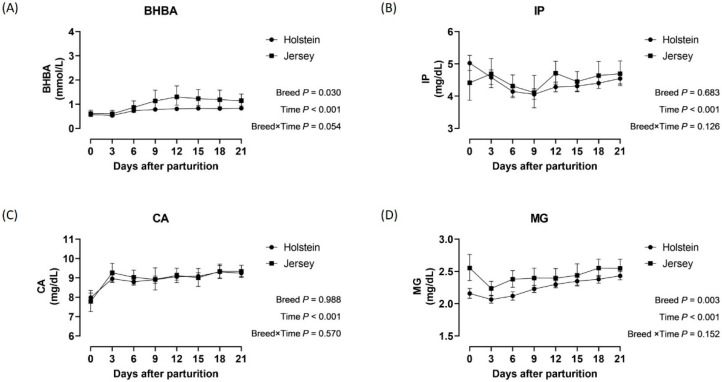 Figure 1
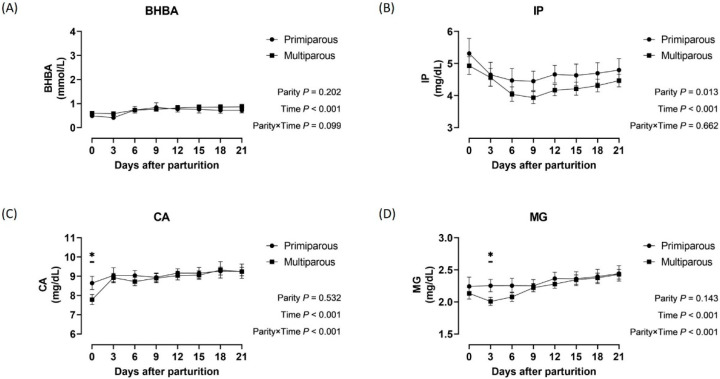 Figure 2
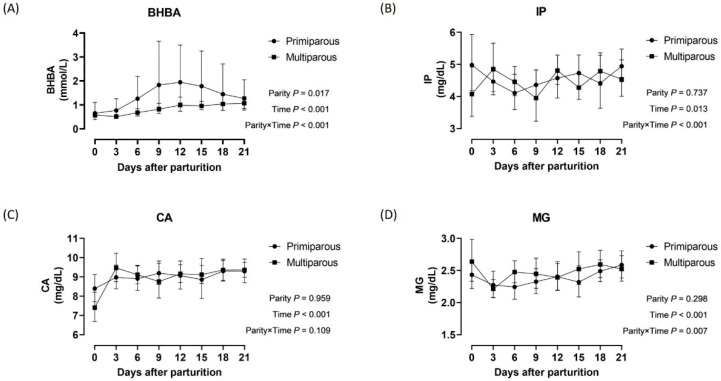 Figure 3
- —National Institute of Animal Science, Rural Development Administration, Republic of Korea
Peer Reviews
No public reviews on file for this paper yet. If you reviewed it on a platform where reviews are public (OpenReview, ICLR, NeurIPS, ICML), you can paste yours below so the community can read it here.
Videos
No videos yet. Explain this paper in a talk, walkthrough, or lecture? Add one.
Taxonomy
TopicsReproductive Physiology in Livestock · Effects of Environmental Stressors on Livestock · Animal health and immunology
1. Introduction
Ketosis (KET) occurs when cows present insufficient gluconeogenic precursors relative to the rate of fatty acid catabolism during negative energy balance [1,2], resulting in elevated blood ketone bodies, such as acetoacetate and β-hydroxybutyrate (BHBA) [3]. This disorder impairs appetite, milk production, and reproductive performance [4]. During late gestation, phosphorus requirements increase substantially, from 1.9 g/day at 190 days to 5.4 g/day at 280 days, to support fetal development [5]. This demand predisposes cows to hypophosphatemia (HP), characterized by decreased blood inorganic phosphorus (IP) [5,6]. Phosphorus homeostasis is closely related to calcium homeostasis because 1, 25-(OH)2_D_3 stimulates the intestinal absorption of both minerals [7]. HP can cause alert downer syndrome and is often complicated by concurrent hypocalcemia (HC) and hypomagnesemia (HM), potentially leading to postparturient hemoglobinuria [6,8]. HC results from decreased serum calcium (CA) concentration driven by increased milk production during early lactation [9,10]. HC is associated with dystocia, uterine prolapse, retained placenta, endometritis, infertility, and KET because of decreased smooth muscle function [11,12]. HM, defined as decreased serum magnesium (MG) concentrations, is caused by insufficient dietary MG supply and impaired absorption [9]. HM is associated with HC, decreased feed intake and milk yield, and may present with neurological symptoms (i.e., ataxia and tetanic muscle spasm) [13,14].
Although the incidence and risk factors of these metabolic disorders have been widely reported, information on the effects of breed and parity remains limited. Some previous studies have suggested that Jersey cows have a higher incidence of KET and HC than Holstein cows [15,16], and multiparous cows are more susceptible to HC than primiparous cows [17]. However, comparative data remains scarce or inconsistent. Jersey cattle are gaining attention in South Korea because of their thermal tolerance, disease resistance, concentrated milk yield, and adaptability [18], suggesting that physiological differences between breeds could influence the incidence and manifestation of metabolic disorders in the circumstance of South Korea. Furthermore, the effect of parity on these disorders may differ between breeds.
This study tested two hypotheses: (1) Jersey cows exhibit incidences and manifestations of postpartal metabolic disorders similar to Holstein cows; and (2) within each breed, primiparous and multiparous cows show similar incidences and manifestations of these disorders. The aim was to identify metabolic disorders, excluding the secondary cases from other disorders, during the postpartal transition periods of Holstein and Jersey cows raised on the same farm and to evaluate their incidence and characteristics by breed and parity.
2. Materials and Methods
2.1. Animals
This study included Holstein and Jersey cows raised and calved at the farm of the National Institute of Animal Science in Cheonan, Republic of Korea, from January 2018 to December 2024 (ethical approval number: NIAS-2018039). The farm houses approximately 360 cows and calves and produces about three tons of milk daily from around 90 lactating cows under free-stall barns. The farm facilities were well-ventilated and kept non- or mild-heat stressed (72 or less on the temperature–humidity index) throughout the testing period. Cows were fed a total mixed ration ad libitum, consisting of concentrates, soybean meal, corn silage, alfalfa hay, timothy hay, enzymes, minerals, and vitamin supplements (Appendix A). Throughout the study period, the management (e.g., diet, housing, bedding) practices remained consistent.
Prepartum, all dams received 5 mL of vitamin AD_3_E (Vigantol E, Elanco Animal Health, Inc., Greenfield, IN, USA) intramuscularly twice (Vitamin A 1.5 × 10^6^ IU, Vitamin D_3_ 5 × 10^5^ IU, and Vitamin E 250 mg were contained in one injection), at 6 and 3 weeks before the expected calving date. Cows with premature deliveries, abortions, stillbirths, or twin births were excluded. In addition, cows that were milked fewer than two times per day or that had mastitis, agalactia, theileriosis, acidosis, abomasal ulcers, or that were culled or medicated during the study period were excluded. In total, 174 cows (149 Holsteins and 25 Jerseys) met the inclusion criteria.
2.2. Blood Sampling and Analysis
Blood samples were collected once from the jugular vein of the cows at 6–23 h postpartum on the calving date, and then every 3 days until 21 days postpartum (eight time points in total). Sampling was performed in the morning, immediately after milking and prior to feeding. Blood samples were collected in serum-separating tubes.
BHBA concentrations were measured using handheld electronic meters (FreeStyle Optimum Neo, Abbott Diabetes Care Ltd., Witney, UK), which were calibrated or purchased annually, and β-ketone test strips (FreeStyle Optimum H β-ketone, Abbott Diabetes Care Ltd., Witney, UK) as described previously [19]. Samples were immediately transported to an on-site laboratory. Serum was separated by centrifuging at 1500× g for 10 min and stored at –70 °C until analysis. All biochemical analyses were performed on a single day using an automated biochemistry analyzer (Hitachi 7180, Hitachi Ltd., Tokyo, Japan). IP, CA, and MG concentrations were measured using commercial enzymatic assay kits (Fujifilm Wako Pure Chemical Ltd., Osaka, Japan) following calibration and quality control procedures.
2.3. Case and Group Definitions
Metabolic disorders were defined using the highest BHBA concentration and the lowest IP, CA, and MG concentrations recorded within 21 days of calving. The thresholds were as follows: normoketotic (highest BHBA < 1.2 mmol/L) and KET (highest BHBA ≥ 1.2 mmol/L); normophosphatemic (lowest IP ≥ 4.0 mg/dL) and HP (lowest IP < 4.0 mg/dL); normocalcemic (lowest CA ≥ 8.0 mg/dL) and HC (lowest CA < 8.0 mg/dL); and normomagnesemic (lowest MG ≥ 1.8 mg/dL) and HM (lowest MG < 1.8 mg/dL) [20,21]. Cows were categorized as primiparous and multiparous according to parity at parturition.
2.4. Statistical Analysis
Statistical analyses were performed using the Statistical Package for the Social Sciences (SPSS version 27.0; IBM Corp., Armonk, NY, USA). Fisher’s exact test was used to analyze cross-tabulations of breed or parity with the presence of metabolic disorders at the cow level (a cow was classified once as a case if the threshold was met at any postpartal time point). The odds ratios for each disorder were also calculated by this Fisher’s exact test. A Mann–Whitney U test was used to compare age, parity, and day of onset of metabolic disorders between breeds or parity groups because of unequal group sizes. An exchangeable generalized estimating equation model was only used to evaluate repeated measurements of BHBA, IP, CA, and MG concentrations between breeds or parity groups, with time and group specified as fixed effects. A sequential Bonferroni’s post hoc test for the generalized estimating equation model was used to compare the concentrations of BHBA, IP, CA, and MG between the cow breeds and parities at each time point. Data are presented as mean ± standard deviation, and statistical significance was set at p < 0.05 for all analyses.
3. Results
3.1. Comparison of Metabolic Disorders by Breed
The average age and parity of Holstein cows were 4.27 ± 1.97 years and 2.44 ± 1.28, respectively, and those of Jersey cows were 4.20 ± 1.66 years and 2.16 ± 1.14, indicating comparable age and parity distributions between breeds. The incidence rate and days of onset for each metabolic disorder by breed are summarized in Table 1. The additional information regarding the heat stress at parturition and the clinical cases are supplied in Appendix B. HP was the most prevalent disorder in both breeds. The odds of KET were 2.83-fold higher in Jerseys than in Holsteins (p = 0.030), whereas the odds of HM were 4.98-fold higher in Holsteins than in Jerseys (p = 0.026). In addition, HM onset occurred significantly earlier in Holsteins than in Jerseys (p = 0.007). Mean changes in BHBA, IP, CA, and MG concentrations during the postpartal period are shown in Figure 1. The average BHBA and MG concentrations were 0.41 mmol/L and 0.18 mg/dl higher, respectively, in Jerseys than in Holsteins throughout the 21-day period. No significant breed-by-time interaction was observed for BHBA, IP, CA, or MG concentrations.
3.2. Comparison of Metabolic Disorders by Parity in Holstein and Jersey Cattle
The incidence rate and day of onset of metabolic disorders by parity in Holstein cows are presented in Table 2. Multiparous Holsteins had a higher incidence of all metabolic disorders except KET, compared to primiparous Holsteins. There were no significant differences in the day of onset for any metabolic disorder between the two parity groups in Holstein cows. In Jersey cows, the incidence rate and day of onset of metabolic disorders by parity are shown in Table 3. Overall, incidence and onset were similar between primiparous and multiparous Jerseys. However, multiparous Jerseys showed a marginally later onset of KET than primiparous Jerseys (p = 0.050).
Time-serial changes in BHBA, IP, CA, and MG concentrations during the postpartal period in primiparous and multiparous Holsteins are shown in Figure 2. The average IP concentrations in primiparous Holsteins were 0.34 mg/dL higher than those in multiparous Holsteins. A significant parity-by-time interaction was observed for CA (p < 0.001) and MG concentrations (p < 0.001) in Holsteins. The multiparous Holsteins presented significantly lower concentrations of CA at parturition (p < 0.05) and MG at 3 days after parturition, respectively. Figure 3 presents the postpartal changes in BHBA, IP, CA, and MG concentrations in primiparous and multiparous Jersey cows. Primiparous Jerseys had average BHBA concentrations 0.93 mmol/L higher than multiparous Jerseys. Significant parity-by-time interactions were observed for BHBA (p < 0.001), IP (p < 0.001), and MG concentrations (p = 0.007) in Jerseys.
4. Discussion
This study investigated the incidence and timing of four major metabolic disorders—KET, HP, HC, and HM—during the postpartal transition period in Holstein and Jersey cows and assessed their relationships with breed and parity. We expected that these findings would provide insight into breed- and parity-specific vulnerabilities that may contribute to the development of metabolic disorders in early lactation.
Jersey cows had a higher incidence of KET than Holsteins did, which coincided with higher BHBA concentrations during the postpartal period. Numerous previous studies have reported a higher incidence of KET in Jerseys, but direct comparisons of blood BHBA concentrations between breeds have been limited [15,22,23]. KET reflects an inadequate adaptive response to negative energy balance that occurs when the hepatic capacity to oxidize or export non-esterified fatty acids is exceeded [20]. BHBA also plays a regulatory role in milk fat synthesis, and Jerseys are typically known to produce milk with higher fat content than Holsteins do [24,25]. For this reason, these inherent differences in fatty acid catabolism may contribute to their increased KET susceptibility. In addition, primiparous Jerseys exhibited earlier onset and higher BHBA concentrations than multiparous Jerseys did in this study, which was consistent with the previous finding that young Jerseys may be particularly prone to KET [26]. However, this interpretation should be considered as a possible explanation because the mechanistic biomarkers (e.g., glucose, non-esterified fatty acids, liver enzymes) were not measured in this study.
The results of this study presented that most cows experience HP within the first few weeks postpartum, consistent with a previous study [27]. However, there is still limited information about breed-dependent differences in HP incidence to the best of our knowledge. In this study, Holstein and Jersey cows showed similar HP incidence and onset; however, the associated risk factors could differ between breeds [5]. In Holsteins, parity at parturition was associated with HP incidence and IP concentrations, and multiparous cows had higher incidences of both HP and HC. In Jerseys, parity did not significantly influence HP or HC incidence. Because phosphorus homeostasis is closely linked to calcium homeostasis, these findings suggest that the interaction between HP and HC may be more pronounced in Holsteins than in Jerseys.
The overall incidence of HC in this study was similar to that reported in a previous study [21]. Contrary to earlier reports that suggested a higher HC incidence in Jerseys [16,28], no significant difference in HC incidence between Holsteins and Jerseys was detected in this study. This discrepancy may be because of differences in diagnosis method as many previous studies focused on the symptoms, whereas the present study evaluated the serum Ca concentrations. In a previous report, the probability of adapting different thresholds for subclinical HC according to the cow breed has been suggested [29], which could affect the result of this study. In Holsteins, HC incidence increased with age and parity, and many multiparous cows already had CA concentrations below the HC threshold on the day of calving, which is consistent with earlier evidence that clinical and subclinical HC increase with parity [17,30,31]. However, in Jerseys, parity did not significantly affect HC incidence, consistent with some previous findings [32].
The overall incidence of HM in this study was slightly higher than in a previous study [33], which may be explained by repeated sampling rather than a single time point. Although a prior study reported similar HM incidence and serum MG concentrations between Holsteins and Jerseys [34], our findings showed higher incidence of HM in Holsteins than in Jerseys. This difference may reflect breed-related variation in ruminal magnesium absorption, which is critical for maintaining magnesium homeostasis [35]. Holsteins have been reported to have a slightly higher ruminal pH than Jerseys, which may decrease magnesium solubility and absorption and thereby increase the risk of HM [36]. However, this should be interpreted only as a potential explanation because ruminal pH was not estimated in this study. In Holsteins, the factors of increasing age and parity were associated with decreased MG concentrations and higher HM incidence, consistent with previous reports that magnesium absorption declines with age [9,37]. However, the insufficient number of HM cases in Jerseys precluded the evaluation of parity effects in this breed. Therefore, further studies are needed to clarify HM risk factors across breeds.
A key limitation of this study is the relatively small number of Jersey cows, reflecting the limited distribution of this breed in South Korea and the single-farm setting. This limited Jersey sample size may have decreased statistical power from some breed- and parity-level comparisons. Also, the parity-stratified odds ratios should be interpreted cautiously because of the sparse number of cows, particularly for Jersey cows. Nevertheless, the uniform management conditions decreased confounding and allowed for the clearer assessment of breed differences.
5. Conclusions
To the best of our knowledge, this is the first field study to simultaneously compare the incidence of four major metabolic disorders and their associations with age and parity in Holstein and Jersey cows during the postpartal transition period. Jerseys had 2.83 times higher odds of KET, whereas Holsteins had 4.98 times higher odds and earlier onset of HM. Multiparous Holsteins showed higher incidences of HP, HC, and HM compared to primiparous ones, while parity effects were minimal in Jerseys. While the pronounced parity effects observed in Holsteins provide robust insights, the corresponding findings in Jerseys should be considered preliminary due to the limited sample size. These results could assist veterinarians and producers, particularly in regions where Jerseys are newly introduced, in developing breed- and parity-specific strategies to prevent and manage postpartal metabolic disorders, while highlighting the need for larger-scale studies to confirm the Jerseys’ risk factors.
The reference list from the paper itself. Each links out to its DOI / PubMed record.
- 1Drackley J.K. Biology of dairy cows during the transition period: The final frontier?J. Dairy Sci.1999822259227310.3168/jds.S 0022-0302(99)75474-310575597 · doi ↗ · pubmed ↗
- 2Tedesco D. Tava A. Galletti S. Tameni M. Varisco G. Costa A. Steidler S. Effects of silymarin, a natural hepatoprotector, in periparturient dairy cows J. Dairy Sci.2004872239224710.3168/jds.S 0022-0302(04)70044-215328238 · doi ↗ · pubmed ↗
- 3Mc Art J.A. Nydam D.V. Overton M.W. Hyperketonemia in early lactation dairy cattle: A deterministic estimate of component and total cost per case J. Dairy Sci.2015982043205410.3168/jds.2014-874025622874 · doi ↗ · pubmed ↗
- 4Andersson L. Subclinical ketosis in dairy cows Vet. Clin. N. Am. Food Anim. Pract.1988423325110.1016/S 0749-0720(15)31046-X 3061609 · doi ↗ · pubmed ↗
- 5Goselink R. Klop G. Dijkstra J. Bannink A. Phosphorus Metabolism in Dairy Cattle: Literature Study on Recent Developments and Gaps in Knowledge Available online: https://edepot.wur.nl/363222(accessed on 16 December 2025)
- 6Goff J.P. Macromineral physiology and application to the feeding of the dairy cow for prevention of milk fever and other periparturient mineral disorders Anim. Feed Sci. Technol.200612623725710.1016/j.anifeedsci.2005.08.005 · doi ↗
- 7Taylor M.S. Calcium and Phosphorus Metabolism in Jersey and Holstein Cows During Early Lactation Ph.D. Thesis Virginia Polytechnic Institute and State University Blacksburg, VA, USA 2007
- 8Macwilliams P.S. Searcy G.P. Bellamy J.E.C. Bovine postparturient hemoglobinuria: A review of the literature Can. Vet. J.19822330931217422195 PMC 1790234 · pubmed ↗