The complete mitochondrial genome of a marine polychaete, Ophryotrocha xiamenensis (Annelida: Dorvilleidae)
Yiping Feng, Wenting Lin, Fengqi Zhang, Ruoyu Liu, Yuting Zhang, Jianming Chen, Ruanni Chen

TL;DR
This paper reports the full mitochondrial genome of a marine worm, Ophryotrocha xiamenensis, and its placement in a genetic group.
Contribution
The study provides the first complete mitochondrial genome for Ophryotrocha xiamenensis and clarifies its phylogenetic position.
Findings
The mitochondrial genome is 16,111 bp long with 13 protein-coding genes, 22 tRNA genes, 2 rRNA genes, and a noncoding region.
Phylogenetic analysis places O. xiamenensis in the 'labronica' clade with gene order matching O. japonica.
The study enhances genetic resources and phylogenetic understanding within the genus Ophryotrocha.
Abstract
Ophryotrocha xiamenensis is an appropriate model for investigating regeneration and evolution. The complete mitochondrial genome is 16,111 bp in length and consists of 13 protein-coding genes (PCGs), 22 transfer RNA genes, 2 ribosomal RNA genes and a noncoding region. Phylogenetic analysis based on concatenated sequences of all 13 PCGs using the maximum-likelihood and Bayesian methods, placed O. xiamenensis within the ‘labronica’ clade and the order of gene arrangement was the same as that of O. japonica. This study contributes to the development of genetic resources and advances the understanding of phylogenetic resolution within the genus Ophryotrocha.
Genes, proteins, chemicals, diseases, species, mutations and cell lines named across the full text — each resolved to its canonical identifier and authoritative record.
Click any figure to enlarge with its caption.
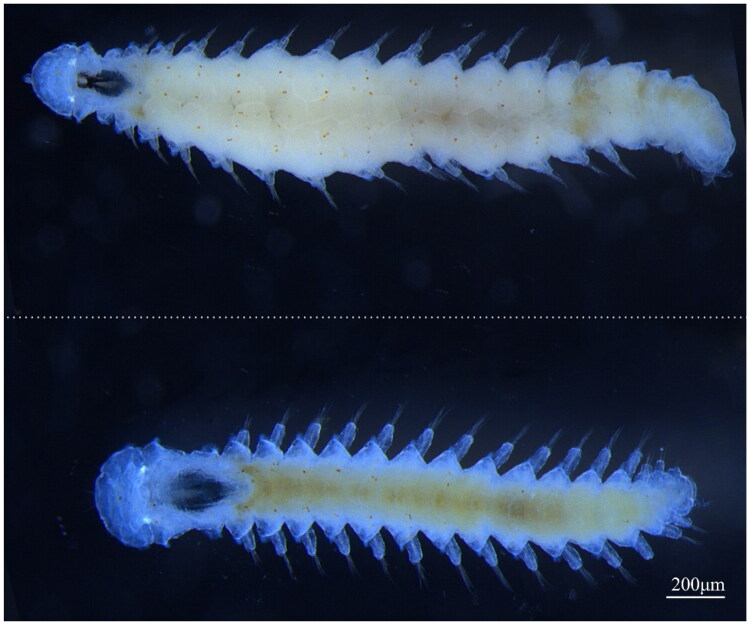 Figure 1
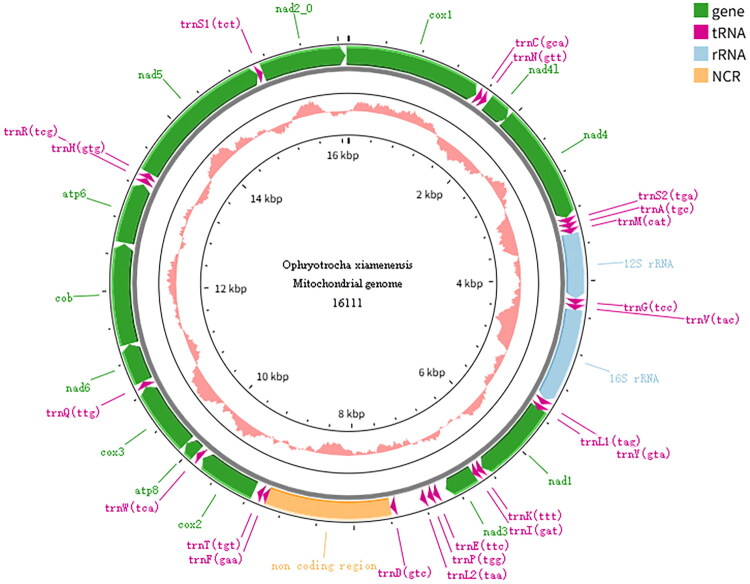 Figure 2
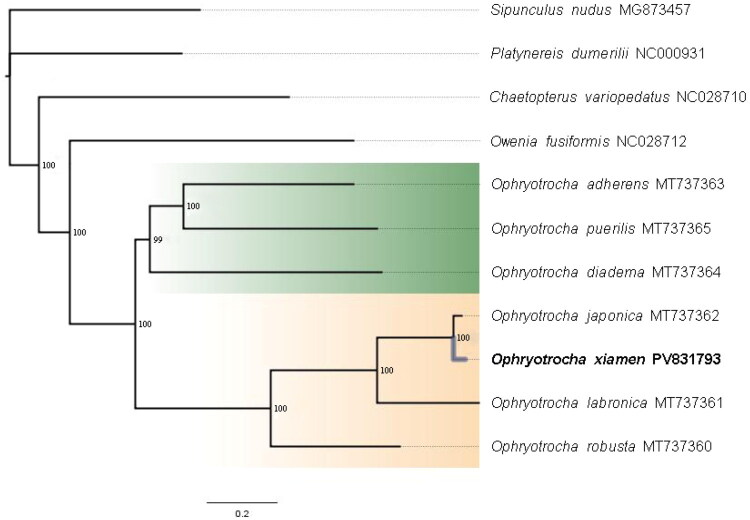 Figure 3
| No. | Primer | Sequence 5′-3′ | Tm (°C) | Lengths |
|---|---|---|---|---|
| 1 | Ox1 | CGTTTTGAAGTGGCGRRGATGT | 58 | 1155 |
| 2 | Ox2 | TAAATGTTRTCACGKAATCCKTTYC | 55 | 1541 |
| CAACCATAATTAATATCMCGAGA | ||||
| 3 | Ox3 | CAATTATTAAGGGGGTTGTTCCTC | 53 | 1598 |
| CAAATCAATTCACATAACTCCTTG | ||||
| 4 | Ox4 | ATAACTGCAGGGCATATTGT | 58 | 1673 |
| TAAYWGGGTGGGGGTAGGGAAAAAG | ||||
| 5 | Ox5 | GKGTATAGRTAYCGRATAAT | 45 | 1581 |
| CCAATATCTTTATGATTWGT | ||||
| 6 | Ox6 | AACKTSRKWTTTTTWRTTTTTA | 48 | 1454 |
| GTAAAMACATCMGGRTAATCT | ||||
| 8 | Ox7 | ATGAGCGGTGATCCCGTGTTCAG | 50 | 1504 |
| GTTTCACTAGTATACTTAAAACTAG | ||||
| 7 | Ox8 | CTATAGTAAGCTCCTTACCTTTG | 55 | 1346 |
| CCAATGTGGATTGTCAAATTAT | ||||
| 9 | Ox9 | TTAGCAGTTTTAGGGGAGTAATCT | 53 | 1258 |
| TTCTAGTCCCCAATTAAGGAAC | ||||
| 10 | Ox10 | CTGCCCGGTGCTTTTTATAGT | 54 | 1167 |
| TGATATTTATCCTATGCCAAAACA | ||||
| 11 | Ox11 | CTCTAAGTATGCGCTTTTAGGG | 55 | 1142 |
| TCTTAACCACGAAAAAGTCACG | ||||
| 12 | Ox12 | TCGTTTAAGAGCCTTCTATAGTT | 51 | 870 |
| ATTCGGTATAAGGTACTCACTCA | ||||
| 13 | Ox13 | GGCATTAATTATAACAACACTATG | 49 | 1393 |
| GGAAAACCGTTAATTGTAGTATAG |
- —Large Instruments Open Foundation of Minjiang University Project
Peer Reviews
No public reviews on file for this paper yet. If you reviewed it on a platform where reviews are public (OpenReview, ICLR, NeurIPS, ICML), you can paste yours below so the community can read it here.
Videos
No videos yet. Explain this paper in a talk, walkthrough, or lecture? Add one.
Taxonomy
TopicsMarine Biology and Ecology Research · Marine and coastal plant biology · Genomics and Phylogenetic Studies
Introduction
Ophryotrocha xiamenensis (Chen et al. 2022) belongs to the order Eunicida, family Dorvilleidae, genus Ophryotrocha, and is a newly found species (Chen et al. 2022). The genus Ophryotrocha Claparède & Mecznikow, 1869, has been found in a wide range of habitats from shallow water to the deep sea (Alalykina and Polyakova 2022; Svensson et al. 2025). Owing to their ability to survive laboratory conditions, high fecundity, short generation times, and rapid individual growth rates, some species of Ophryotrocha have been used as model organisms among marine invertebrates, in the fields of genetics, reproduction, development, and regeneration (Tempestini et al. 2020; Santovito et al. 2023; Chen et al. 2024). Molecular-based taxonomic approaches have been used to identify morphologically similar species in the genus Ophryotrocha. Approximately 97 species in this genus, excluding O. xiamenensis, have been described according to GBIF data (https://www.gbif.org/); however, the complete mitochondrial genomes of only 6 species have been sequenced (Tempestini et al. 2020). The complete mitochondrial genome may serve as a foundation for thorough evolutionary investigations. The study of the genomic sequences of intermediate forms may shed light on the nuances of molecular evolution mechanisms as well as the conditions of relic species survival. In this study, we explored the complete mitochondrial genome of O. xiamenensis and examined its phylogenetic relationships with other species.
Materials and methods
Sample collections
2.1.
Specimen samples (Figure 1) were collected from Baicheng Bay, Xiamen, China (118.08E, 24.44 N), and cultured in our laboratory for more than five years. The species was identified by pairwise comparisons of cox1 and histone H3 sequences (Chen et al. 2022). All the samples are now deposited in the Fujian Key Laboratory on Conservation and Sustainable Utilization of Marine Biodiversity, College of Geography and Oceanography, Minjiang University under voucher number F3-7 (contact Ruanni Chen, [email protected]).
Photographs of live O. xiamenensis, smaller male and larger female, in dorsal view (Ruanni Chen, Minjiang University).
Sequencing and annotation
2.2.
Genomic DNA was extracted from whole worms using a TIANamp Marine Animals DNA Kit (TIANGEN, Beijing, China). Universal and specific PCR primers were designed on the basis of the cox1 sequence from O. xiamenensis and conserved sequences from the genus Ophryotrocha using MEGA5.0 (Table 1). The fragments were amplified using Premix Taq (RR901, TaKaRa Co., Dalian, China) with initial denaturation at 95 °C for 4 min, followed by 35 cycles at 95 °C for 30 s, annealing at 45–58 °C for 1 min, and extension at 72 °C for 1 min, with a final elongation at 70 °C for 10 min after the last cycle. The amplified fragments were separated through 1.2% agarose gel electrophoresis and sequenced using the Sanger sequencing method (Figure S1, supplementary material). For assembly, the annotation of the mitogenome was performed using MITOS2 and EMBOSS Transeq (Bernt et al. 2013). Exact positions of protein-coding genes (PCGs) and rRNAs were found by searching for ORFs (employing genetic code 2, the invertebrate mitochondrion) or by homologous comparison. The circular mitochondrial genome of O. xiamenensis was then visualized using the Proksee web server (Grant et al. 2023).
Phylogenetic analysis
2.3.
Molecular phylogenetic analyses were performed with datasets from all 13 PCGs through MEGA 5.05 software (Tamura et al. 2011). Each PCG was separately aligned, after which the concatenated and poorly aligned regions were removed. In total, 11 terminal taxa were used in the analyses—7 species from the genus Ophryotrocha, including O. xiamenensis, and 3 species from the other families of Polychaeta; the tree was rooted using Sipunculus nudu. The aligned sequences were used as datasets to generate the genetic distance using Kimura’s two-parameter (K2P) model. On the basis of the K2P distances (Table S1), we calculated the interspecific genetic differences among the closest taxa. The phylogenetic trees were constructed by the maximum likelihood method (ML) using MEGA software, with 1,000 bootstrap pseudo replicates. ModelFinder was used to select the best-fit model for Bayesian analysis by using PhyloSuite version 1.2.3 (Zhang et al. 2020). Bayesian inference (BI) phylogenies were inferred under the TVM+I + G + F model (2 parallel runs, 200000 generations), in which the initial 25% of the sampled data were discarded as burn-in. FigTree v1.4.4 was used to visualize the tree. There are neither trans-splicing nor cis-splicing genes in the mitochondrial genome.
Results
We assembled a complete mitochondrial genome of O. xiamenensis which has been maintained in our laboratory for more than five years. The complete mitogenome (GenBank Accession No. PV831793) is 16,111 bp long and A + T biased. Sanger sequencing chromatograms of the O. xiamenensis mitogenome are provided in the supplementary material. Thirty-seven genes were identified from the mitogenome sequence, including 13 PCGs, 2 ribosomal genes (12S and 16S), 22 transport RNA genes, and 1 noncoding region (NCR). The NCR of the mitochondrial genome was located between trnD and trnF. The total base composition was A (26.8%), T (37.8%), G (24.1%), and C (11.3%). All the genes were coded on the plus strand (Figure 2), and no introns were found (see Figure S2, supplementary material). The total length of the 13 PCGs and NCR was 10,994 bp and 6 overlapping regions were present in the whole mitochondrial genome, including 1 to 17 bp (see Table S2, supplementary material). Most of the genes started with an ATG codon and ended with a TAA/TAG stop codon. Specifically, for cox1 and cytb, ATT and GTG as start codons.
Circular map of the complete mitochondrial genome of ophryotrocha xiamenensis. The complete mitochondrial genome was 16,111 bp in length. Genes were shown with standard abbreviations. The outer circle indicated the plus strand (outer line) and the minus strand (inner line), while all genes were coded on plus strand. The inner pink bars indicated the GC content, and the Middle line represented 50%.
After the poorly aligned positions were removed, a total of 12550 bp of 13 PCGs were used for phylogenetic analyses. Phylogenetic analyses revealed similar tree topologies regardless of whether the ML or Bayesian approach was used; therefore, only the results from the Bayesian analysis are shown (Figure 3). Maximum-likelihood and BI revealed phylogenetic relationships within the genus Ophryotrocha, indicating that O. xiamenensis fell within the ‘labronica’ clade. O. xiamenensis presented the same gene order as O. japonica did, except for trnD. The 13 PCGs of O. xiamenensis and O. japonica were in the same order. The positions of trnL2, trnD, and trnP could help to identify related species in the ‘labronica’ clade. The mitochondrial genome, especially its gene arrangement, is valuable for studying evolutionary relationships among the genus Ophryotrocha.
Phylogenetic tree was constructed using 13 protein-coding genes of the complete mitochondrial genome through PhyloSuite v1.2.3. Bayesian posterior probabilities were shown at each node. The following sequences were used: Sipunculus nudus MG873457 (Zhong et al. 2018), Platynereis dumerilii NC000931 (Won et al. 2013), Chaetopterus variopedatus NC028710 (Weigert et al. 2016), Owenia fusiformis NC028712 (Weigert et al. 2016), Ophryotrocha adherens MT737363 (Tempestini et al. 2020), Ophryotrocha puerilis MT737365 (Tempestini et al. 2020), Ophryotrocha diadema MT737364 (Tempestini et al. 2020), Ophryotrocha japonica MT737362 (Tempestini et al. 2020), Ophryotrocha xiamenensis PV831793, Ophryotrocha labronica MT737361(Tempestini et al. 2020), and Ophryotrocha robusta MT737360 (Tempestini et al. 2020).
Discussion and conclusion
The genus Ophryotrocha has been used as a model organism in several fields of comparative and evolutionary biology of marine invertebrates. Herein, the complete mitogenome of O. xiamenensis was sequenced and found to be 16,111 bp in length, including 13 PCGs, 22 tRNAs, 2 rRNAs and 1 NCR. Notably, cox1 and cytb used ATT and GTG were used as start codons for cox1 and cytb, which were also found in O. japonica and O. labornica (Tempestini et al. 2020). Previous studies have demonstrated that mitogenomes within the genus Ophryotrocha exhibit high dynamism in terms of gene order (Tempestini et al. 2020; Struck et al. 2023). In this study, the gene order of O. xiamenensis was most similar to that of O. japonica but differed from that of O. labronica, indicating that gene arrangement varies between species (Table S3).
The phylogenetic tree based on all available genomes of species within the genus Ophryotrocha has improved our understanding of their evolutionary process. Only the position of O. diadema changes between the two mitochondrial trees on the basis of 13 PCGs or cox1/Histone H3 sequences (Dahlgren et al. 2001; Tempestini et al. 2020; Pruitt 2021). O. xiamenensis, O. japonica and O. labronica, have the same gene order, and differ from other annelids, such as O. adherens, O. diadema, O. robusta, and Capitella teleta (Tempestini et al. 2020; Tilic and Rouse 2024; Su et al. 2025). Overall, our findings contribute to the exploration of the evolution, high biodiversity, and phylogenetic relationships among annelid taxa.
Supplementary Material
Initial The complete mitochondrial genome of a marine polychaete.docx
Revised 1113 The complete mitochondrial genome of a marine polychaete.docx
Editing Certificate.pdf
Supplementary material.pdf
clean copy The complete mitochondrial genome of a marine polychaete.docx
The reference list from the paper itself. Each links out to its DOI / PubMed record.
- 1Alalykina IL, Polyakova NE. 2022. New species of Ophryotrocha (Annelida: dorvilleidae) associated with deep-sea reducing habitats in the Bering Sea, Northwest Pacific. Deep Sea Res Part II. 206:105217. 10.1016/j.dsr 2.2022.105217 · doi ↗
- 2Bernt M et al. 2013. MITOS: improved de novo metazoan mitochondrial genome annotation. Mol Phylogenet Evol. 69(2):313–319. 10.1016/j.ympev.2012.08.02322982435 · doi ↗ · pubmed ↗
- 3Chen R, Cheng Y, Zhang Y, Chen J. 2024. Identification and expression analysis of Oxfibrillin gene involved in the regeneration process of Ophryotrocha xiamen (Annelida, Dorcilleidae). Dev Comp Immunol. 151:105102. 10.1016/j.dci.2023.10510237995918 · doi ↗ · pubmed ↗
- 4Chen R, Mukhtar I, Wei S, Wu S, Chen J. 2022. Morphological and molecular features of early regeneration in the marine annelid Ophryotrocha xiamen. Sci Rep. 12(1):1799. 10.1038/s 41598-022-04870-335110576 PMC 8810878 · doi ↗ · pubmed ↗
- 5Dahlgren TG, Akesson B, Schander C, Halanych KM, Sundberg P. 2001. Molecular phylogeny of the model annelid Ophryotrocha. Biol Bull. 201(2):193–203. 10.2307/154333411687391 · doi ↗ · pubmed ↗
- 6Grant JR et al. 2023. Proksee: in-depth characterization and visualization of bacterial genomes. Nucleic Acids Res. 51(W 1):W 484–W 492. 10.1093/nar/gkad 32637140037 PMC 10320063 · doi ↗ · pubmed ↗
- 7Pruitt J. 2021. Phylogeny of Ophryotrocha (Annelida Dorvilleidae) Revisited, with Description of Six New Species from Eastern Pacific Seeps and Whalefalls [Master’s thesis]. University of California San Diego.
- 8Santovito A, Pappalardo A, Nota A, Prearo M, Schleicherová D. 2023. Lymnaea stagnalis and Ophryotrocha diadema as model organisms for studying genotoxicological and physiological effects of benzophenone-3. Toxics. 11(10):827. 10.3390/toxics 1110082737888678 PMC 10610920 · doi ↗ · pubmed ↗