Inorganic Cobalt Sandwich Complex [(η5‑P5)Co(η3‑P3)]−
Karolina Trabitsch, Christoph G. P. Ziegler, Lukas Prock, Gábor Balázs, Kai Schwedtmann, Eduardo García-Padilla, Florian Meurer, Demi D. Snabilié, Bas de Bruin, Jan J. Weigand, Robert Wolf

TL;DR
Scientists created a new cobalt sandwich complex using phosphorus rings, expanding inorganic chemistry beyond traditional carbon-based structures.
Contribution
A novel inorganic cobalt sandwich complex with all-phosphorus ligands was synthesized and characterized.
Findings
The complex [(η5-P5)Co(η3-P3)]− was synthesized via a stepwise P4 activation/unmasking sequence.
The dianion [(η4-P5)Co(η3-P3)]2− was isolated and confirmed using X-ray diffraction and EPR spectroscopy.
The study demonstrates a strategy for creating carbon-free metallocene structures with cobalt in multiple oxidation states.
Abstract
Sandwich compounds are foundational to organometallic chemistry, yet carbon-free analogs remain exceptionally rare. We report the all-phosphorus heteroleptic cobalt sandwich anion [(η5-P5)Co(η3-P3)]− (4), obtained via a stepwise P4 activation/unmasking sequence in which (nacnac′)SiP4 serves as a controllable, silicon-protected P4 synthon. Reaction with the cobalt(−I) complex [K(THF)0.2][Co(η2:η2-cod)2] furnishes a bis(silatetraphosphacyclopentadienyl) cobaltate anion (1), and successive cleavage of the Si(nacnac′) units delivers the “naked” cyclo-P5/cyclo-P3 sandwich framework via monosilylated intermediates 2 and 3. The cryptate salts [M(crypt-222)]4 (M = Na, K) were characterized by 31P{1H} NMR spectroscopy, ESI-MS, and single-crystal X-ray diffraction (scXRD) for [Na(crypt-222)]4. In solution, 4 undergoes slow disproportionation to give the paramagnetic dianion…
Genes, proteins, chemicals, diseases, species, mutations and cell lines named across the full text — each resolved to its canonical identifier and authoritative record.
Click any figure to enlarge with its caption.
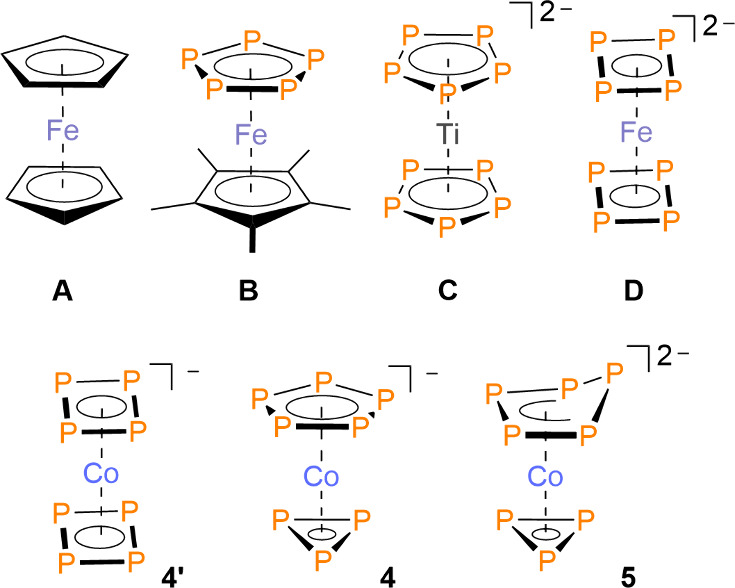 Figure 1
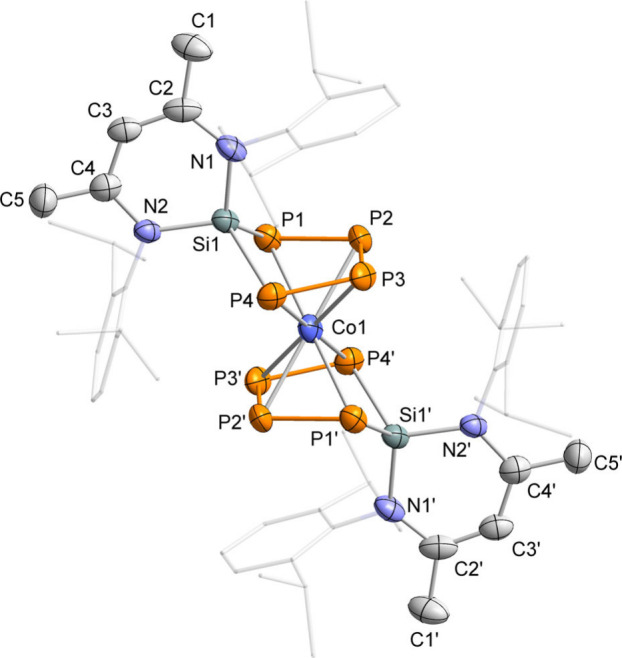 Figure 2
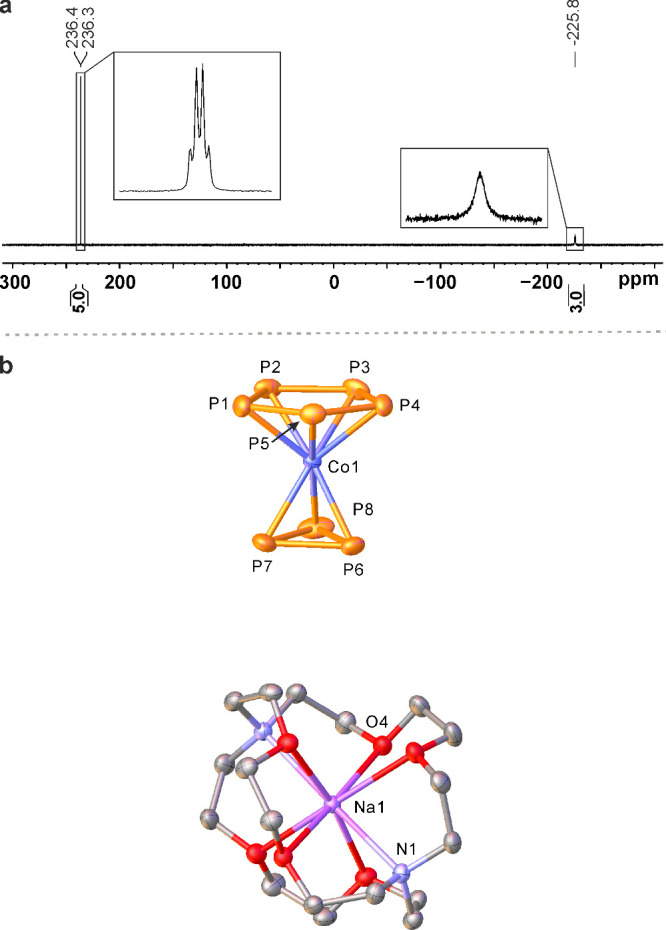 Figure 3
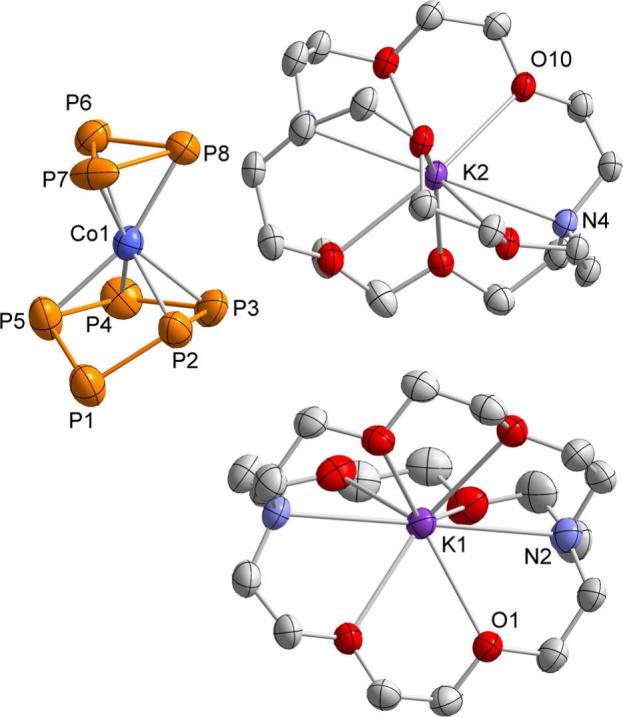 Figure 4
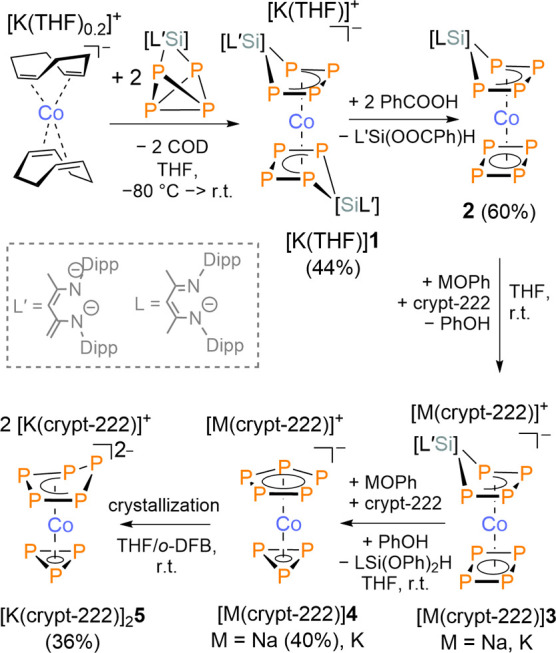 Figure 5
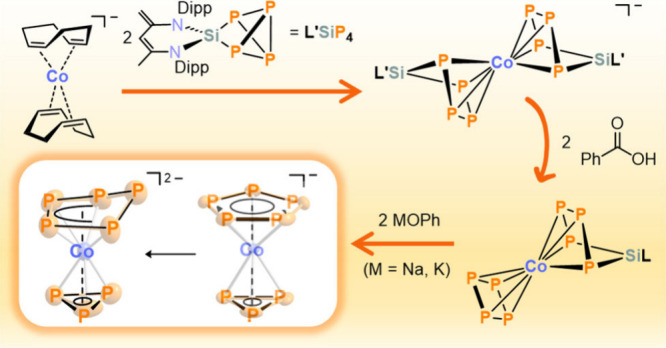 Figure 6
- —European Commission10.13039/501100000781
- —Deutsche Forschungsgemeinschaft10.13039/501100001659
- —Deutsche Forschungsgemeinschaft10.13039/501100001659
- —European Synchrotron Radiation Facility10.13039/501100001671
Peer Reviews
No public reviews on file for this paper yet. If you reviewed it on a platform where reviews are public (OpenReview, ICLR, NeurIPS, ICML), you can paste yours below so the community can read it here.
Videos
No videos yet. Explain this paper in a talk, walkthrough, or lecture? Add one.
Taxonomy
TopicsSynthesis and characterization of novel inorganic/organometallic compounds · Organometallic Complex Synthesis and Catalysis · Crystal structures of chemical compounds
Sandwich complexes such as ferrocene, Cp_2_Fe (A, Cp = η^5^-C_5_H_5_), are a significant class of organometallic compounds. ?−? ? ? Numerous sandwich complexes have been synthesized, and metallocenes in particular have been widely used in catalysis, materials science, and medicinal chemistry. ?−? ? ? ? Recently, there has been renewed interest in their redox chemistry, leading to the discovery of rare metallocene anions and dications. ?−? ? ?
Based on the isolobal analogy, the CH units in a Cp ligand can be formally substituted by a phosphorus atom.? Baudler and co-workers demonstrated an application of this idea by synthesizing the pentaphosphacyclopentadienide (P_5_ ^–^) anion, a genuine phosphorus analogue of Cp^–^.? The solid-state molecular structure of P_5_ ^–^ and its assembly on the Ag(111) surface were reported recently. ?,? The reaction of P_5_ ^–^ with FeCl_2_ in the presence of LiCp* (Cp* = C_5_Me_5_) yielded the pentaphosphaferrocene [Cp*Fe(η^5^-P_5_)] (B, Chart), which has been applied as a building block in supramolecular chemistry. ?,?,?
In contrast to the rich chemistry of hydrocarbon-based metallocenes, carbon-free sandwich complexes are largely unexplored, with only two examples reported to date. A landmark report by Ellis demonstrated the synthesis of the carbon-free sandwich complex [(η^5^-P_5_)2_Ti]^2–^ (C, Chart) through the reaction of white phosphorus (P_4) with the highly reduced titanate [Ti(η^4^-C_10_H_8_)3]^2–^ (C_10_H_8_ = naphthalene).? Additionally, Sun has recently reported the complex [(η^4^-P_4_)2_Fe]^2–^ (D, Chart), which has been synthesized by the reaction of in situ-generated P_4 ^2–^ with Fe(OtBu)3.? Carbon-free sandwich-like compounds based on As and Sb have also been reported.? Here, we describe the inorganic sandwich complex [(η^5^-P_5_)Co(η^3^-P_3_)]^−^ (4), accessed via a stepwise P_4_ activation/unmasking sequence that enables deliberate installation of “naked” cyclo-P_n_ decks. To our knowledge, complex 4 is the first carbon-free sandwich complex of cobalt and the first example containing two different *cyclo-*P_n_ ligands. In solution, complex 4 disproportionates slowly to generate the dianion [(η^4^-P_5_)Co(η^3^-P_3_)]^2–^ (5).
DFT calculations showed that 4 is a viable species with calculated ^31^P NMR signals at δ = 243 ppm and −211 ppm. The putative isomer [Co(η^4^-P_4_)2]^−^ (4′) analogous to complex D is higher in energy by 11.5 kcal·mol^–1^. Building on previous studies of P_4_ activation by low-oxidation-state cobalt complexes, ?−? ? ? we initially attempted to synthesize 4 by reaction of P_4_ with cobaltate anions, such as [K([18]-crown-6)][Co(η^4^-C_14_H_10_)2], and [K(THF)0.2][Co(η^2^:η^2^-1,5-cod)2] (C_14_H_10_ = anthracene, cod = 1,5-cyclooctadiene). ?−? ? However, these reactions did not produce 4 or any other tractable product. Given the complex reactivity of P_4_ and its well-known tendency to oligomerize,? we reasoned that a stepwise activation procedure would be more suitable and devised a simple synthetic strategy based on the previously reported SiP_4_ compound (nacnac′)SiP_4_ (nacnac′ = CH[(CCH_2_)CMe][N(2,6-iPr_2_C_6_H_3_)]2), which is readily accessible from P_4_ and Driess’s silylene (nacnac′)Si (Scheme).?
The addition of [K(THF)0.2][Co(η^2^:η^2^-cod)2] to a solution of (nacnac)SiP_4_ in THF at low temperature (−80 °C) readily gave [K(THF)][Co{η^4^-P_4_Si(nacnac′)}2] ([K(THF)]1, Scheme) in 44% isolated yield. The ^31^P{^1^H} NMR spectrum reveals signals corresponding to two partly overlapping AA′A″A‴XX′X″X‴ spin systems, corresponding to two isomers, which arise from different orientations of the asymmetrical nacnac′ ligands (see SI).
Crystals suitable for single-crystal X-ray diffraction (scXRD) were obtained by recrystallization of [K(THF)]1 from DME/n-hexane. The solid-state molecular structure of the resulting DME-containing salt of [K(DME)3]1 confirms that two (nacnac′)SiP_4_ are coordinated to cobalt with the (nacnac′)Si moieties in a transoid orientation (Figure). As expected, the P atoms form a planar, butadiene-like arrangement. ?,?
Next, we investigated the release of one (nacnac′)Si moiety. Treatment of [K(THF)]1 with benzoic acid (2.0 equiv) afforded the complex [(η^4^-P_4_)Co{η^4^-P_4_Si(nacnac)}] (2), featuring a cyclo-P_4_ ring and an η^4^-coordinated silatetraphosphacyclopentadiene ligand (Scheme). The side-product (nacnac′)Si(H)(OOCPh) was detected by multinuclear NMR spectroscopy (see SI). Complex 2 was isolated as a brown powder by precipitation from a THF solution with Et_2_O/n-hexane (1:3 v:v) in 60% yield. Its identity was confirmed by multinuclear NMR and a preliminary scXRD analysis, which confirmed the atom connectivity (see SI). The ^31^P{^1^H} NMR spectrum shows an A_4_MM′XX′ spin system with a singlet at δ(P_A_) = 175.0 ppm corresponding to the cyclo-P_4_ moiety (Figure S15).
Motivated by a report by Cordaro and Grützmacher on the synthesis of cyaphide (CP^–^) complexes through the desilylation of silylphosphaalkynes R_3_SiCP with NaOPh, we attempted to remove the remaining Si(nacnac′) unit by reaction with phenoxides MOPh.? Gratifyingly, NaOPh and KOPh (2.0 equiv) selectively react with 2 in the presence of [2.2.2]-cryptand (crypt-222, 2.0 equiv) to generate the target complexes [M(crypt-222)][(η^5^-P_5_)Co(η^3^-P_3_)] ([M(crypt-222)]4, M = Na, K) and (nacnac)SiH(OPh)2 as the presumed byproduct (Scheme). Variable-temperature ^31^P{^1^H} NMR reaction monitoring studies revealed that the reaction proceeds stepwise, initially forming 3, which is identified by a similar A_4_MM′XX′ spin system as 2 with resonances at δ = 159.3 (P_A_), 108.0 (P_MM′) and −63.7 (P_XX′) ppm in an integral ratio of 4:2:2 (Figures S18 and S27). Compound 3 is the only detectable product in the temperature range of 193 to 273 K. At 298 K, the formation of [K(crypt-222)]4 becomes visible. After 3 h at room temperature, 3 is fully converted to [K(crypt-222)]4. Compound 3 is the major phosphorus-containing product in the reaction of 2 with an equimolar amount of KOPh (1.0 equiv) and crypt-222 (1.0 equiv, Figure S23) and the reaction of [K(THF)]1 with PhOH (2.0 equiv, Figure S18).
The constitution of 4 was initially confirmed by heteronuclear NMR spectroscopy and electrospray ionization mass spectrometry (ESI-MS). ESI-MS of the reaction solution detected the molecular ions of 4 at m/z = 306.7248 in the negative ion mode and [K(crypt-222)]^+^ at m/z = 415.2230 in the positive ion mode. The ^31^P{^1^H} NMR spectra of [M(crypt-222)]4 (M = Na, K) display two resonances (Figurea) in a 5:3 integral ratio. The low-field resonance at δ = 239.1 ppm is assigned to the cyclo-P_5_ ligand. This signal appears as a singlet at room temperature and resolves into a quartet due to ^31^P–^31^P coupling with the cyclo-P_3_ moiety at 193 K (J PP = 15.3 Hz). The broad singlet at δ = −225.8 ppm (Δν_1/2_ = 874 Hz) arising from the cyclo-P_3_ unit is consistent with the characteristically deshielded ^31^P NMR signals of end-deck cyclo-P_3_ transition metal complexes. ?,? The chemical shifts of 4 are in good agreement with those calculated by DFT (vide supra). Based on variable-temperature NMR studies down to 153 K, the rotation of cyclo-P_3_ and cyclo-P_5_ ligands is associated with low activation barriers, similar to those observed for the valence-isoelectronic complex [Cp‴Ni(η^3^-P_3_)] and organic sandwich compounds (see SI). ?,? The broadening of the ^31^P NMR signals is due to an additional, unidentified exchange process.
Crystallization of [Na(crypt-222)]4 and [K(crypt-222)]4 is hindered by the presence of nacnac-containing byproducts. However, [Na(crypt-222)]4 can be isolated as an orange-brown solid by filtration of a THF/toluene solution over alumina. This procedure removes byproducts and leads to the exchange of K^+^ for Na^+^ (see SI). Subsequent cooling to −35 °C yielded crystals of [Na(crypt-222)]4 suitable for scXRD (Figureb). The molecular structure shows the expected heteroleptic complex 4, featuring a planar η^5^-cyclo-P_5_ ligand (P–P 2.1103(7)-2.1283(8) Å) and an η^3^-cyclo-P_3_ ring (P–P 2.1317(8)-2.1382(7) Å). The structure is reminiscent of [CpNi(η^3^-C_3_Ph_3_)], a valence-isoelectronic hydrocarbon-based analogue of 4. ?,? The P–P distances are typical for cyclo-P_3_ ligands and cyclo-P_5_ ligands and indicate partial multiple bond character. While several cyclo-P_3_ cobalt complexes are known, ?,?,?−? ? ? ? ? the complex [(η^5^-P_5_)Co{η^2^-P_2_H(Mes)}]^2–^, prepared from K_3_P_7_ and [Co(Mes)2(PEt_2_Ph)2] (Mes = 2,4,6-Me_3_C_6_H_2_) by Goicoechea and co-workers, appears to be the only other crystallographically characterized, mononuclear cyclo-P_5_ cobalt complex.?
A quantum crystallographic Hirshfeld atom refinement of 4 indicates a typical tetrahedrane-like bonding environment similar to that reported for [Cp‴Ni(η^3^-P_3_)] and P_4_. ?,? Calculations of nucleus-independent chemical shifts and natural resonance theory suggest substantial aromatic character of the cyclo-P_3_ ligand (see the SI).
In solution, [K(crypt-222)]4 undergoes slow disproportionation over several days, leading to a decline in the signal-to-noise ratio in the ^31^P{^1^H} NMR spectra (Figure S25) and resulting in the formation of the paramagnetic complex [K(crypt-222)]2[(η^4^-P_5_)Co(η^3^-P_3_)] ([K(crypt-222)]2 5), which was isolated in small amounts. This process additionally generates a dark brown precipitate, presumably a mixture of cobalt phosphides of unknown constitution. The nature of this solid is currently under investigation. Cyclic voltammetry shows that [Na(crypt-222)]4 is reduced at a cathodic peak potential of E p,c = −2.8 V vs Fc/Fc^+^, probably to 5 (Figure S31). Crystals of [K(crypt-222)]2 5 were obtained by extraction of the crude reaction mixture of 2, KOPh (2.0 equiv) and crypt-222 (2.0 equiv) with toluene/THF (1:1, v:v) and o-DFB (1,2-F_2_C_6_H_4_). An scXRD study revealed that [K(crypt-222)]2 5 crystallizes as a separated ion triple with a [(η^4^-P_5_)Co(η^3^-P_3_)]^2–^ dianion and two [K(crypt-222)]^+^ cations in the asymmetric unit (Figure). The anion features an η^3^-coordinated cyclo-P_3_ ring and an envelope-shaped η^4^-ccordinated cyclo-P_5_ moiety. One of the P atoms (P5) is bent away from the cobalt atom. This arrangement maintains an 18-valence-electron count at cobalt.? As a result, the Co–P and P–P bond lengths are similar to those in [K(crypt-222)]4.
The composition of [K(crypt-222)]2 5 was confirmed by elemental analysis and powder X-ray diffraction of the bulk solid (see SI). Compound 5 is likely formed from the disproportionation of 4 into 5 and neutral, unidentified polyphosphorus compounds. In agreement with the expected paramagnetic behavior, an X-band EPR spectrum on a solid sample of [K(crypt-222)]2 5 at 10 K shows a nearly axial, broad signal with g _ iso _ = 2.03 (Figure S28). Hyperfine couplings to the Co or P nuclei are not resolved. After dissolving a solid sample of [K(crypt-222)]2 5 in a mixture of 2-methyltetrahydrofuran and o-DFB, freezing the solution immediately after dissolution and recording the EPR spectrum at 10 K, a weak and broad signal can be detected, which is similar to the signal of solid [K(crypt-222)]2 5 (Figure S29). This reveals an S = 1/2 species consistent with the solid-state sample. DFT calculations reproduce well the experimental g-values and predict a rather large hyperfine coupling to Co and P. However, the magnitude of the hyperfine coupling is considerably lower than the line width (Table S3). According to the DFT calculations, the spin density in 5 is mainly located at the out-of-plane phosphorus atom and in a lesser extent on the cobalt center (Figure S30).
In conclusion, we have presented a new synthetic strategy for carbon-free transition metal polyphosphido complexes. Using the compound (nacnac′)SiP_4_ originating from P_4_ activation and the silylene (nacnac′)Si, this approach has led to the isolation of the remarkable complexes [K(crypt-222)]4 and [K(crypt-222)]2 5, which are the first inorganic sandwich compounds isolated in two different oxidation states and with two different cyclo-P_n_ ligands. Notably, the stepwise “protect–activate–unmask” logic enables controlled access to heteroleptic, carbon-free sandwich architectures that are otherwise difficult to obtain from direct P_4_ activation. These results demonstrate that the stepwise activation of P_4_ constitutes a promising approach for accessing unprecedented transition-metal compounds. Efforts to synthesize additional inorganic sandwich compounds using this methodology and further investigations into the properties and reactivity of [M(crypt-222)]4 and [K(crypt-222)]2 5 are underway.
Supplementary Material
The reference list from the paper itself. Each links out to its DOI / PubMed record.
- 1Kealy T. J.Pauson P. L.A New Type of Organo-Iron Compound Nature 19511681039104010.1038/1681039 b 0 · doi ↗
- 2Goodwin C. A. P.What Is a Sandwich Complex?Organometallics 20244359559710.1021/acs.organomet.4c 00017 · doi ↗
- 3Long, N. J. Metallocenes: An Introduction to Sandwich Complexes; Blackwell Science Ltd, 1998.
- 4Metallocenes, Synthesis, Reactivity, Applications; Togni, A. , Halterman, R. L. , Eds.; Wiley VCH: Weinheim, 1998. 10.1002/9783527619542. · doi ↗
- 5Beer P. D.Hayes E. J.Transition Metal and Organometallic Anion Complexation Agents Coord. Chem. Rev.200324016718910.1016/S 0010-8545(02)00303-X · doi ↗
- 6Dai L.-X.Tu T.You S.-L.Deng W.-P.Hou X.-L.Asymmetric Catalysis with Chiral Ferrocene Ligands Acc. Chem. Res.200336965966710.1021/ar 020153 m 12974649 · doi ↗ · pubmed ↗
- 7van Staveren D. R.Metzler-Nolte N.Bioorganometallic Chemistry of Ferrocene Chem. Rev.2004104125931598610.1021/cr 010151015584693 · doi ↗ · pubmed ↗
- 8Astruc D.Why Is Ferrocene so Exceptional?Eur. J. Inorg. Chem.2017201762910.1002/ejic.201600983 · doi ↗