Stabilization of the [C2N5]7– Anion in Recoverable High-Pressure Eu4Fe0.864(6)(C2N5)2 Pyronitridocarbonate
Fariia Iasmin Akbar, Nityasagar Jena, Christian Tobeck, Pascal L. Jurzick, Niko T. Flosbach, Valerio Cerantola, Elena Bykova, Lukas Brüning, Andrey Aslandukov, Dominik Spahr, Valentin Kovalev, Gaston Garbarino, Anna Pakhomova, Georgios Aprilis, Nico Giordano, Leonid Dubrovinsky

TL;DR
Scientists created a new inorganic compound with unique nitrogen-rich anions using high-pressure synthesis and confirmed its structure with advanced techniques.
Contribution
The first synthesis and characterization of the hydrogen-free pyronitridocarbonate Eu4Fe0.864(6)(C2N5)2 with novel [C2N5]7– anions.
Findings
Eu4Fe0.864(6)(C2N5)2 was synthesized at 50(3) GPa and features [C2N5]7– anions.
The compound is recoverable at near-ambient pressure and partially decomposes into [CN3]5– and [CN2]2– anions.
Crystal structures were confirmed using synchrotron X-ray diffraction and DFT calculations.
Abstract
Synthesis at extreme conditions enables access to nitrogen-rich carbon–nitrogen anions that cannot be obtained at ambient conditions. Here, through a direct reaction between Eu(N3)2 and EuC2 with Fe in a laser-heated diamond anvil cell (DAC) at 50(3) GPa, we synthesized the first inorganic hydrogen-free pyronitridocarbonate, Eu4Fe x (C2N5)2, x = 0.864(6), featuring novel highly charged [C2N5]7– anions, along with the first stoichiometric oxygen-free rare-earth metal guanidinate Eu5(CN3)3. The crystal structures of both compounds were determined via synchrotron single-crystal X-ray diffraction (SCXRD) and fully corroborated by density functional theory (DFT) calculations. Eu4Fe x (C2N5)2 was found to be recoverable at pressures close to ambient. Keeping the sample at ambient conditions for 1 day leads to splitting of half of the [C2N5]7– units in Eu4Fe x (C2N5)2 into the guanidinate…
Genes, proteins, chemicals, diseases, species, mutations and cell lines named across the full text — each resolved to its canonical identifier and authoritative record.
Click any figure to enlarge with its caption.
 1
1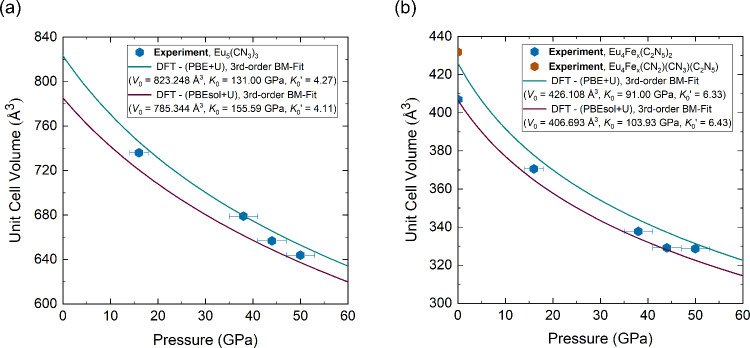 2
2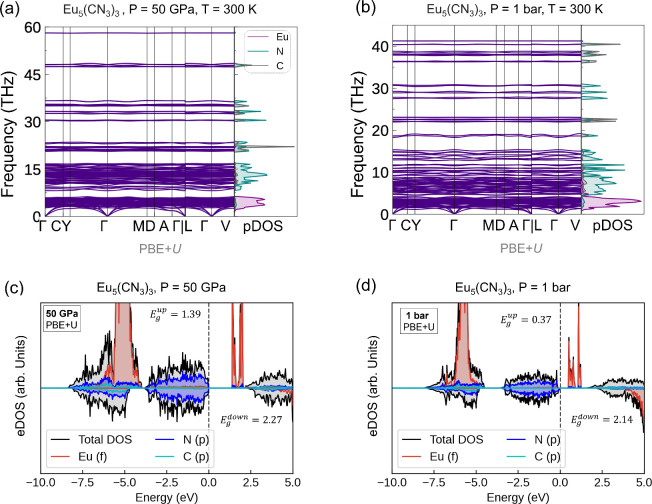 3
3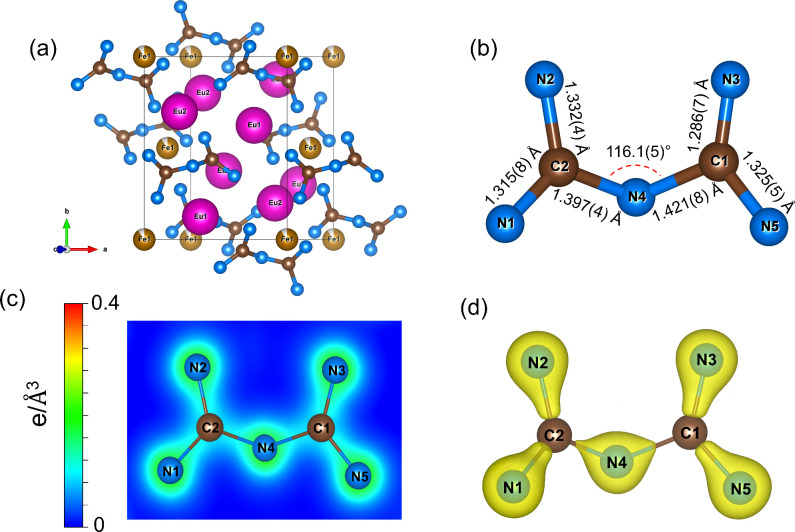 4
4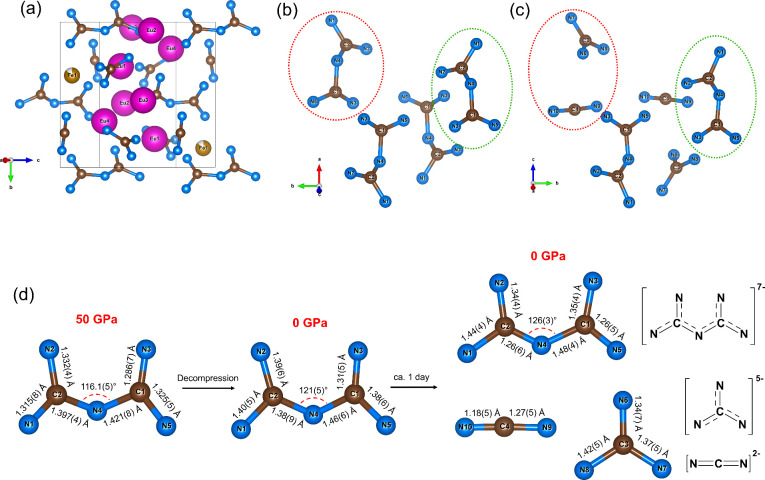 5
5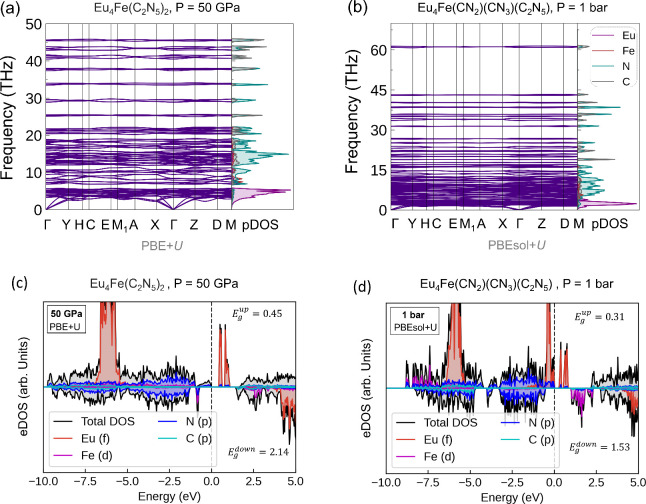 6
6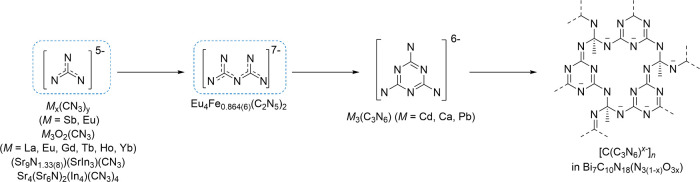 7
7- —European Research Council10.13039/501100000781
- —Deutsche Forschungsgemeinschaft10.13039/501100001659
- —Deutsche Forschungsgemeinschaft10.13039/501100001659
- —Deutsche Forschungsgemeinschaft10.13039/501100001659
- —Hessisches Ministerium f?r Wissenschaft und Kunst10.13039/501100003495
- —Link?pings Universitet10.13039/501100003945
- —Knut och Alice Wallenbergs Stiftelse10.13039/501100004063
- —Knut och Alice Wallenbergs Stiftelse10.13039/501100004063
- —Vetenskapsr?det10.13039/501100004359
- —Vetenskapsr?det10.13039/501100004359
- —Johanna Quandt Stiftung10.13039/501100022604
Peer Reviews
No public reviews on file for this paper yet. If you reviewed it on a platform where reviews are public (OpenReview, ICLR, NeurIPS, ICML), you can paste yours below so the community can read it here.
Videos
No videos yet. Explain this paper in a talk, walkthrough, or lecture? Add one.
Taxonomy
TopicsHigh-pressure geophysics and materials · Inorganic Chemistry and Materials · Thermal Expansion and Ionic Conductivity
Introduction
Synthesis and stabilization of compounds containing complex nitridocarbonate anions is an emerging topic in high-pressure chemistry, offering access to previously unknown bonding motifs and highly charged carbon–nitrogen species. Carbon–nitrogen anions occur in important classes of inorganic solids and include widely studied cyanides [CN]^− ^ ? and carbodiimides [CN_2_]^2–^, ?,? as well as less common acetonitriletriides [C_2_N]^3–^, ?,? dicyanamides [N(CN)2]^−^,? tricyanidomethanides [C(CN)3]^−^,? tetracyanoethylene radicals [C_2_(CN)4]^•–^,? pentacyanoethanides [C_2_(CN)5]^−^,? pentacyanopropenides [NCC{C(CN)2}2]^−^, ?,? guanidinates [CN_3_]^5–^,? tricyanidomelaminates [C_6_N_9_]^3–^,? melonates [C_6_N_7_(NCN)3]^3–^,? cyanopolyynides [C_2n+1_N]^−^ (n = 0, 1, 2),? cyano adduct anions of fullerenes [C_60_(CN)_ n ]^−^ (n = 1, 3, 5),? [C_60(CN)_ n ]^2–^ (n = 2, 4, 6),? [C_70(CN)_ n ]^−^ (n = 1, 2, 3), and [C_70(CN)_ n ]^2–^ (n = 2, 4, 6).? Ternary M–C–N compounds featuring nitrogen–nitrogen bonds are represented by the derivatives of tetrazole, e.g., 5-azidotetrazolate [CN_7]^−^,? 5,5′-azotetrazolate [N_2_(CN_4_)2]^2–^, ?,? and 4,5-bis(tetrazol-5-yl)-2H-1,2,3-triazolate [C_2_N_3_(CN_4_)2]^3–^.?
Despite this structural diversity, most C–N anions remain nitrogen-poor. High-pressure synthesis is effective way to stabilize nitrogen-rich species, as was shown on the examples of various polynitrides. ?−? ? ? ? ? ? ? Recent high-pressure reactions in multicomponent C–N systems yielded compounds featuring guanidinate [CN_3_]^5–^, ?,? melaminate [C_3_N_6_]^6–^, ?,? as well as the poly-N-(1,3,5-triazin-2-yl)-guanidine anions in Bi_7_C_10_N_18_(N_3(1–x)_O_3x ).? Syntheses at megabar pressure revealed the formation of polynitridocarbonates formed by anionic three-dimensional framework consisting of CN_4 tetrahedra connected via di- or oligo-nitrogen linkers.?
Despite recent discoveries in ternary C–N-containing compounds, many potential forms of C–N anions remain unknown. A similar tendency to form a wide variety of species composed of two light elements has been identified in high-pressure carbonates, where pressure stabilizes pyrocarbonates containing [C_2_O_5_]^2–^ anions. ?−? ? ? ? ? We hypothesize that by analogy with a series of carbonate-pyrocarbonate species, the elusive pyronitridocarbonate anion [C_2_N_5_]^7–^ may also exist and be accessible in a high-pressure synthesis. The biggest challenge is to stabilize a relatively high odd-number charge in a rather small anion. Highly charged anions are typically found either in extended polyanionic frameworks (e.g., in Bi_7_C_10_N_18_(N_3(1–x)O_3x ),? LaCN_3 and CeCN_5 ?) or within large, isolated clusters ([P_3_N_9_]^12–^ in Li_12_P_3_N_9_, [P_4_N_10_]^10–^ in α-/β-Li_10_P_4_N_10_, and [B_3_P_3_N_13_]^15–^ in Li_47_B_3_P_14_N_42_).? Small highly charged isolated anions are rare. Among examples are the ethanide anions [C_2_]^6–^ in Dy_3_C_2._
In this work, we present the synthesis of the first inorganic hydrogen-free pyronitridocarbonate Eu_4_Fe_0.864(6)(C_2_N_5)2 featuring [C_2_N_5_]^7–^ anionsfully deprotonated derivatives of biguanide C_2_N_5_H_7_.? Under similar conditions we also obtained the first stoichiometric oxygen-free rare-earth element nitridocarbonate, Eu_5_(CN_3_)3.
Results and Discussion
We employed a new high-pressure synthetic strategy to access ternary and quaternary nitridocarbonates by laser-heating a mixture of europium azide Eu(N_3_)2 and europium carbide EuC_2_ with a minor amount of iron in a DAC. Products of chemical reaction performed at 50(3) GPa and a temperature of 2800(200) K were identified by means of SCXRD at ESRF (ID15b, ID27) and DESY (P02.2) (see section Methods in the Supporting Information). The multigrain diffraction data analysis revealed the formation of several novel compounds in the laser-heated area. Full experimental details are provided in Tables S1–S6 and Figures S1–S4 of the Supporting Information. All supplemental results of the theoretical calculations are given in Tables S7–S10, Figures S5–S15, and Discussion S1. In the following sections, we describe the crystal structures and physical properties of two main products: Europium(III) nitridocarbonate Eu_5_(CN_3_)3 and Europium(III)–Iron(II)-pyronitridocarbonate Eu_4_Fe_0.864(6)(C_2_N_5)2.
Europium Nitridocarbonate Eu5(CN3)3
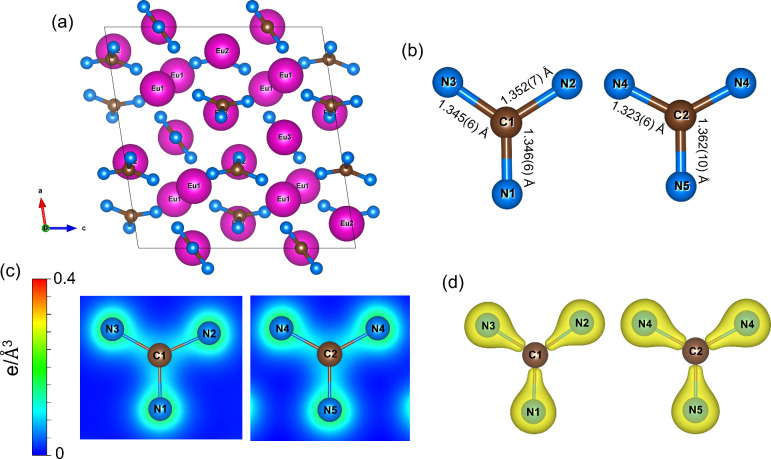
Europium guanidinate Eu_5_(CN_3_)3 crystallizes in the monoclinic space group C2/c (Figure, Table S2) and contains three crystallographically unique Eu atoms (Eu1 and Eu2 occupying the 8f Wyckoff site, and Eu3 on the 4e site). The structure features two symmetry-independent guanidinate anions [CN_3_]^5–^ with C–N distances varying in the range of ∼1.32–1.36 Å (Figureb), consistent with those reported for SbCN_3,_ ? Ln_3_O_2_(CN_3_) (Ln = La, Eu, Gd, Tb, Ho, Yb),? Sr_4_(Sr_6_N)2[In_4_][CN_3_]4, and (Sr_9_N_1.33(8))(SrIn_3)[CN_3_],? supporting the formal C–N bond order of 1.33. Europium atoms are coordinated by 9 or 10 nitrogen atoms, forming a distorted monocapped tetragonal antiprism (Eu1), a cis-bicapped cube (Eu2), and a tricapped trigonal prism (Eu3) (Figure S2a). Eu_5_(CN_3_)3 remains detectable via synchrotron XRD down to 16(2) GPa during decompression (Table S3).
Crystal structure of europium guanidinate Eu5(CN3)3 at 50(3) GPa. All Eu atoms are purple, C atoms are brown, and N atoms are blue; gray thin lines outline the unit cell. (a) The unit cell in projection along the b axis. (b) A view of the [CN3]5– units. (c) Charge density distribution in plains containing the [CN3]5– unit atoms. (d) Charge density isosurfaces of the guanidinate anions (with an isosurface level of 0.3).
The experimental crystal structure of Eu_5_(CN_3_)3 was fully optimized at 50 GPa within the GGA+U framework using both the PBE+U and PBEsol+U functionals. The optimized lattice parameters at 50 GPa exhibit excellent agreement with experimental values obtained from SCXRD data with a deviation of less than 2% (Table S8).
A BM3 EoS was used to describe volume–pressure dependence obtained from DFT calculations in the range of 0–60 GPa, yielding equilibrium unit cell volumes of 823 Å^3^ and 785 Å^3^ using PBE+U and PBEsol+U functionals, respectively, with an estimated bulk modulus K 0 in the range of 130–155 GPa (Figurea). Lattice parameters of Eu_5_(CN_3_)3 increase monotonically upon pressure release over the entire pressure range without any sign of lattice distortions (Figure S5a). Phonon dispersion relations calculated using the harmonic approximation (Figure S6) indicate dynamical instabilities in Eu_5_(CN_3_)3 both at the synthesis pressure and at 1 bar, attributed to C–N bond asymmetry in the [CN_3_]^5–^ units. This instability is lifted by using finite-temperature phonon dispersion calculations at T = 300 K via the sTDEP method (Figurea, b).
(a) The pressure dependence of the unit cell volume of Eu5(CN3)3 over a pressure range of 0–60 GPa, calculated using both PBE+U and PBEsol+U functionals within the DFT+U framework, compared with the experimental data. Solid lines correspond to the third-order Birch–Murnaghan Equation of State (BM3 EoS) based on DFT calculations. (b) The pressure dependence of the unit cell volume of Eu4Fe(C2N5)2. The experimental data at ambient conditions for the Eu4Fe(CN2)(CN3)(C2N5) is marked by different color (brown).
(a)–(b) Finite temperature phonon dispersion relations and the phonon density of states (pDOS) for Eu5(CN3)3 at 50 GPa, and 1 bar, respectively, calculated using the sTDEP methods at T = 300 K. (c)–(d) Spin-resolved electronic density of states (eDOS) for Eu5(CN3)3 at 50 GPa and 1 bar, respectively, calculated using PBE+U functional.
Within the PBE+U calculations, at 50 GPa, Eu_5_(CN_3_)3 is an insulator with an energy gap between the occupied N 2p-states and unoccupied highly localized Eu 4f states of 1.39 eV for the spin-up channel and 2.27 eV for the spin-down channel (Figurec). Comparable bandgap values were obtained using the PBEsol+U functional (Table S8, Figures S7a and S8b). Eu_5_(CN_3_)3 remains insulating over the entire pressure range from 50 GPa to 1 bar (Figurec, d).
The occupied Eu 4f states lie at ∼6 eV below the Fermi energy, and nitrogen 2p orbitals dominate the valence band edge. The bandgap of Eu_5_(CN_3_)3 decreases monotonically upon decompression with an increasing discrepancy between PBE+U and PBEsol+U bandgap energy values (Figure S7a). Each europium atom in Eu_5_(CN_3_)3 carries a calculated magnetic moment of 6 μ_ B _, with unoccupied localized 4f states near the conduction band edge comprising one f-electron from each europium atom.
Although the finite-temperature (T = 300 K) phonon dispersion relation calculated for Eu_5_(CN_3_)3 at ambient pressure shows the lattice dynamic stability of the compound (Figureb), it was not observed in our SCXRD experiments below a pressure of 16 GPa (Figurea).
Europium–Iron Pyronitridocarbonate Eu4Fe
x (C2N5)2
Europium–iron pyronitridocarbonate, Eu_4_Fe_ x (C_2_N_5)2, x = 0.864(6) (space group P2_1_/c) (Table S4), contains an unprecedented pyronitridocarbonate [C_2_N_5_]^7–^ anion (Figures and S3), representing the fully deprotonated form of biguanide C_2_N_5_H_7_.? Europium, iron, nitrogen, and carbon atoms in Eu_4_Fe_ x (C_2_N_5)2 occupy the following Wyckoff sites: 4e (Eu1, Eu2, N1–N5, C1, and C2) and 2a (Fe1) (Table S4). Two symmetry-independent Eu atoms, Eu1 and Eu2, are coordinated by 10 and 11 nitrogen atoms, respectively, forming a distorted bicapped tetragonal antiprism and a fully capped trigonal prism. Fe1 atoms feature octahedral coordination (Figure S2b).
Crystal structure of europium pyronitridocarbonate Eu4Fe x (C2N5)2 at 50(3) GPa. Eu atoms are purple, Fe atoms are yellow, C atoms are brown, and N atoms are blue; gray thin lines outline the unit cell. (a) A general view of the crystal structure of Eu4Fe x (C2N5)2. (b) A pyronitridocarbonate anion geometry. (c) Charge density distribution in plains containing the [C2N5]7– unit atoms. (d) Charge density isosurface of the pyronitridocarbonate anion (with an isosurface level of 0.3).
The C–N distances in the [C_2_N_5_]^7–^ units of Eu_4_Fe_ x (C_2_N_5)2, determined at 50(3) GPa, are equal to ∼1.40–1.42 Å for bridging nitrogen atoms and ∼1.29–1.33 Å for the terminal nitrogen atoms (Figureb). Both distance ranges indicate an intermediate state between a single C–N bond (∼1.47 Å?) and a bond of order 1.5, as observed in pyridine (d C–N ∼ 1.34 Å ?,? ). Moreover, bond orders derived from the resonance forms of the biguanide molecule C_2_N_5_H_7_ ? are consistent with the C–N distances in the [C_2_N_5_]^7–^ anions: 1.25 for the bridging atom and 1.375 for the terminal ones. The charge density distribution clearly shows the difference between the bridging and terminal C–N bonds in [C_2_N_5_]^7–^ (Figurec, d), specifically, the peripheral bonds show a more pronounced electron density (Figurec, d). The geometry of the observed nonplanar [C_2_N_5_]^7–^ anions (Figuresb and S3) can be compared to those in pyrocarbonates, possessing a wide variety of anion geometries. ?−? ? ? ? ?
The partial occupancy x = 0.864(6) of Fe in Eu_4_Fe_ x (C_2_N_5)2, along with the interatomic C–N distances, was determined through the statistical analysis of 26 individual structure refinements (as described in the Methods section). The Mössbauer spectrum of Eu_4_Fe_ x (C_2_N_5)2 at 50(3) GPa represents a singlet component with a center shift of 0.26 mm/s (Figure S4), in agreement with a low-spin state of Fe^2+^ in an octahedral coordination. ?,? The low signal intensity is attributed to the fact that the sample was prepared with naturally occurring iron rather than ^57^Fe-enriched iron, which is typically used in high-pressure experiments exploiting Mössbauer spectroscopy as an analytical technique. The deviation from 100% Fe site occupancy requires the presence of a fraction of Fe^III^ for the charge balance (e.g., Eu_3_Fe^II^ 0.592_Fe^III^ 0.272(C_2_N_5)2). The Fe^III^ component, regardless of its spin state, may lie below the detection limit of Mössbauer spectroscopy due to the low signal-to-noise ratio and overlap with the signal from the beamline optics and is therefore not clearly observable in the spectrum. Nonstoichiometry in iron-containing compounds, where iron is present predominantly in the +II oxidation state with a smaller proportion in the +III state, is well-known, as exemplified by wüstite Fe_1–x _O. ?,?
Decompression of the DAC containing the sample demonstrated the recoverability of Eu_4_Fe_ x (C_2_N_5)2 down to ambient pressure (Tables S5 and S6). After ca. 1 day under ambient conditions, half of the [C_2_N_5_]^7–^ anions split into guanidinate [CN_3_]^5–^ and carbodiimide [CN_2_]^2–^ anions (Figuresb–d and S3), resulting in an abrupt increase of the unit cell volume and symmetry lowering (Table S6) in the compound, whose chemical formula can be written as Eu_4_Fe_ x (CN_2)(CN_3_)(C_2_N_5_).
Crystal structure of the europium pyronitridocarbonate after chemical transformation to Eu4Fe x (CN2)(CN3)(C2N5) under ambient conditions. Eu atoms are purple, Fe atoms are yellow, C atoms are brown, and N atoms are blue; gray thin lines outline the unit cell. (a) A general view of the crystal structure of Eu4Fe x (CN2)(CN3)(C2N5). (b) A view of the [C2N5]7– units before chemical transformation. (c) A view of the C–N anions after chemical transformation at ambient conditions. (d) Schematic representation of the [C2N5]7– anion splitting into guanidinate [CN3]5– and carbodiimide [CN2]2– anions.
The DFT+U optimized crystal structure of Eu_4_Fe(C_2_N_5_)2 (space group P2_1_/c) at 50 GPa shows excellent agreement with the experimental crystal structure obtained from SCXRD (Tables S4 and S9). In the DFT calculations, we used an idealized chemical composition with x = 1 for both Eu_4_Fe_ x (C_2_N_5)2 and Eu_4_Fe_ x (CN_2)(CN_3_)(C_2_N_5_). At ambient pressure, the calculated unit cell volume of Eu_4_Fe(CN_2_)(CN_3_)(C_2_N_5_) differs from experiment by ∼5% with PBE+U, whereas PBEsol+U significantly improves the agreement with an error of less than 1.3% (Figureb, Table S9).
A BM3 fit to the pressure–volume data of Eu_4_Fe(C_2_N_5_)2 yields an equilibrium unit cell volume of 426 Å^3^ and 406 Å^3^ using PBE+U and PBEsol+U, respectively (Figureb, with an estimated bulk modulus in the range of 90–100 GPa). The lattice parameters calculated within PBE+U closely match the experiment at 50 GPa, whereas PBEsol+U provides better agreement at ambient pressure. At 50 GPa, Eu_4_Fe(C_2_N_5_)2 is dynamically stable as shown in Figurea. The experimental unit cell volumes at the intermediate pressure range 45–15 GPa fall between the PBE+U and PBEsol+U predictions (Figureb). Additionally, the lattice parameters (a, b, and c) of Eu_4_Fe(C_2_N_5_)2 show a smooth, monotonous decrease over the pressure range 10–50 GPa (Figure S5b). Below 10 GPa, lattice distortions emerge, indicating potential phase transformations from Eu_4_Fe(C_2_N_5_)2 to Eu_4_Fe(CN_2_)(CN_3_)(C_2_N_5_). This interpretation is further supported by phonon dispersion calculations for Eu_4_Fe(C_2_N_5_)2 at ambient pressure, which reveal imaginary phonon modes associated with Fe–N lattice vibrations, indicative of dynamic instability in Eu_4_Fe(C_2_N_5_)2 (Figure S9). Conversely, the Eu_4_Fe(CN_2_)(CN_3_)(C_2_N_5_) phase remains dynamically stable at ambient pressure (Figureb), supporting experimental observations.
(a)–(b) Phonon dispersion relations and pDOS for Eu4Fe(C2N5)2 at 50 GPa and Eu4Fe(CN2)(CN3)(C2N5) at 1 bar using harmonic approximations. (c)–(d) Spin-resolved eDOS of Eu4Fe(C2N5)2 at 50 GPa and Eu4Fe(CN2)(CN3)(C2N5) at 1 bar calculated with the PBE+U and PBEsol+U functionals, respectively.
Figurec shows the spin-polarized total and partial eDOS of Eu_4_Fe(C_2_N_5_)2 at 50 GPa, using the PBE+U functional. The phase exhibits an insulating behavior in both majority (spin-up) and minority (spin-down) spin channels, with energy gaps of 0.45 and 2.14 eV, respectively. The occupied Eu 4f states lie ∼ −6 eV below the Fermi level, while the unoccupied 4f states reside within the conduction band. Strong Fe 3d – N 2p hybridization occurs below the Fermi level for the spin-down channel, whereas in the spin-up channel the occupied Fe 3d states are distributed over a wider energy range of about 8 eV. The fundamental energy gap between the occupied (valence band) states and the unoccupied (conduction band) states is 0.45 eV, with unoccupied Eu 4f states exhibiting two distinct peaks, subject to a large exchange splitting induced by the localized moments of Eu 4f states with an energy width of 0.7 eV. A more detailed analysis of the eDOS and magnetic ordering for Eu_4_Fe(C_2_N_5_)2 is provided in Supplementary Discussion S1.
Figured shows the spin-polarized eDOS for Eu_4_Fe(CN_2_)(CN_3_)(C_2_N_5_) at 1 bar, using PBEsol+U. It exhibits a band gap of 0.31 eV for the spin-up channel and 1.53 eV for the spin-down channel. In Eu_4_Fe(CN_2_)(CN_3_)(C_2_N_5_), the occupied Eu 4f states appear at two distinct energy positions below the Fermi level: the majority of these states are positioned at −6 eV, while a smaller fraction appears just below the Fermi energy. A detailed analysis of the Wyckoff site resolved eDOS suggests that the Eu 4f states at −6 eV primarily originate from three europium sublattices (Eu1(2a), Eu2(2a), and Eu4(2a)), whereas the occupied states just below the Fermi level arise from a single Eu3(2a) sublattice (Figure S10d). This suggests a partial reduction of one Eu^3+^ ion to Eu^2+^ and oxidation of iron from +II to +III in Eu_4_Fe(CN_2_)(CN_3_)(C_2_N_5_).
Conclusions
High-pressure synthesis at 50(3) GPa enabled the stabilization of fully deprotonated guanidinate [CN_3_]^5–^ and pyronitridocarbonate [C_2_N_5_]^7–^ anions in Eu_5_(CN_3_)3 and Eu_4_Fe_ x (C_2_N_5)2 (x = 0.864(6)), respectively. The [C_2_N_5_]^7–^ anion represents a key new member of the sp ^2^-hybridized C–N polyanion family, positioned between simple nitridocarbonates [CN_3_]^5–^ and melaminates [C_3_N_6_]^6–^ (Figure). These results highlight the importance of precise pressure tuning and strategic selection of countercations for the design of highly charged nitridocarbonate species. While [CN_3_]^5–^ can be stabilized by the group 5 and group 15 cations (e.g., Sb as shown experimentally for SbCN_3_,? or V, Nb, Ta as predicted for (V,Nb,Ta)CN_3_ ?), stabilization of anions with the formal ionic charge of 7– is much more challenging and requires either a single element in a mixed-valence state, or a selected combination of two cations. In the case of [C_2_N_5_]^7–^, such stabilization was achieved by a combination of the Eu and Fe ions. This finding opens new directions for nitridocarbonate chemistry under extreme conditions.
*Schematic representation of the family of nitridocarbonates featuring progressive condensation of CN3 building blocks: [CN3]5–, ,, [C2N5]7–, [C3N6]6–, , and [C4N6
x–] n .*
Traditional high-pressure routes to M–C–N phases often rely on metal–nitrogen reactions with carbon provided by the diamond anvils or involve C–N precursors such as cyanuric triazide (C_3_N_12_). ?,?,? Our approach employs precursors that already contain oxidized metals with fixed M:C and M:N ratios, offering more opportunities for stoichiometry control.
Eu_4_Fe_ x (C_2_N_5)2 significantly expands the chemistry of ternary and quaternary M–C–N compounds. Hitherto, only very few quaternary RE–Fe–C–N compounds had been explored, namely RE 2_Fe_17_CN x _ (RE = Y, Sm, Gd, Tb, Dy, and Er)? and NdFe(CN)6.? The former compounds are interstitial carbonitrides, while the latter is a cyanide. Among ternary rare earth-containing nitridocarbonate compounds, only carbodiimides RE 2(CN_2_)3 (RE = Sc,? Sm,? Yb,? Lu ?,? ), carbodiimide nitrides Ce_3_(CN_2_)3_N,? cyanamides EuCN_2,? and dicyanamides RE[N(CN)2]3 (RE = La,? Ce,? Pr,? Nd,? Sm,? Eu,? and Gd?) are known to date.
Finally, decompression of Eu_4_Fe_ x (C_2_N_5)2 resulted in an interesting example of in crystallo chemistry: a single-crystal-to-single-crystal transformation in which 50% of the [C_2_N_5_]^7–^ anions split into [CN_2_]^2–^ and [CN_3_]^5–^ anions while preserving the main structural motifs.
Supplementary Material
The reference list from the paper itself. Each links out to its DOI / PubMed record.
- 1Schulz A.Surkau J.Main Group Cyanides: From Hydrogen Cyanide to Cyanido-Complexes Rev. Inorg. Chem.20234314918810.1515/revic-2021-0044 · doi ↗
- 2Sougrati M. T.Darwiche A.Liu X.Mahmoud A.Hermann R. P.Jouen S.Monconduit L.Dronskowski R.Stievano L.Transition-Metal Carbodiimides as Molecular Negative Electrode Materials for Lithium- and Sodium-Ion Batteries with Excellent Cycling Properties Angew. Chemie - Int. Ed.201655165090509510.1002/anie.20160009826989882 · doi ↗ · pubmed ↗
- 3Corkett A. J.Reckeweg O.Pöttgen R.Dronskowski R.The [NCN]2– Carbodiimide Complex Anion and Its Compounds–A “Divalent Nitride” Unit for Nitridocarbonates in Materials and Applications Chem. Mater.202436199107912510.1021/acs.chemmater.4c 01615 · doi ↗
- 4Jach F.Höhn P.Prots Y.Ruck M.Sr 4N[CN 2][C 2N]: The First Carbodiimide Acetonitriletriide Eur. J. Inorg. Chem.2019201991207121110.1002/ejic.201801242 · doi ↗
- 5Clark W. P.Köhn A.Niewa R.The Quasi-Binary Acetonitriletriide Sr 3[C 2N]2 Angew. Chem., Int. Ed.202059133934210.1002/anie.201912831 PMC 697314831612543 · doi ↗ · pubmed ↗
- 6Jürgens B.Irran E.Schnick W.Synthesis and Characterization of the Rare-Earth Dicyanamides Ln[N(CN)2]3 with Ln=La, Ce, Pr, Nd, Sm, and Eu J. Solid State Chem.20051781727810.1016/j.jssc.2004.10.030 · doi ↗
- 7Bessler K. E.Gatto C. C.Romualdo L. L.Ellena J. A.Sales M. J. de A.Pseudohalides of Main Group Metals: The Alcaline Earth Tricyanomethanides - The Crystal Structures of Calcium and Barium Tricyanomethanide Main Group Met. Chem.2007302–313514210.1515/MGMC.2007.30.2-3.135 · doi ↗
- 8Her J.-H.Stephens P. W.Davidson R. A.Min K. S.Bagnato J. D.van Schooten K.Boehme C.Miller J. S.Weak Ferromagnetic Ordering of the Li+[TCNE]•– (TCNE = Tetracyanoethylene) Organic Magnet with an Interpenetrating Diamondoid Structure J. Am. Chem. Soc.201313548180601806310.1021/ja 410818 e 24261863 · doi ↗ · pubmed ↗