Editorial: New insights in nucleic acid approaches for vaccine and biologic delivery
Ebony N. Gary, David B. Weiner

Abstract
Click any figure to enlarge with its caption.
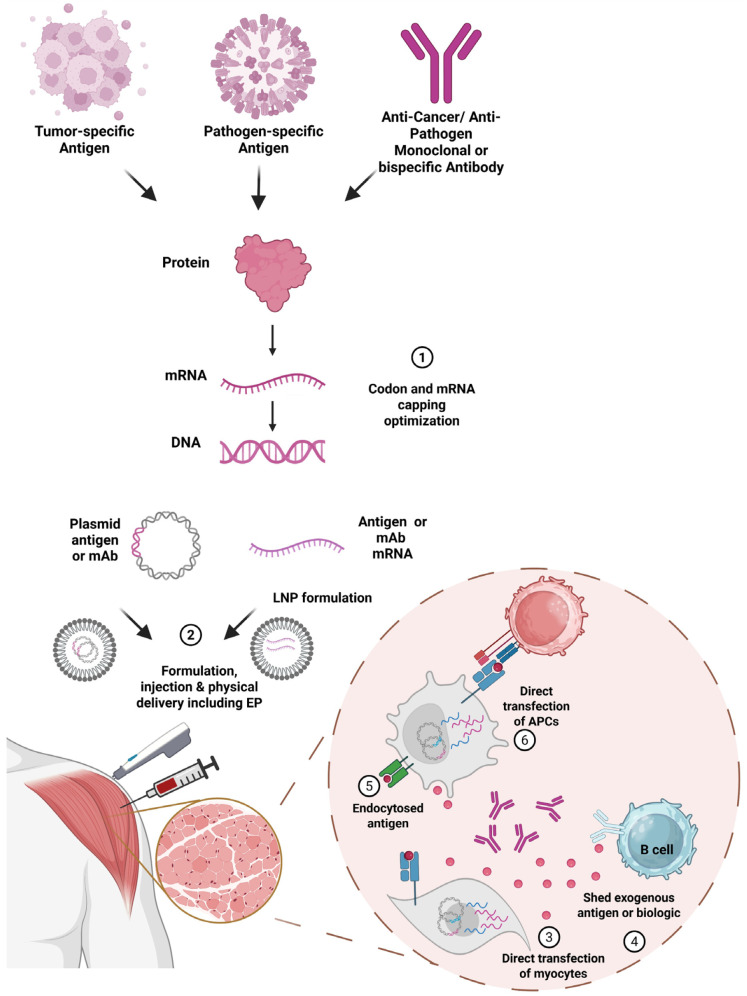 Figure 1
Peer Reviews
No public reviews on file for this paper yet. If you reviewed it on a platform where reviews are public (OpenReview, ICLR, NeurIPS, ICML), you can paste yours below so the community can read it here.
Videos
No videos yet. Explain this paper in a talk, walkthrough, or lecture? Add one.
Taxonomy
TopicsRNA Interference and Gene Delivery · CRISPR and Genetic Engineering · Immunotherapy and Immune Responses
The last decade has seen an unprecedented increase in the use of nucleic acid platforms, such as DNA and RNA, for vaccine and biologic delivery, culminating in the global deployment of mRNA vaccines during the COVID-19 pandemic. The 2023 Nobel Prize in Physiology or Medicine was awarded for the development of mRNA vaccine technology (1), reflecting the transformative impact of this platform on global health. Nucleic acid delivery approaches offer unparalleled advantages in terms of speed, scalability, and flexibility in antigen design, making them increasingly attractive not only for infectious diseases but also for cancer immunotherapy, autoimmune disorders, rare diseases, and therapeutic delivery. This Research Topic was launched to critically examine the current landscape and future directions of nucleic acid-based approaches for vaccine and biologic delivery. The contributions to this Research Topic include original research, comprehensive reviews, and clinical and preclinical studies, providing both mechanistic insight and translational support for nucleic acid based vaccines and therapeutics (Figure 1).
Several articles in this Research Topic highlight advances in RNA vaccine optimization. For instance, Sun et al. explore a new frontier in RNA engineering by demonstrating the use of group IIC self-splicing introns for the development of circular RNA vaccines, with promising results in a mouse model of RSV. Wang et al. focus on optimizing mRNA-LNP delivery using an intradermal, needle-free injection system to induce robust cellular and humoral responses. Two contributions from ST Pharm Co. present a novel mRNA capping strategy (SmartCap^®^), which enhances mRNA stability and protein expression. Choi et al. describe the capping library screening method used to identify the cap, SC101. Next, Kim et al. demonstrate the real-world efficacy of this cap in the context of a SARS-CoV-2 mRNA vaccine candidate. Expanding the use of the RNA platform to bacterial vaccine targets, Roier et al. report the ability of an LNP-formulated mRNA encoding uropathogenic E. coli virulence factor FimH to induce functional cellular and humoral responses in mice.
The DNA landscape is also expertly represented in this Research Topic with preclinical studies of vaccines spanning cancer and infectious disease targets. Helble et al., from the Wistar Institute, describe a DNA-launched nanoparticle vaccine that targets the HPV16 E6 and E7 antigens, showing strong CD8^+^ T-cell responses with translational potential demonstrated in outbred mouse models. Gary et al. report the use of a synthetic consensus approach to generate novel plasmid-encoded influenza nucleoprotein (NP) antigens, which generate robust and durable cellular responses in mice, supporting protection from an H1 influenza challenge. Eisenhauer et al. advance the recently clinically validated DNA-encoded monoclonal antibody (DMAb) approach (2), demonstrating that Fc modification of anti-PcrV DMAbs supports protection against a lethal Pseudomonas aeruginosa mouse challenge. In the translational space, studies supporting the use of novel DNA delivery techniques in primates and two clinical trial reports from Inovio Pharmaceuticals underscore the growing translatability of plasmid DNA as a vaccine platform. Sood et al. report on the ability of cationic polymer-formulated plasmid DNA to drive strong and protective cellular and humoral responses in mice and primates. Two clinical studies from Inovio Pharmaceuticals demonstrate the ability of intradermal electroporation (EP) to generate robust and durable responses in humans. Agnes et al. report on the safety, tolerability, and immunogenicity of INO-4700, a DNA vaccine against the MERS-CoV spike glycoprotein. Similarly, Koram et al. reported that INO-4500, a DNA vaccine encoding the Lassa virus (Josiah strain) glycoprotein precursor (GPC), supported strong humoral responses and persistent cellular responses in human patients.
These studies are complemented by several comprehensive reviews. Tadic et al. examine the landscape of anti-angiogenic nucleic acid vaccines and the potential of mRNA vaccine technology in this area. Konopka et al. discuss how aging affects vaccine efficacy and how design considerations specific to the DNA and mRNA platforms can overcome immunosenescence, while Bello et al. provide a thorough summary of nucleic acid vaccine efforts against mosquito-borne flaviviruses, highlighting both current progress and the remaining challenges of achieving broad protection in endemic regions. Complementing these studies, Hojecki et al. provide a comprehensive summary of the use of nucleic acid-encoded adjuvants, termed molecular adjuvants, to enhance vaccine-induced immunity and the recently reported ability of lipid delivery to enhance DNA vaccine-induced responses.
Together, these articles illustrate the depth and breadth of ongoing efforts to harness nucleic acid technologies for diverse applications in disease prevention and treatment. As the field moves beyond pandemic-era urgency to a new phase of innovation and clinical translation, we hope this Research Topic provides both a snapshot of current progress and a foundation for future discoveries.
We thank the authors, reviewers, and journal staff for their contributions to this Research Topic and look forward to continued advances in this rapidly evolving field.
The reference list from the paper itself. Each links out to its DOI / PubMed record.
- 1Krammer F Palese P . Profile of Katalin Karikó and Drew Weissman: 2023 Nobel laureates in physiology or medicine. Proc Natl Acad Sci. (2024) 121:e 2400423121. doi: 10.1073/pnas.2400423121, PMID: 38381788 PMC 10907315 · doi ↗ · pubmed ↗
- 2Tebas P Patel A Agnes JT Parzych EM Baer A Caturla M . Safety and pharmacokinetics of SARS-Co V-2 DNA-encoded monoclonal antibodies in healthy adults: a phase 1 trial. Nat Med. (2025) 31:4150–9. doi: 10.1038/s 41591-025-03969-0, PMID: 41120767 PMC 12705453 · doi ↗ · pubmed ↗