A qualitative study on cannabis use for harm reduction and pain among veterans enrolled in an SUD treatment program
Traben Pleasant, Sarah Ono, Devan Kansagara, Jennette Lovejoy, Travis Lovejoy, Jessica Wyse

TL;DR
This study explores how veterans in a substance use disorder treatment program use cannabis to manage pain and reduce harm, highlighting their motivations and concerns.
Contribution
The study provides new insights into veterans' perspectives on cannabis use as a harm reduction strategy and pain management tool during SUD treatment.
Findings
Approximately one-third of patients used cannabis during treatment to manage pain and related symptoms.
Half of the patients abstained from cannabis due to past negative effects, fear of relapse, or legal concerns.
Some non-users expressed interest in future cannabis use based on recent scientific and anecdotal information.
Abstract
Two-thirds of adults in the United States (U.S.) find recreational and medical cannabis use acceptable. Evidence shows that cannabis use is an effective treatment for pain, and as a harm reducing therapeutic for Substance Use Disorder (SUD). In contrast to most SUD treatment models, some models allow illegal substance use as a harm reduction strategy, which is the case for the SUD treatment program examined in this study. Little is known about veterans with SUD and their perspectives on cannabis use to treat pain. This study characterizes veteran perspectives on cannabis use to manage chronic pain, and pain-related anxiety and poor sleep, during treatment for non-cannabis SUD. Thirty-three U.S. military veterans with a diagnosis of chronic pain, who were receiving care from a Veterans Affairs (VA) SUD treatment program were eligible to participate. Patients with polysubstance use could…
Genes, proteins, chemicals, diseases, species, mutations and cell lines named across the full text — each resolved to its canonical identifier and authoritative record.
Click any figure to enlarge with its caption.
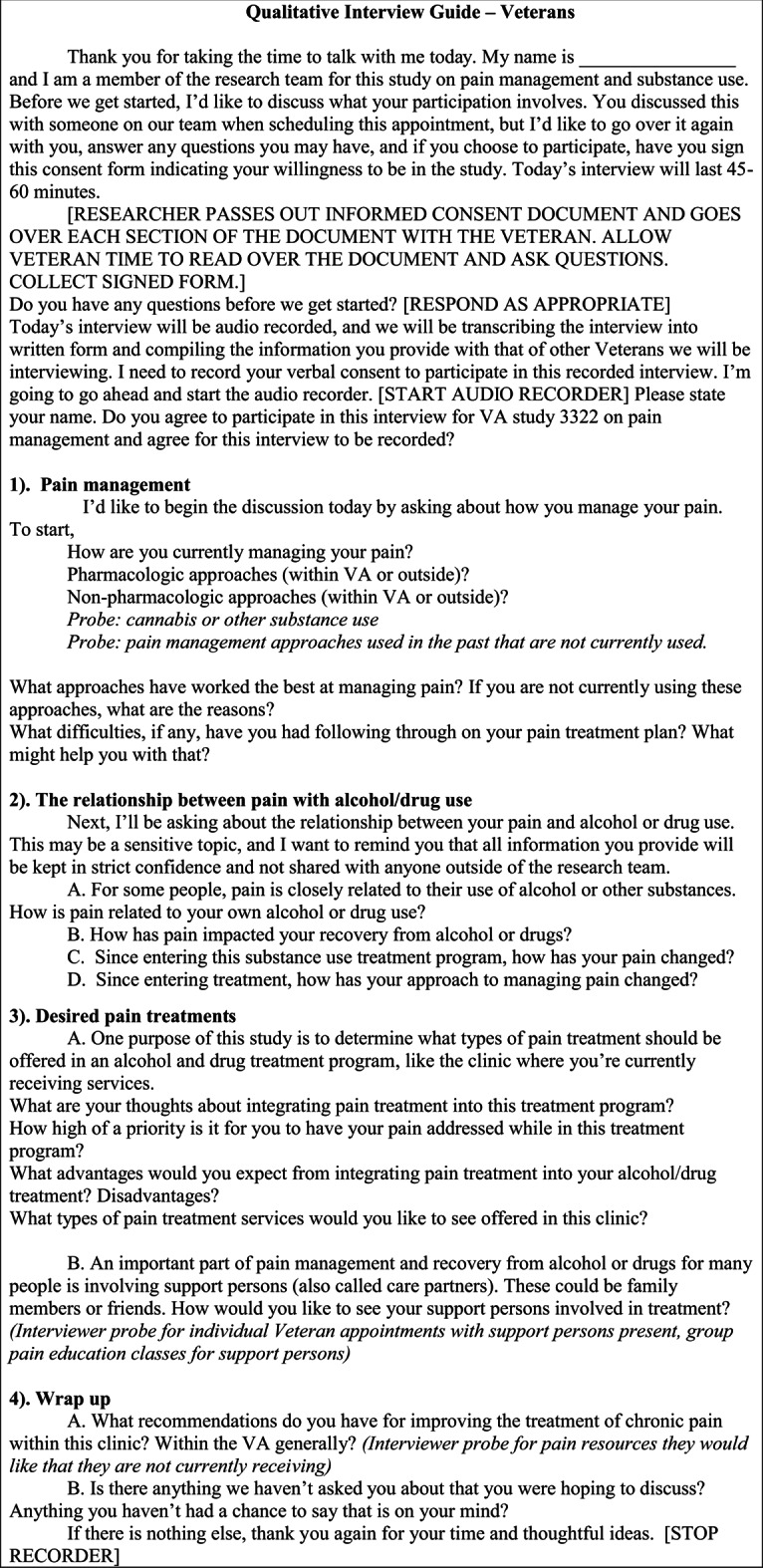 Figure 1
- —United States Department of Veterans Affairs Health Services Research & Development
Peer Reviews
No public reviews on file for this paper yet. If you reviewed it on a platform where reviews are public (OpenReview, ICLR, NeurIPS, ICML), you can paste yours below so the community can read it here.
Videos
No videos yet. Explain this paper in a talk, walkthrough, or lecture? Add one.
Taxonomy
TopicsOpioid Use Disorder Treatment · Cannabis and Cannabinoid Research · Substance Abuse Treatment and Outcomes
Background
Attitudes in the United States (U.S.) towards cannabis have significantly shifted in recent decades, as more than two-thirds of adults now accept cannabis use for medicinal and recreational purposes [1]. Thirty-nine states and Washington, D.C. have legalized cannabis for medicinal use, with 24 states permitting recreational use for adults [2–4]. Tetrahydrocannabinol (THC), a psychotropic compound, and its sibling, a non-psychotropic compound called cannabidiol (CBD) are the primary phytocannabinoids in the cannabis plant [5–7]. The cannabis plant contains hundreds of cannabinoids, varying chemical profiles, and unpredictable physical and mental effects on cannabis users, making it difficult to regulate [8]. Within the cannabis industry, this lack of regulation can result in the inaccurate labeling of ingredients and inconsistent cannabis potencies. In a study of cannabis products sold online, only 30% of CBD-advertised products contained the actual reported levels of CBD, while more than 20% of “THC free” products contained THC [9]. Additionally, prior research found that some cannabis labeling leads customers to misunderstand product compositions, and today, sound regulation practices in the cannabis industry across states remains absent [10, 11]. While acceptance of cannabis for medical purposes grows, poor regulation makes prescribing cannabis challenging.
From a medical science perspective, systematic reviews highlight evidence that cannabis may reduce symptoms of anxiety, though its efficacy for mood disorders—including bipolar and depressive disorders—and PTSD remains unclear [12, 13]. Among patients with chronic pain, a 2025 living systematic review conducted by the U.S. Agency for Healthcare Research and Quality of 29 randomized controlled trials and 15 observational studies found that cannabis formulations of equivalent THC and CBD may produce small reductions in pain severity, with low-to-moderate strength of evidence and predominantly in patients with neuropathic pain [14]. This review highlighted that there is insufficient evidence that cannabis improves pain outcomes in other chronic pain syndromes, such as musculoskeletal pain. However, patients who report use of cannabis for chronic pain qualitatively endorse its benefits in improving pain, sleep, and mental and physical functioning,^15^ suggesting that individual patient preferences and experiences, perhaps more than scientific evidence, influences patients’ decisions around cannabis use. It is unclear how such patients might endorse and/or use cannabis to treat pain in the context of substance use disorder treatment.
Substance use disorders (SUD) and chronic pain frequently co-occur [16, 17], and many patients specifically report substance use as a “self-medicating” treatment for chronic pain, including opioids and alcohol [16, 18, 19]. Some patients with a non-cannabis primary SUD may perceive cannabis as an alternative to opioids or other substances to manage pain [20]. Moreover, in the midst of an opioid epidemic, cannabis has been proposed as a harm reduction method to prevent the misuse of opioids—a potentially more dangerous substance than cannabis—among people with pain syndromes [19–22]. SUD treatment programs traditionally focus on complete termination of any drug use, while harm reduction strategies appreciate that recovery is not a linear path for most patients and do not necessarily require complete abstinence from all substances [24]. Indeed, a systematic review that examined reasons for cannabis use among patients living with chronic pain highlighted reducing prescription medication use, namely opioids, as a primary factor motivating patients’ cannabis use [25].
Despite the growing acceptance and availability of cannabis products and evidence that cannabis may benefit patients with neuropathic pain, little is known about the perceptions of cannabis use among patients living with chronic pain who also have substance use disorders. The purpose of this qualitative study was to characterize perspectives on cannabis use as a chronic pain therapeutic and a harm reduction strategy among patients diagnosed with chronic pain who were receiving SUD treatment.
Methods
Patients and procedures
Patients were recruited from a U.S. Department of Veterans Affairs (VA) medical center’s outpatient SUD treatment program. Patient eligibility was established through telephone interviews and electronic health record (EHR) reviews. Eligible patients were at least 18 years old, participating in the outpatient SUD treatment program, had a chronic musculoskeletal pain diagnosis in their EHR in the preceding five years, and reported an average pain intensity of ≥ 4 on a 0–10 rating scale within the past week and the past 3 months (where 0 = no pain and 10 = worst pain imaginable). Patients who had a cancer pain diagnosis or a pending pain-related disability claim were excluded. All patients provided written informed consent to participate. The study was approved by the Institutional Review Board of the participating VA hospital.
Treatment setting
The SUD treatment program is located in a U.S. state where laws permit adult use of medicinal and recreational cannabis. However, because the VA is a federal agency, cannabis is not permitted on hospital grounds, and VA clinicians are currently unable to prescribe medicinal cannabis to their patients. The SUD program comprises two tracks. All patients have access to individual and group therapy, delivered by licensed clinical social workers, psychologists, or master’s-trained counselors, as well as addiction medicine services.
The first track focuses on complete cessation of substances for which a use disorder is present and represents the focus of SUD treatment. Patients with polysubstance use may continue to use substances, as long as they commit to a goal of cessation of the substance that is the primary focus of treatment. Patients who continue to use any substances during treatment may speak about their use with program counselors but are asked not to discuss their ongoing use with patients in the program.
This first track, that focuses on substance cessation, permits continued use of cannabis and alcohol, if they are not the primary substances for which a patient is seeking treatment. Some patients may possess medical cannabis “cards,” that serve as a record of the patient receiving a cannabis “prescription” from a non-VA clinician. For patients with a medical cannabis card, SUD treatment program administrators obtain records from the non-VA cannabis-prescribing clinician that document the medical condition(s) for which cannabis is prescribed.
The second track focuses on harm reduction and exploration of patients’ interest in reducing and/or the negative impacts substance use has on patients’ lives. Patients on this second track receive individual motivational interviews from substance counselors and participate in a clinician-led support group composed of only patients in this track. For patients who start on the second track and later determine they seek the complete cessation of a substance, they have the opportunity to switch to the first track. All patients in this study were part of the first track that focused on substance cessation. Nevertheless, this track implements a harm reduction approach, which moves away from the complete cessation of all substances as a primary goal, allowing incremental behavioral changes that may be more sustainable while in SUD treatment [26].
Data collection
Data analyzed in the current study were part of a larger study focused on treating chronic pain among patients with substance use disorders. Forty-six patients were referred to the study based on initial review of the EHR. We were unable to contact seven referred patients, one declined participation, and four missed their scheduled appointments, resulting in 34 patients interviewed. One of the 34 interviewed patients was excluded based on a primary diagnosis of cannabis use disorder, as the purpose of this study was to gather perspectives on cannabis use from patients with non-cannabis primary SUD in this treatment setting (N = 33). The study’s principal investigator (PI) completed a semi-structured interview with each patient. Private in-person interviews were audio recorded in an office at the SUD treatment center. Patients received a $30 gift card for completing interviews (see Appendix for the interview guide).
Data analysis
Interviews were transcribed verbatim by a study team member and reviewed by the PI for accuracy. A codebook was developed by four doctoral-level scientists with training in qualitative methods who independently coded a random sample of five interview transcripts. Codes were developed inductively (i.e., open coded) following conventional content analysis [27]. Each coder “tagged” sections of text with a descriptive label or code utilizing Atlas.ti version 7.
The analysis team randomly assigned primary and secondary coders to each transcript. Transcripts were coded by the primary coder and reviewed by the secondary coder for accuracy. Disagreements between the primary and secondary coders were resolved through team consensus. We then pulled quotes associated with codes that described patients’ use of cannabis generally, and cannabis used for the management of pain specifically. These queries produced reports including data tagged with the identified codes. The analysis team reviewed and sorted the text into categories and identified similarities and differences within and across categories to develop key themes.
Results
Cohort characteristics
The sample (N = 33) was predominantly male (88%), and White-non-Hispanic (97%) with an average age of 51 years. 33% of patients reported currently or occasionally using cannabis while enrolled in this SUD treatment program to manage pain, pain-related anxiety and sleep issues, while an additional 24% reported no current cannabis use but expressed interest in trying it in the future. The majority (87%) of patients reported having used cannabis at some point in their lives, and 81% of patients reported past or current cannabis use to treat pain specifically. Regarding the primary substances that were the focus of SUD treatment, 70% reported an alcohol use disorder, 18% reported an opioid use disorder, and 12% reported a stimulant use disorder primary diagnosis. The average pain intensity in the past three months reported by patients was 5.6 on the 0–10 pain intensity numeric rating scale (Range: 4–10). All patients had at least one chronic musculoskeletal pain diagnosis (Table 1).
Table 1. Primary/secondary SUD, chronic pain diagnoses, current cannabis use/interestPatient IDN = 33Primary SUDSecondary SUDChronic pain DxCurrent cannabis use/interest1Alcohol dependenceCannabis dependenceOsteoarthritisNo/Interested in CBD use2Heroin dependenceCocaine and Opioid dependenceRheumatoid arthritis and ankle injuryYes3Alcohol dependenceStimulant dependenceOsteoarthritis, foot pain and migrainesYes4Alcohol dependenceCocaine and amphetamine abuse, cannabis and stimulant dependenceFoot, knee, low back pain and sciaticaYes5Opioid dependenceNoneShoulder and lower back painNo/Interested in CBD use6Alcohol dependenceNonePlantar fasciitisNo7Alcohol abuseCocaine and cannabis abuse, and opioid dependenceBack painNo8Opioid dependenceCannabis dependenceTendinitis and myofascial painYes9Alcohol dependenceNoneBack painNo10Alcohol dependenceNoneLow back and shoulder painYes11Heroin dependenceAlcohol dependenceLow back pain, spinal stenosis and migrainesNo/Interested in future use12Alcohol dependenceOpioid dependenceKnee and wrist osteoarthritisNo13Methamphetamine dependenceAlcohol dependenceBack painNo14Alcohol dependenceNoneKnee osteoarthritisNo15Alcohol dependenceCocaine dependenceLeft shoulder painNo16Alcohol dependenceNoneOsteoarthritisNo17Alcohol dependenceNoneLow back painNo18Stimulant dependenceNoneLumbosacral radiculopathy and shoulder painNo19Alcohol dependenceNoneShoulder pain, low back pain and tennis elbowYes20Alcohol dependenceNoneLow back pain and migrainesNo21Alcohol dependenceNoneKnee pain and fibromyalgiaNo22Alcohol dependenceNoneBack, neck and shoulder pain, headaches and dysmenorrheaYes23Alcohol dependenceCannabis abuseCervical radiculopathyYes24Alcohol dependenceAmphetamine abuseAnkle, foot, shoulder and pelvis pain and carpal tunnelNo/Interested in CBD use25Alcohol dependenceNoneShoulder pain, cervical radiculopathy and osteoarthritisNo26Alcohol dependenceCannabis abuseLow back painNo/Interested in future use27Methamphetamine dependenceOpioid abuseChronic painNo28Methamphetamine dependenceAlcohol dependenceLow back painNo/Interested in future use29Opioid dependenceNoneAnkle, foot and low back painYes30Alcohol abuseNoneSpinal stenosisNo31Alcohol dependenceNoneNeck and shoulder painNo/Interested in smokeless alternatives32Opioid dependenceAlcohol dependenceLow back painNo33Alcohol dependenceNoneShoulder painNo/Interested in future use
Primary themes
Cannabis for harm reduction, pain, and pain-related anxiety and sleep issues
Some patients perceived cannabis, particularly non-psychotropic CBD, as a harm reducing, non-compromising substance to their treatment program goals and policies. For example, Patient 8 stated, “I’ve been clean off THC for three weeks now, and I’ve been using just straight CBD products…and it’s legal now, it’s not a big deal anymore.” Additionally, Patient 11 stated, “I used [cannabis] during the time that I was sober from heroin and all the other drugs.” For such patients, cannabis products were viewed as acceptable therapeutics while engaged in SUD treatment, as some perceived cannabis as a “softer” alternative compared to “hard” substances like opioids, illicit or prescribed. For example, considering prescribed therapeutics, Patient 23 stated, “Marijuana helps me relax…and I can function, or I take all these pills they want me to take and I’m a zombie,” while Patient 11 stated, “I just know that there are holistic alternatives…marijuana’s one of them,” highlighting the perceived benign profile of cannabis compared to other drugs or medications.
Within this harm reduction setting, patients reported using cannabis for body ache and pain mitigation, as Patient 22 stated, “I do feel that, especially on my neck, [CBD cannabis oil] really helps with the pain.” Patient 13 also noticed that high concentration CBD “really takes the pain away.” Similarly, Patient 2 used cannabis to reduce pain-related anxiety, noting that, after cannabis use, “I’m calmer, I’m not as panicked when [the pain] is really bad.” Patient 3 highlighted the distinction between their use of cannabis for physical pain and pain-related anxiety, mentioning that the “RSO [Rick Simpson Cannabis Oil] is more for the physical pain and if I need something for anxiety…I use the oil pen [smokable cannabis].”
Patients also mentioned using cannabis to induce or sustain sleep in the presence of pain. For example, Patient 18, who struggled to sleep due to pain, stated that after using cannabis, “I was able to go to sleep a lot easier and a lot quicker without all the wrestling around and stuff,” while Patient 11 mentioned that “pain was affecting my ability to fall asleep,” and that cannabis helped them sleep better in general. Further, Patient 1 explained that cannabis helped them stay asleep, “work around the pain,” and not “focus as intently on the pain when under the influence of marijuana,” while Patient 4 mentioned that cannabis “doesn’t make me sleepier, it just helps me stay asleep.”
Interest in future cannabis use as a therapeutic agent
Some patients, like patients 1, 5 and 11 were interested in future use, particularly CBD because they believe it to be less psychoactive and a new approach to cannabis use. Moreover, for some who were not currently using cannabis, interest in future cannabis use was framed within the context of addressing their physical pain. Patient 31described a history of smoking cannabis for many years prior to SUD treatment, and having no desire to resume smoking cannabis, while showing interest in using cannabis that did not involve smoking to manage pain, stating, “I want to try the alternative to smoking marijuana [cannabis edibles, oils or topicals for pain]…I’ve never even been to a dispensary… but I’ve been curious to go in.” For this patient and others, the rise in alternative forms of cannabis consumption, the growing popularity of cannabis and the number of cannabis dispensaries in their state was noticeable and piqued their interest.
Patient motivations for complete avoidance of cannabis
Some patients reported avoiding cannabis due to unwanted physical and mental effects. For example, Patient 25 described disliking feeling sedated or lethargic, noting that cannabis made “me feel all groggy and sleepy, and I don’t like that.” Patient 30 described avoiding cannabis because it “tends to have me focus on the pain instead of relieving it or making it feel better.” Further, Patient 5 mentioned that cannabis increased their anxiety, stating, “I never liked it [smoking cannabis] personally; it always made me paranoid.” These perspectives highlight contrasting opinions of the effects of cannabis among patients with SUD, some of whom perceive no therapeutic benefit to cannabis.
Additionally, some patients perceived cannabis as a compromising substance that increases the risk of returning to use of substances for which they have a diagnosed disorder. For example, Patient 18 perceived cannabis as a substance that could lead to the abuse of other illicit substances, noting, “I quit everything when I stay sober…[cannabis] could lead me back to doing meth; I try to stay away from all of it.” Additionally, Patient 7 reported that while cannabis “worked fabulously” for their pain, they ceased to use all “substances except what’s prescribed” while in SUD treatment. Due to a fear of returning to use substances targeted for cessation, even when cannabis use is permitted when aligned with a harm reduction strategy, patients may find a strict adherence to suggested SUD treatment plans as paramount.
Discussion
Nearly 30% of patients diagnosed with chronic pain in this study reported current cannabis use for either pain, pain-related anxiety, sleep issues due to pain, or as a therapeutic alternative while receiving SUD treatment. Understanding that 1 in 10 veterans use cannabis [28], and that more than 1 in 10 veterans have a SUD [29], our findings have broader implications, particularly in states where cannabis use is legal, and in SUD treatment programs that implement a harm reduction approach. Our findings show that all patients who did use cannabis during SUD treatment had either a primary alcohol or opioid dependence diagnosis. Cannabis has shown to be and effective harm reducing therapeutic for both alcohol and opioid SUD treatment [30]. Although cannabis use was permissible if patients progressed toward their non-cannabis SUD treatment goals, several patients who abstained from cannabis use during SUD treatment expressed interest in future therapeutic cannabis use based on recent cannabis science, promotion and laymen’s knowledge.
A growing number of studies examine cannabis’ efficacy for various medical conditions, including pain, with some showing that veterans with chronic pain may choose to use cannabis as a therapeutic [30–34]. While other alternative pain relief therapies for veterans exist, including non-pharmacological approaches like yoga and acupuncture [36, 37], cannabis has shown to be an effective pain reliever that can enhance the quality of life of long term users [38, 39], and serve as a harm reducing substance [40].
Some patients who abstained from cannabis while in SUD treatment expressed concerns about cannabis leading them to use the substance they have targeted for cessation, and about the impact of cannabis use on their overall SUD treatment goals. Some patients abstained from cannabis use due to the negative physical or mental side effects they experienced using cannabis, such as lethargy, a heightened sense of one’s pain, anxiety and paranoia. As we see in our findings, the side effects of cannabis can vary among individual patients, and unlike standard pharmacotherapies, cannabis products lack strict regulation resulting in considerable variability in the cannabis strains sold in dispensaries [41].
Variability in the potency and the individual mental and physical effects of cannabis complicates patients’ and clinicians’ ability to predict cannabis use healthcare outcomes faithfully. While patients who are prescribed cannabis by a clinician may trust that the products available to them will adequately manage their medical conditions, clinicians lack control over the products patients actually receive from dispensaries. Patients in this study often relied on dispensary staff, friends and heuristic knowledge as motivating factors, and as a risk management strategy when considering the use or non-use of cannabis while in SUD treatment. Unfortunately, no studies have examined SUD treatment outcomes between patients who use and those who do not use cannabis while in SUD treatment. Randomized controlled trials and high-quality observational studies are needed to determine if cannabis use during SUD treatment leads to positive health outcomes or compromises the quality of care SUD patients receive. Nevertheless, our findings expand on existing literature and are a novel step towards longitudinal studies on SUD patient health outcomes regarding cannabis use for harm reduction and pain while in SUD treatment.
Limitations
This qualitative study has several limitations. First, interviews were conducted with VA patients receiving care in a single SUD treatment program among predominantly male, White non-Hispanic, middle-aged U.S. veterans. As such, findings may not generalize to other settings and populations. Second, most patients were receiving treatment for alcohol use disorder, and findings may not be applicable to populations dealing with largely non-alcohol primary SUD. Third, this is a qualitative study focused on veterans’ perspectives of cannabis use during SUD treatment, and while valuable, our qualitative data preclude quantifying reasons for cannabis use or abstinence. Epidemiologic studies with larger samples are needed to better identify the prevalence of, and reasons for, cannabis use while in SUD treatment.
Conclusions
This study contributes to the limited knowledge on SUD patient perspectives of cannabis use by exploring those of U.S. military veterans with SUD and chronic pain enrolled in a SUD treatment program. Cannabis use was fairly common among SUD patients who were permitted to use cannabis while in treatment. However, motivations for cannabis use varied as patients used cannabis to alleviate physical pain, mental health issues like anxiety and for problems with sleep due to pain, with many perceiving cannabis as a harm reducing therapeutic. Clinicians, particularly those in the VA Healthcare System and other federally employed providers in states where cannabis is legal, should be prepared to educate patients on the medical evidence, gaps, policies, and federal and state laws regarding cannabis use. However, the ability for such a knowledge exchange remains limited, particularly in federal healthcare settings, due to a lack of comprehensive federal guidance, uncertainty, and fear of policy violations and punishment among clinicians and patients. This further complicates the ability for clinicians to help patients manage risks and make informed healthcare decisions regarding cannabis use.
The reference list from the paper itself. Each links out to its DOI / PubMed record.
- 1Gallup. Support for Legal Marijuana Holds at Record High of 68%. 2021. https://news.gallup.com/poll/356939/support-legal-marijuana-holds-record-high.aspx. Accessed 3 Jan 2025.
- 2STEM. Systematically Testing the Evidence on Marijuana. 2023. https://www.cannabisevidence.org/. Accessed March 3, 2024.
- 3National Academies of Sciences, Engineering, and Medicine. Cannabis policy impacts public health and health equity. 2024 Sep 26.39602559 · pubmed ↗
- 4Ayers C, Shaw B, Robalino S, Ward R, Yeddala S, Morasco B, Kansagara D. Cannabis for anxiety and mood disorders. The Systematically Testing the Evidence on Marijuana Project; 2025. https://www.cannabisevidence.org/evidencesyntheses/anxiety and mood disorders/. Accessed 1 Jan, 2026.
- 5Ayers C, Harrod C, Durbin S, Shaw B, Robalino S, Paynter R, Yeddala S, Kansagara D. Cannabis for the management of symptoms of PTSD: a living systematic review. Portland, OR: The Systematically Testing the Evidence on Marijuana Project. 2021; revised December 2022. https://www.cannabisevidence.org/evidence-syntheses/ptsd/. Accessed 1 Jan, 2026.
- 6Systematic Review: Living Systematic Review on Cannabis and Other Plant-Based Treatments for Chronic Pain. Content last reviewed August 2025. Effective Health Care Program, Agency for Healthcare Research and Quality, Rockville, MD. https://effectivehealthcare.ahrq.gov/products/plant-based-chronic-pain-treatment/living-review. Accessed 3 Dec 2025.
- 7Cummings H, Ul Haq MZ, Dargham A, Shakeel N, Busse JW, Darzi AJ, Alvarez E. Individuals’ values and preferences regarding medical cannabis for chronic pain: a descriptive qualitative study. J Pain Res. 2024;31:21–34.10.2147/JPR.S 432823 PMC 1077173138192366 · doi ↗ · pubmed ↗
- 8Lau NSP, Averill S, Murphy F, Sato S, Murphy S. A safer alternative: cannabis substitution as harm reduction. Drug Alcohol Rev. 2015;34(6):654–9.10.1111/dar.12275 PMC 1084041825919477 · doi ↗ · pubmed ↗