Rickettsia tillamookensis-like strain in brown dog ticks in Brazil
Lucas Lisboa Nunes Bonifácio, Kamila Gaudêncio da Silva Sales, Ennya Rafaella Neves Cardoso, Felipe da Silva Krawczak, Filipe Dantas-Torres

TL;DR
A new strain of Rickettsia, similar to Rickettsia tillamookensis, was found in ticks from Brazil, raising questions about its potential impact on human health.
Contribution
The discovery of a Rickettsia tillamookensis-like strain in Brazilian ticks adds to the understanding of rickettsial diversity and potential zoonotic risks.
Findings
Rickettsia tillamookensis-like strain was detected in brown dog ticks from northeastern Brazil.
A dog with infected ticks showed antibodies to Rickettsia rickettsii, indicating possible exposure to related rickettsiae.
Abstract
Brown dog ticks (Rhipicephalus linnaei) collected from dogs in northeastern Brazil in 2015 tested positive for a rickettsial organism phylogenetically related to Rickettsia tillamookensis (referred to as R. tillamookensis-like). One of the dogs with R. tillamookensis-like-positive ticks tested positive for IgG antibodies to Rickettsia rickettsii antigens, suggesting a potential reaction to spotted fever group rickettsiae. Future research should assess whether the rickettsia detected herein is R. tillamookensis or a closely related species, its distribution, potential vectors, and possible pathogenicity to humans.
Genes, proteins, chemicals, diseases, species, mutations and cell lines named across the full text — each resolved to its canonical identifier and authoritative record.
Click any figure to enlarge with its caption.
 Figure 1
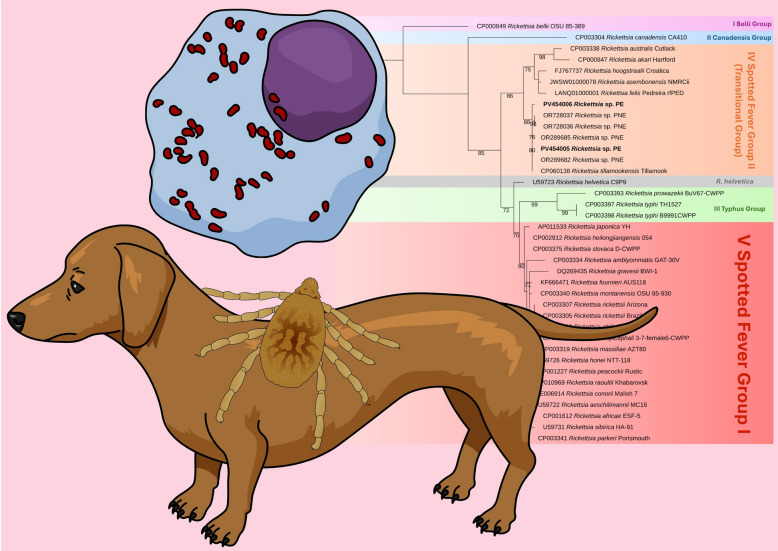 Figure 2
- —https://doi.org/10.13039/501100003593Conselho Nacional de Desenvolvimento Científico e Tecnológico
Peer Reviews
No public reviews on file for this paper yet. If you reviewed it on a platform where reviews are public (OpenReview, ICLR, NeurIPS, ICML), you can paste yours below so the community can read it here.
Videos
No videos yet. Explain this paper in a talk, walkthrough, or lecture? Add one.
Taxonomy
TopicsVector-borne infectious diseases · Bartonella species infections research · Leptospirosis research and findings
Ticks are important vectors for significant pathogens affecting humans and animals. For example, tick-borne rickettsiae are found worldwide, with new species being discovered sporadically. One such species, Rickettsia tillamookensis, was initially isolated from the western black-legged tick (Ixodes pacificus) collected in 1967 in Tillamook County, Oregon, USA, and recently (2021) formally described [1]. We report the detection of a rickettsia phylogenetically related to R. tillamookensis (referred to from now on as R. tillamookensis-like) in brown dog ticks (Rhipicephalus linnaei) collected from dogs in Brazil.
Ticks (n = 373) were collected from 100 privately owned dogs in Goiana, Pernambuco state, northeastern Brazil, during a previous study conducted in 2015–2016 [2]. In brief, ticks preserved in 70% ethanol were morphologically identified [3] and then grouped into pools of two to five ticks per dog. Pooled prevalence and 95% confidence limits (95% CL) were estimated using Epitools (https://epitools.ausvet.com.au/ppvariablepoolsize).
Genomic DNA was extracted from the ticks using Chelex^®^ 100 resin (Bio-Rad Laboratories, Hercules, CA, USA). Partial fragments of the citrate synthase (gltA) gene of Rickettsia spp. and the 16S rRNA gene of ticks were amplified via polymerase chain reactin (PCR) as previously described [4, 5]. PCR assays were conducted on a Veriti^®^ 96-well thermocycler (Applied Biosystems, Foster City, CA, USA), and the results were analyzed by electrophoresis on a 1.5% agarose gel stained with ethidium bromide under ultraviolet (UV) illumination. The PCR products were purified using the PureLink™ PCR Micro Kit (Invitrogen, Carlsbad, CA, USA) and sequenced in both directions with the same primers as for PCR and the BigDye Terminator v3.1 sequencing kit (Applied Biosystems, Foster City, CA, USA) on an ABI Prism 3500XL (Applied Biosystems, Foster City, CA, USA). Sequences were trimmed (Phred ≥ 20) and assembled using Clustal Omega in Geneious Prime v. 2025.0.3 (https://www.geneious.com). The resulting consensus sequences underwent similarity searches using the Basic Local Alignment Search Tool (BLAST) for nucleotides (http://blast.ncbi.nlm.nih.gov/Blast.cgi). The consensus gltA gene sequences generated in this study were aligned with sequences retrieved from GenBank using ClustalW in MEGA11 [6, 7]. The evolutionary history of Rickettsia spp. was inferred using maximum likelihood with 1000 ultrafast bootstrap replicates, on the basis of a dataset from a previous study [8]. Phylogenetic analysis was performed with W-IQ-TREE [9], with the best-fit evolutionary model (K3Pu + F + G4) determined using ModelFinder. The obtained consensus tree was rooted with a Rickettsia bellii sequence (GenBank accession no. CP00084). The final phylogenetic tree was edited using iTOL v7 (https://itol.embl.de). We also assessed the genetic distance between our sequences and related species using the Kimura 2-parameter model in MEGA11.
Dogs underwent serological testing using an immunofluorescence assay (IFA) targeting antibodies to four Rickettsia spp. antigens from Brazil (R. rickettsii strain Pampulha, Rickettsia parkeri strain Atlantic rainforest, Rickettsia amblyommatis strain Ac37, and R. bellii strain Mogi), as described in prior studies [10–12].
Ticks were morphologically identified as 220 females and 153 males of R. linnaei. Our representative 16S rRNA gene sequence of R. linnaei (GenBank accession no. PV449820) showed 100% (434/434) identity with R. linnaei from the southwestern USA (GenBank accession no. OM985256).
Four pools of R. linnaei (nine females and six males) tested positive for the gltA gene, with an estimated pooled prevalence of 1.1% (95% CL: 0.3–2.5%). Sequences from two pools of R. linnaei containing two ticks (one male and one female) and five ticks (three males and two females) showed 99.2% (387/390; GenBank accession no. PV454006) and 99.7% (382/383; GenBank accession no. PV454005) identity with the R. tillamookensis type strain (Tillamook 23) (GenBank accession no. CP060138). Attempts to sequence the PCR products from other positive samples were unsuccessful, likely owing to the low DNA amount. We also attempted to amplify other rickettsial genes, such as ompB, but were unsuccessful.
Our partial gltA gene sequences clustered with R. tillamookensis and related sequences previously reported in Brazil within spotted fever group II (Fig. 1). The pairwise distance between R. tillamookensis and our sequences ranged from 0.003 to 0.005 (Table 1). This distance is less than that (0.011–0.016) observed between the nearest species within the spotted fever group II, namely, Rickettsia felis, Rickettsia asembonensis, and Rickettsia hoogstraalii. This suggests that the species detected in this study is, in fact, R. tillamookensis. Still, we prefer to wait for further research with additional sequences and genetic markers to confirm this hypothesis.Fig. 1. Phylogenetic tree reconstruction of the Rickettsia genus based on a fragment of the gltA gene, utilizing a dataset of 38 sequences (30 species) of 350 base pairs (bp). The tree was inferred using the maximum-likelihood method with 1000 ultrafast bootstrap replicates (bootstrap values < 70 were omitted) and the K3Pu + F + G4 substitution model. Rickettsia bellii (CP00084) served as the outgroup. Sequences generated in this study are highlighted in boldTable 1Estimates of evolutionary divergence between the gltA gene sequences of Rickettsia spp. belonging to the spotted fever group II (ancestral group)123456781. CP060138 Rickettsia tillamookensis strain Tillamook 23–2. PV454006 Rickettsia sp. strain PE870.0053. PV454005 Rickettsia sp. strain PE070.003****0.0034. LANQ01000001 Rickettsia felis strain Pedreira rfPED0.0300.0360.0335. JWSW01000078 Rickettsia asembonensis strain NMRCii0.0270.0330.0300.0116. FJ767737 Rickettsia hoogstraalii strain Croatica0.0330.0390.0360.0160.0117. CP000847 Rickettsia akari strain Hartford0.0510.0570.0540.0510.0450.0458. CP003338 Rickettsia australis strain Cutlack0.0510.0570.0540.0450.0390.0390.027–The number of base substitutions per site between sequences is presented. Analyses were conducted using the Kimura 2-parameter model. This analysis included eight nucleotide sequences, and all positions containing gaps and missing data were eliminated (complete deletion option). There were 383 positions in the final dataset. The distances between the Rickettsia tillamookensis strain Tillamook 23 and our sequences are in bold
In the serological assessment, 43% of the dogs tested positive for antibodies against Rickettsia spp. Specifically, 4 dogs showed reactions to R. rickettsii antigens (with titers ranging from 64 to 512), while 43 reacted to R. bellii (with titers ranging from 64 to 2048). None of the dogs were positive to R. parkeri or R. amblyommatis antigens.
Our data indicate that R. tillamookensis, or a closely related rickettsia, circulates among brown dog ticks and possibly among dogs in northeastern Brazil. A high level of exposure (43%) to rickettsial antigens was detected among dogs from which ticks were collected. While we did not test the dogs against R. tillamookensis antigens, we cannot rule out that at least some reactions were to R. tillamookensis or another species from the ancestral group. In addition to the original report in I. pacificus from Tillamook County, Oregon [1], this rickettsia has also been documented in I. pacificus from California [13, 14] and Ixodes scapularis from Oklahoma [15]. More recently, strains closely related to R. tillamookensis have also been detected in Amblyomma sculptum and Amblyomma triste from central-western Brazil [8] and in Haemaphysalis inermis from Bulgaria [16]. Further research is needed to establish whether this rickettsia is a strain of R. tillamookensis or a closely related but different species. Our attempts to amplify and sequence other genes (e.g., outer membrane protein B gene) were unsuccessful, likely owing to the low amount of DNA available in the samples.
Rickettsia tillamookensis belongs to the spotted fever group II (the transitional group), indicating an ancestral relationship with the rickettsiae in this group [1, 8]. Other rickettsiae belonging to the spotted fever group II have been reported in R. sanguineus, including Rickettsia asemboensis [17].
One of the dogs with R. tillamookensis-like-positive ticks showed anti-R. rickettsii antibodies (titer = 128), suggesting previous exposure to spotted fever group rickettsiae. However, this cannot be confirmed, as the dog also reacted to R. bellii antigens.
The pathogenicity of R. tillamookensis in humans remains unknown; however, experimentally infected guinea pigs exhibited mild clinical signs, including low fever and slight scrotal edema [1]. Detecting a rickettsia related to R. tillamookensis in a widely distributed urban tick in Brazil suggests that its distribution throughout the country may be broader than currently recognized. Indeed, R. linnaei is a vector for many significant pathogens [18]. For instance, it is a confirmed vector of R. rickettsii and a suspected vector of Rickettsia massiliae in Mexico [19]. Unfortunately, attempts to amplify other gene fragments were unsuccessful, which constitutes the main limitation of the present work. Therefore, future studies are essential to assess the identity of this R. tillamookensis-like strain in Brazil, its distribution, potential vectors, and potential pathogenicity in humans.