Identification of a recessive PCDH15 nonsense variant in purebred goats with vestibular dysfunction
Eva Petzl, Joana Jacinto, María Climent Aroz, Michael Suntz, Michael Karl, Lutz Plobner, Kaspar Matiasek, Andrea Fischer, Regina Hannemann, Viktoria Balasopoulou, Holm Zerbe, Andreas Brühschwein, Cord Drögemüller, Anna Letko

TL;DR
A genetic variant in PCDH15 causes vestibular dysfunction in a breed of goats, resembling Usher syndrome in humans.
Contribution
First report of a naturally occurring Usher-like syndrome in goats caused by a PCDH15 nonsense variant.
Findings
A nonsense variant in PCDH15 is linked to vestibular dysfunction in Bunte Deutsche Edelziege goats.
The variant is homologous to a pathogenic mutation causing Usher syndrome type 1F in humans.
Genomic diagnostics can prevent further cases through molecular diagnosis and genetic testing.
Abstract
•Nonsense PCDH15 variant causes vestibular impairment in Bunte Deutsche Edelziege.•Affected goats show head excursions, wide-based stance, and poor postural control.•Pedigree information suggests autosomal recessive inheritance.•First report of naturally occurring Usher-like syndrome in goats.•Pathogenic variant corresponds to Usher syndrome type 1F-related variant in humans. Nonsense PCDH15 variant causes vestibular impairment in Bunte Deutsche Edelziege. Affected goats show head excursions, wide-based stance, and poor postural control. Pedigree information suggests autosomal recessive inheritance. First report of naturally occurring Usher-like syndrome in goats. Pathogenic variant corresponds to Usher syndrome type 1F-related variant in humans. Genetic diseases in goats are less well characterized than in other livestock species. This study reports a previously unrecognized…
Genes, proteins, chemicals, diseases, species, mutations and cell lines named across the full text — each resolved to its canonical identifier and authoritative record.
Click any figure to enlarge with its caption.
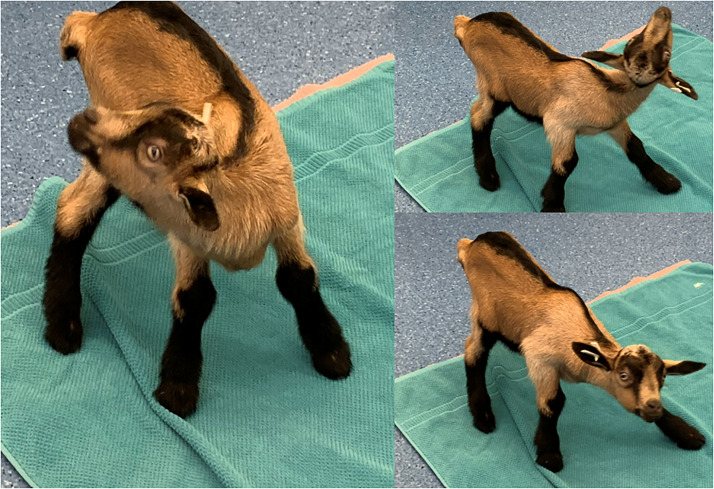 Figure 1
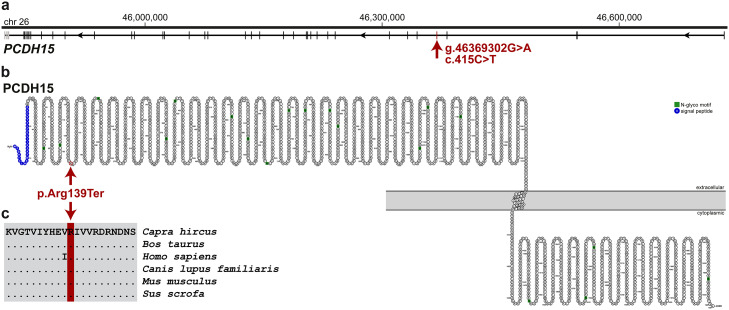 Figure 2
Peer Reviews
No public reviews on file for this paper yet. If you reviewed it on a platform where reviews are public (OpenReview, ICLR, NeurIPS, ICML), you can paste yours below so the community can read it here.
Videos
No videos yet. Explain this paper in a talk, walkthrough, or lecture? Add one.
Taxonomy
TopicsHearing, Cochlea, Tinnitus, Genetics · Vestibular and auditory disorders · Genetic Neurodegenerative Diseases